Entering the Web3 ecosystem requires reliable infrastructure, and understanding what is crypto wallet 2026 technology remains the foundational step for every digital asset investor. A cryptocurrency wallet is not a physical leather pouch holding metallic coins, nor is it a server storing digital tokens. Instead, it serves as your personal cryptographic gateway to interact with decentralised blockchain networks securely.
Whether you trade non-fungible tokens (NFTs), stake governance tokens, or hold Bitcoin long-term, grasping what is crypto wallet 2026 standards will help you retain full sovereignty over your digital wealth while minimizing security exposure.
1. What Is a Crypto Wallet? Simple Explanation for Beginners
To understand what is crypto wallet 2026 architecture, you must unlearn a common misconception: crypto wallets do not store actual cryptocurrency.
All digital assets live permanently on public blockchain networks (like Bitcoin, Ethereum, or Solana). Your wallet acts as a secure cryptographic interface—a digital keyring—that holds the private credentials needed to authorize transactions and move those assets on the blockchain. If you want a basic conceptual background on blockchain architecture before diving deeper, check out our guide on [What Is Cryptocurrency](link bài đã publish).
+-----------------------------------------------------------------------+
|                           THE BLOCKCHAIN                              |
|   (Where your actual crypto assets and transaction records reside)    |
+-----------------------------------------------------------------------+
                                   ^
                                   | Cryptographic Signatures
                                   v
+-----------------------------------------------------------------------+
|                          YOUR CRYPTO WALLET                           |
|   (Stores your Public Keys, Private Keys, and Seed Phrase locally)    |
+-----------------------------------------------------------------------+
When evaluating what is crypto wallet 2026 technology, three fundamental cryptographic components form the backbone of asset ownership:
Public Keys vs. Private Keys
-
Public Key (Your Wallet Address): Comparable to a bank account number or email address. You can share your public key freely with anyone who wishes to send you funds or view your public wallet activity on a block explorer.
-
Private Key (Your Digital Signature): Comparable to your online banking password or private PIN. A private key is an alphanumeric string that grants control over the funds associated with your public key. Never share your private key with anyone.
The Seed Phrase (Recovery Phrase)
A seed phrase (or secret recovery phrase) is a human-readable representation of your private keys, typically composed of 12 or 24 random words drawn from the BIP-39 standard list.
When configuring software or hardware wallets, your seed phrase acts as the master key. If your device breaks, burns, or vanishes, inputting this precise sequence of words into a new wallet restores complete access to all associated accounts and private keys. Consequently, safeguarding your seed phrase is the single most important rule in crypto security.
2. Comparing the 4 Main Types of Crypto Wallets in 2026
Modern Web3 security offers distinct wallet categories tailored to different user profiles, risk tolerances, and activity levels. Understanding what is crypto wallet 2026 selection criteria involves balancing operational convenience against complete self-custody and personal responsibility.
| Wallet Type | Examples | Custody Model | Best Used For | Primary Security Risk |
| Exchange Wallet | Bybit, Binance | Custodial (Third-party) | Active trading, fiat onboarding, quick swaps | Exchange hacks, platform insolvency, account freezes |
| Software Wallet | MetaMask, Trust Wallet | Non-Custodial (Hot Wallet) | DeFi protocols, dApp interaction, minting NFTs | Phishing sites, keylogger malware, malicious dApp approvals |
| Hardware Wallet | Ledger Nano Gen3/Flex, Trezor | Non-Custodial (Cold Wallet) | Long-term cold storage, HODLing large capital | Physical loss, damaged seed phrase, supply-chain attacks |
| Paper Wallet | Printed QR Codes / Keys | Non-Custodial (Offline) | Ultra-long-term offline cold storage | Physical destruction, water/fire damage, printer malware |
Custodial Exchange Wallets
When you sign up for a centralized exchange (CEX) like Bybit or Binance, the platform generates and manages the private keys associated with your deposit accounts on your behalf. This setup is known as a custodial model.
While exchange wallets offer user-friendly conveniences—such as instant fiat currency onboarding, zero-gas internal trading, and traditional password recovery options—they require you to trust a third-party intermediary completely. Because you do not hold the private keys yourself, you possess an IOU rather than direct ownership of the underlying assets. You remain subject to platform risks, including centralized exchange hacks, sudden regulatory asset freezes, or corporate insolvency—a foundational concept we explore thoroughly in our Bybit Review 2026.
Software (Hot) Wallets
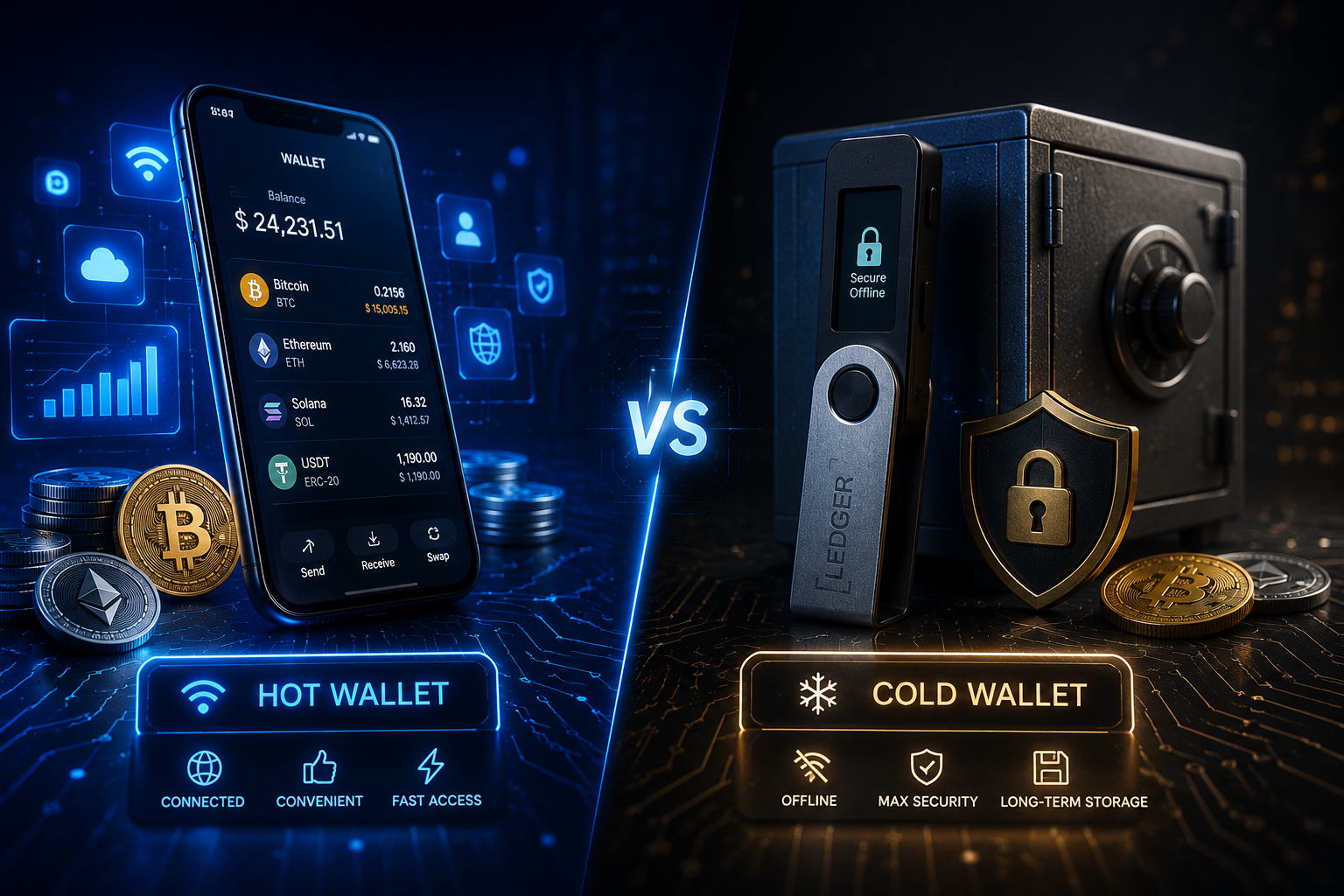
Software wallets—often referred to as hot wallets—are non-custodial applications installed as browser extensions (like MetaMask on Chrome or Brave) or mobile apps (like Trust Wallet on iOS and Android). They grant users complete self-custody by generating private keys and encrypted seed phrases locally on the user’s personal device.
Connected directly to the internet, software wallets provide seamless, low-friction integration with the Web3 ecosystem. Understanding what is crypto wallet 2026 hot wallet connectivity allows users to execute decentralized token swaps, interact with yield farming protocols, stake governance tokens, and mint NFTs in real time. However, perpetual internet connectivity makes software wallets vulnerable to device-level security threats, such as clipboard-hijacking malware, phishing links, and malicious smart contract approvals.
Hardware (Cold) Wallets
Hardware wallets represent the benchmark standard for digital asset protection and self-custody. These physical devices—such as the Ledger Nano series, Ledger Flex, or Trezor models—store your private keys offline inside a specialized, tamper-resistant microchip known as a Secure Element.
Unlike hot wallets, hardware devices keep private key data completely air-gapped from the internet. When you initiate a transaction on a dApp or decentralized exchange, the raw transaction data is sent to the physical hardware wallet, signed locally on the device using your offline private keys, and sent back to the computer as a verified signature. Even if you plug a hardware wallet into a computer thoroughly infected with malware or keyloggers, your private keys never leave the encrypted physical device, shielding your funds from remote online hacking attempts.
Paper Wallets
Paper wallets are an analog cold-storage method popular during the early days of cryptocurrency. This approach involves generating a public address and private key pair on an offline computer and printing the alphanumeric keys alongside corresponding QR codes directly onto a physical sheet of paper or cardstock.
Because paper wallets are generated completely offline and contain no digital footprint or wireless connectivity, they are entirely immune to cyberattacks, server breaches, and online malware vectors. However, paper wallets lack modern usability and flexibility for active trading or dApp interaction. Furthermore, they carry severe physical risk vulnerabilities: if the printed paper suffers water damage, fades over time, or is destroyed in a fire without a duplicate physical backup, the associated funds become permanently unrecoverable on the blockchain.
3. Strategic Wallet Selection: Matching Crypto Storage to Your Use Case
Choosing the right digital asset storage strategy requires a clear understanding of your personal risk tolerance, transaction frequency, and portfolio size. Rather than relying on a single wallet type, modern Web3 participants structure their setups using specialized tools tailored to specific operational needs.
                  ┌─────────────────────────────────────────┐
                  │      Determining Your Wallet Mix        │
                  └────────────────────┬────────────────────┘
                                       │
            ┌──────────────────────────┴──────────────────────────┐
            ▼                                                     ▼
┌───────────────────────┐                             ┌───────────────────────┐
│ Active Day-Trading &  │                             │ Long-Term Storage &   │
│   dApp Interactions   │                             │  High-Value Assets    │
└───────────┬───────────┘                             └───────────┬───────────┘
            │                                                     │
            ▼                                                     ▼
┌───────────────────────┐                             ┌───────────────────────┐
│ Software/Exchange     │                             │ Hardware Cold Wallet  │
│ Wallet (Hot Storage)  │                             │   (Ledger / Trezor)   │
└───────────────────────┘                             └───────────────────────┘
a. Active Day-Traders & Beginners: Centralized Exchange & Software Hot Wallets
If your primary focus involves frequent spot trading, executing fast token swaps, or onboarding fiat currency into the Web3 ecosystem, maintaining liquid capital on trusted centralized exchange accounts or non-custodial software wallets provides maximum efficiency.
Beginners benefit from the familiar user interfaces, customer recovery mechanisms, and low initial technical barriers offered by managed custodial platforms. Active traders rely on these environments for instant order execution without waiting for blockchain network confirmations or paying network gas fees on every transaction.
b. DeFi Farmers & NFT Collectors: Hardware-Paired Software Wallets
For power users actively participating in decentralized finance (DeFi) yield farming, liquidity provision, governance voting, or minting non-fungible tokens (NFTs), browser-based software extensions remain indispensable tools. However, connecting pure software hot wallets to high-value portfolios exposes assets to potential smart contract vulnerabilities and malicious signature requests.
The recommended protocol for active Web3 users is to connect a physical hardware wallet (like a Ledger or Trezor) directly to browser extensions such as MetaMask or Trust Wallet. This hybrid setup allows you to navigate decentralized app (dApp) interfaces seamlessly while requiring physical button presses on your isolated hardware device to approve and sign every outgoing transaction.
c. Long-Term Investors & HODLers: Isolated Hardware Cold Storage
If your investment strategy centers on long-term accumulation and capital preservation rather than daily trading, keeping your assets on centralized exchange platforms or perpetually connected hot wallets introduces unnecessary counterparty and network risks.
High-net-worth investors and long-term HODLers should move their primary digital holdings off exchange platforms completely and migrate them into dedicated, air-gapped hardware cold storage solutions. Hardware devices ensure that your private keys remain permanently isolated from internet-connected devices, protecting your core capital from remote cyberattacks, server breaches, and exchange insolvencies.
The Tiered Security Model: Balancing Security and Accessibility
Mastering what is crypto wallet 2026 risk management involves adopting a multi-layered, tiered storage framework rather than keeping all your capital in a single location:
-
Operational Hot Wallet (5–10% of Portfolio): Maintain a small “spending wallet” on a software application or exchange platform for daily trading, gas fees, and small Web3 interactions. Treat these funds like physical cash in your daily wallet.
-
Cold Storage Hardware Vault (80–90% of Portfolio): Secure the vast majority of your wealth in offline hardware devices or cold storage setups. These funds remain untouched by dApp interactions and are reserved exclusively for long-term holding.
For a comprehensive walkthrough on establishing a multi-layered asset protection framework, review our dedicated guide on [How to Store Crypto Safely].
4. How to Set Up MetaMask (Hot Wallet): Step-by-Step Guide
MetaMask remains one of the premier non-custodial software wallets in the Web3 ecosystem, serving as a primary browser extension and mobile app interface for accessing Ethereum, Layer-2 scaling networks, and EVM-compatible blockchains. Following a proper, secure setup process ensures you maintain absolute control over your private keys and operational security from day one.
Step 1: Download and Verify the Official Browser Extension
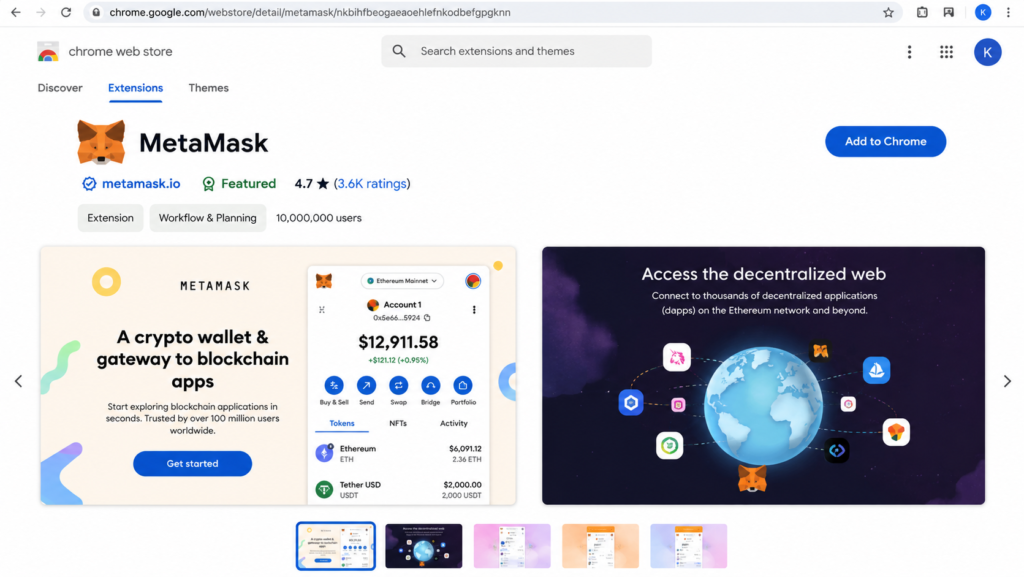
Begin by opening a clean, secure Web browser (such as Google Chrome, Brave, Firefox, or Microsoft Edge). Navigate exclusively to the official website at MetaMask official. Always double-check the URL bar to ensure you are not visiting a spoofed or phishing website.
Click the Download or Install button, which will redirect you to your browser’s official web store (e.g., the Chrome Web Store). Verify that the extension developer is listed as the official entity with millions of active users and verified reviews before clicking Add to Chrome (or your browser’s equivalent button) to complete the installation.
Step 2: Initialize the Application & Create a Strong Local Password
Once the extension finishes installing, click the MetaMask fox icon in your browser’s extension toolbar to launch the onboarding interface. Read and agree to the Terms of Use, then select Create a new wallet.
You will be prompted to set up a local password. This password locks and unlocks the MetaMask extension specifically on your current browser and device. Choose a unique, high-entropy password combining uppercase letters, lowercase letters, numbers, and special symbols.
Note: This local password does not access your funds on the blockchain directly; it simply protects your wallet file locally on your computer. If you forget this password, you can reset it using your Secret Recovery Phrase.
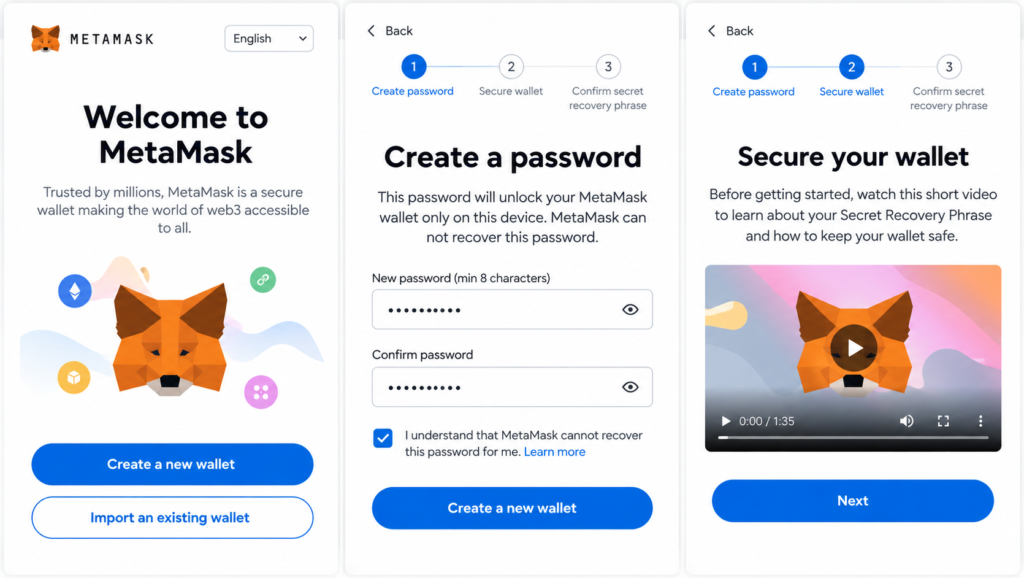
Step 3: Secure Your 12-Word Secret Recovery Phrase
After creating your local password, MetaMask will present an educational overview regarding the critical importance of your Secret Recovery Phrase (Seed Phrase). Click Secure my wallet to reveal your unique 12-word recovery sequence.
Your 12-word seed phrase is the master cryptographic key that generates your wallet’s private keys. Anyone who obtains this phrase gains full, permanent control over all your assets across every supported blockchain network.
-
DO NOT save these 12 words in plain text on your computer, cloud storage, password manager, or email drafts.
-
DO NOT take a screenshot or digital photo of the phrase.
-
DO grab a pen and physically write down all 12 words in their exact sequential order on piece of paper or cardstock.
-
Store your physical backup in a secure, private location away from water, heat, and unauthorized individuals.
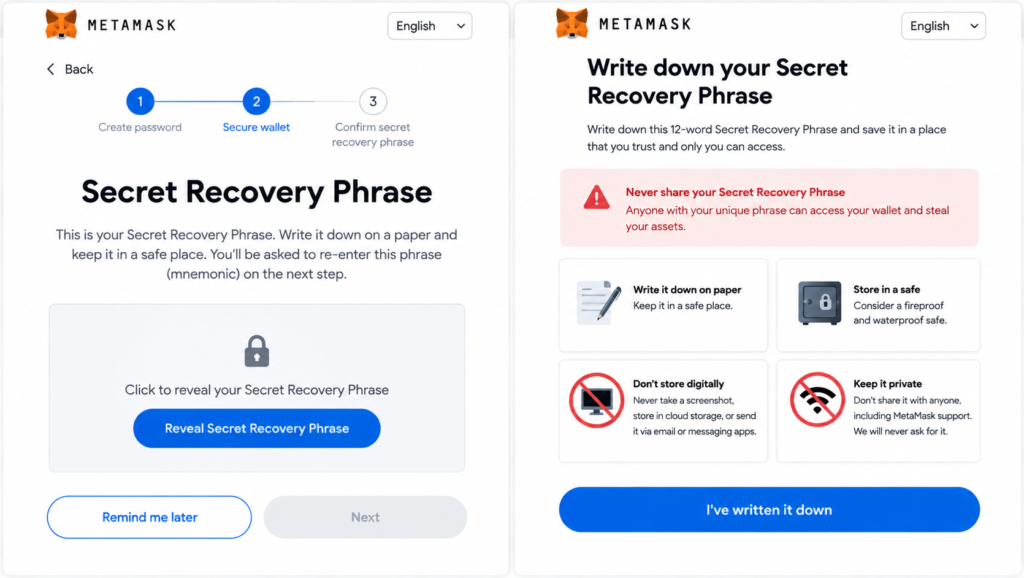
Step 4: Confirm Your Seed Phrase Sequence & Finalize Setup
To ensure you recorded your Secret Recovery Phrase accurately without typos or missing words, MetaMask will prompt you to complete a backup verification step. You will need to select or fill in the missing words from your 12-word sequence in the exact order they were generated.
Once you correctly confirm the phrase order, click Confirm and complete the final onboarding prompts. Your MetaMask software wallet is now fully operational! You can view your newly generated public wallet address (which starts with 0x...), copy it to receive tokens, connect to decentralized applications, or link your hardware cold wallet for enhanced transaction signing security.
5. Top 5 Common Crypto Wallet Mistakes to Avoid
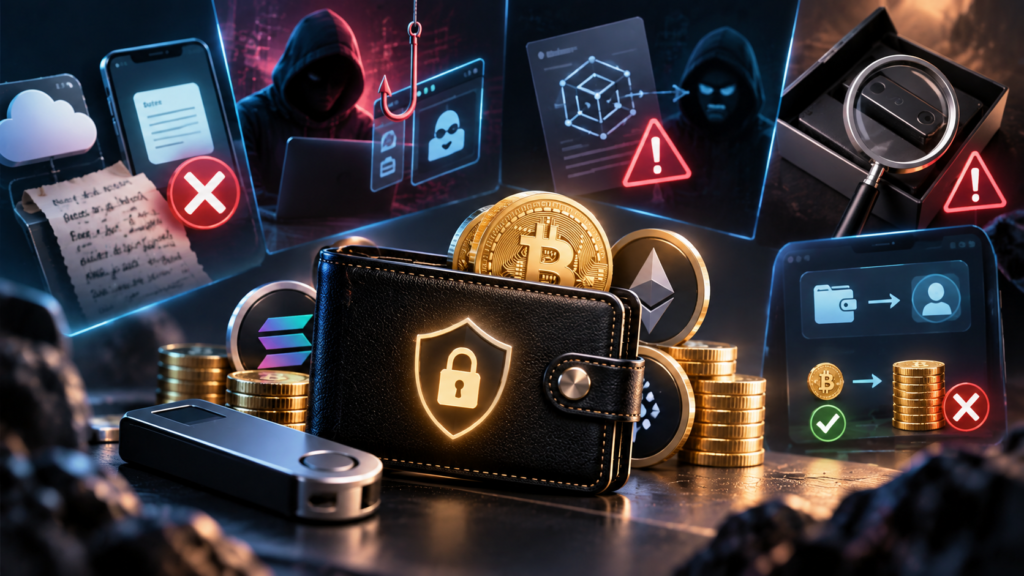
Navigating what is crypto wallet 2026 security standards demands perpetual operational vigilance. Because public blockchain networks operate on immutable smart contracts without central customer support or chargeback features, mistakes in Web3 are strictly irreversible. A single misstep can lead to permanent financial loss. Review our comprehensive guide on [How to Avoid Crypto Scams](link bài đã publish) alongside these top five operational security pitfalls that every digital asset investor must actively avoid:
a. Storing Seed Phrases in Digital or Cloud Environments
Storing your 12- or 24-word Secret Recovery Phrase on internet-connected digital devices remains one of the most widespread security mistakes in crypto self-custody. Saving your recovery phrase in cloud storage services, note-taking applications, password managers, screenshots, or draft emails exposes your master key to automated cloud breaches, device keyloggers, and malicious spyware.
If an attacker gains unauthorized access to your cloud account or infects your machine with malware, they can extract your seed phrase and instantly drain your funds from any device anywhere in the world. To maintain true cold storage security, always record your recovery phrase physically using ink on paper or engrave it onto industrial stainless steel plates, and store those physical backups in multiple secure, geographically separated, fireproof locations.
b. Interacting with Unverified Smart Contracts and Decentralized Apps
The expanding Web3 ecosystem grants users direct interaction with decentralized finance (DeFi) protocols, automated market makers, and NFT marketplaces. However, connecting your software or hardware wallet to unvetted, audited-deficient, or malicious decentralized applications (dApps) poses severe financial risks.
When you interact with a smart contract, you often sign a cryptographic token approval or allowance. A malicious contract can request unlimited spending access to your ERC-20 tokens or native assets. If signed without careful review, the smart contract permits the attacker’s script to automatically siphon assets directly from your public address. Always double-check transaction parameters, utilize web-of-trust browser extensions that simulate transaction outputs, and periodically revoke unnecessary contract allowances using security platforms like Revoke.cash.
c. Falling for Phishing Websites, Impersonation, and Malicious Direct Messages
Social engineering remains the most lucrative vector for Web3 cybercriminals. Attackers regularly clone popular wallet interfaces, decentralized exchange front-ends, and search engine advertisements to create pixel-perfect phishing websites designed to trick users into typing in their secret recovery phrases. Furthermore, scammers frequently impersonate official support staff, community managers, or high-profile influencers across direct messages on Telegram, Discord, and X (formerly Twitter).
Legitimate software developers, hardware vendors, and Web3 support teams will never message you first, ask for your recovery phrase, or request that you input private keys on a verification website. Always bookmark official URLs, verify domain SSL signatures, and treat all unsolicited direct offering assistance as high-risk phishing attempts.
d. Neglecting Hardware Device Verification and Supply Chain Integrity
While hardware wallets like Ledger or Trezor provide the gold standard for self-custody, improperly sourcing or initializing a physical hardware device can undermine its offline security benefits entirely. Purchasing a hardware wallet from unauthorized third-party resellers, auction sites, or secondary market vendors exposes you to physical supply-chain tamper risks, such as pre-installed malicious firmware or pre-generated seed phrases inside the box.
Always purchase hardware devices strictly from official manufacturer stores, such as Ledger official, or verified authorized distributors. Upon unboxing, meticulously inspect the anti-tamper packaging, verify the device firmware authenticity through the manufacturer’s official desktop application during initial setup, and ensure that you—and only you—generate a fresh seed phrase directly on the device’s secure internal screen.
e. Failing to Execute Small Test Transactions First
Transferring digital assets across blockchain networks requires absolute precision. Cryptographic wallet addresses consist of long, complex strings of alphanumeric characters where a single misplaced digit results in funds being sent to an unrecoverable address. Additionally, modern scammers deploy “address poisoning” attacks, creating fake addresses that match the first and last few characters of your frequent contacts to trick you into copying the wrong address from your transaction history.
Failing to verify the entire recipient address—or attempting to move substantial capital in a single unverified transaction—increases your vulnerability to human error and clipboard-hijacking malware. Before executing high-value transfers, always send a small, nominal test transaction to confirm that the recipient address receives the funds successfully before transferring the remaining balance.
Frequently Asked Questions (FAQ)
What happens if I lose my crypto wallet hardware device?
Your cryptocurrency assets are stored permanently on the decentralized blockchain network itself, rather than inside the physical hardware wallet device. The physical hardware unit—such as a Ledger or Trezor device—functions exclusively as an isolated cryptographic tool that stores your encrypted private keys and signs transactions.
If your hardware device is lost, stolen, damaged, or physically destroyed, your digital assets remain entirely secure and intact on the blockchain. To regain access to your wallet address and associated funds, you simply need to purchase a new hardware device (or set up a compatible non-custodial software wallet) and import your 12- or 24-word Secret Recovery Phrase (Seed Phrase). As long as your offline seed phrase backup remains secure and confidential, physical loss of the device will not cause permanent loss of your crypto wealth.
Can a crypto wallet be hacked?
Whether a crypto wallet can be compromised depends heavily on its architecture, its internet connectivity, and user execution.
-
Cold Hardware Wallets: True hardware cold storage devices kept completely offline cannot be remotely hacked over the internet because their internal Secure Element microchips isolate private keys from online environments. Even if you plug a hardware wallet into a computer infected with keyloggers or viruses, the device performs cryptographic signatures internally without revealing private keys to the host machine.
-
Hot Software Wallets: Software wallets, browser extensions, and mobile applications maintain an active or periodic connection to the internet, exposing them to online attack vectors. These wallets can be compromised through sophisticated malware, phishing websites that trick users into revealing seed phrases, or malicious smart contract approvals where users unknowingly grant attackers permission to transfer tokens out of their wallet address.
Are exchange wallets safe for long-term storage?
While centralized crypto exchanges (such as Bybit or Binance) offer convenient fiat gateways, simple account recovery options, and high liquidity for active day trading, they are fundamentally ill-suited for long-term wealth preservation.
Centralized exchanges operate on a custodial model, meaning the exchange retains exclusive control over the private keys associated with your deposit addresses. When holding funds on an exchange platform, you operate under the principle of financial counterparty risk—often summarized by the industry standard rule: “Not your keys, not your coins.” If the exchange platform suffers internal security breaches, regulatory asset freezes, operational bankruptcy, or sudden insolvency, you risk losing access to your digital holdings indefinitely. For long-term asset storage, transferring funds off centralized exchanges and into self-custodial software or hardware cold wallets remains essential.
What is the difference between hot wallets and cold wallets?
The primary distinction between hot and cold wallets lies in their internet connectivity and private key storage environment:
-
Hot Wallets (Online Connectivity): Hot wallets encompass browser extensions (e.g., MetaMask), mobile apps (e.g., Trust Wallet), and desktop clients that remain connected to the internet. They excel in operational convenience, allowing instantaneous interactions with decentralized finance (DeFi) protocols, non-fungible token (NFT) marketplaces, and cross-chain dApps. However, perpetual internet exposure increases their vulnerability to online exploits, phishing attacks, and malicious software.
-
Cold Wallets (Offline Security): Cold wallets consist of hardware devices, air-gapped physical storage, or paper wallets that operate completely offline. Because their private keys never touch an internet-connected device or server, cold wallets eliminate remote digital hacking risks, making them the industry standard for securing substantial capital, long-term investments, and reserve funds.
Conclusion
Understanding what is crypto wallet 2026 architecture is the single most critical step in safeguarding your financial autonomy within the decentralized economy. As Web3 applications, decentralized finance protocols, and digital assets continue to mature, knowing how to properly balance hot wallet accessibility with cold wallet cold storage guarantees that you maintain total control over your private keys. By adopting robust operational security practices—protecting your seed phrase, verifying smart contract interactions, and avoiding common self-custody traps—you can navigate the crypto landscape in 2026 and beyond with complete confidence and peace of mind.
Disclaimer: The information provided in this article is for educational and informational purposes only and does not constitute financial, investment, or legal advice. Cryptocurrency markets and Web3 technologies involve substantial risk of loss. Always perform your own independent research and consult a certified financial advisor before making investment decisions.