Learn how to store crypto safely 2026 with our ultimate guide. Compare hot wallets vs cold wallets, understand key security practices, and protect your digital assets today.
The cryptocurrency landscape has evolved dramatically, but one golden rule remains completely unchanged: security is entirely your responsibility. As decentralized finance (DeFi), layer-2 networks, and institutional adoption reach new heights, learning how to store crypto safely 2026 is the single most important skill any investor can acquire.
Every year, millions of dollars in digital assets are lost to phishing scams, smart contract exploits, and exchange collapses. If you are still keeping your entire life savings on a trading platform, you are exposing yourself to unnecessary risks.
In this comprehensive guide, we will break down the essential strategies on how to store crypto safely 2026, compare the pros and cons of hot wallets vs cold wallets, and help you choose the ultimate security setup for your portfolio size.
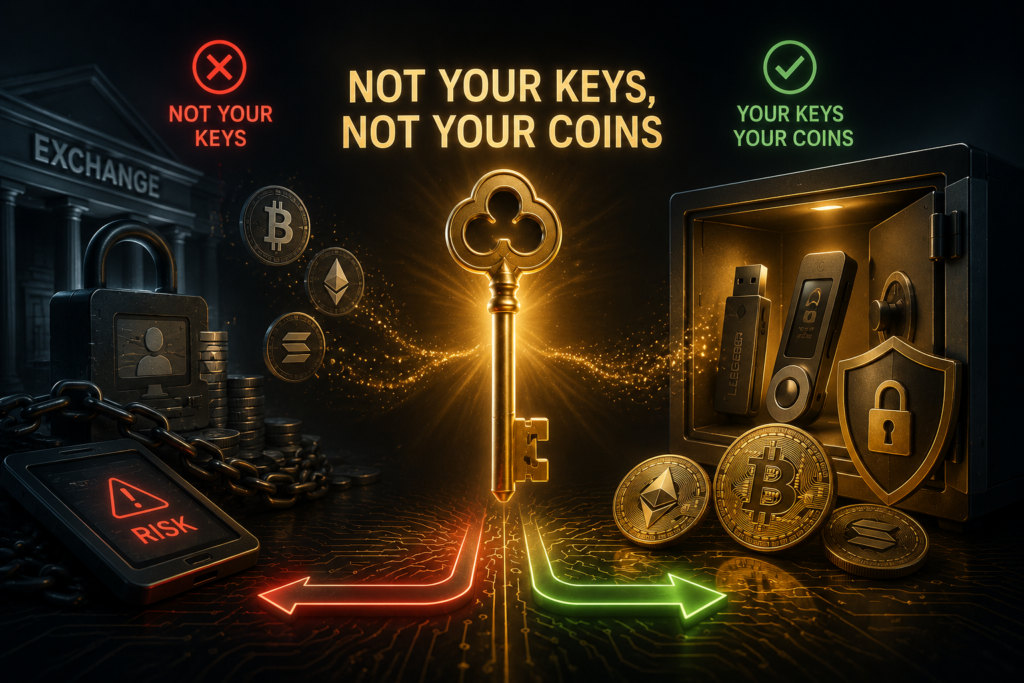
1. The Golden Rule: “Not Your Keys, Not Your Coins”
Before diving into the technical differences between wallets, we must address the fundamental philosophy of cryptocurrency: self-custody. This is the cornerstone of understanding how to store crypto safely 2026.
When you buy digital assets on a centralized exchange (CEX) like Binance, Coinbase, or Bybit, the exchange holds the private keys to those funds on your behalf. You do not actually own the crypto; instead, you own a digital claim on the exchange’s database. If the exchange goes bankrupt, gets hacked, or freezes your account, your funds can vanish overnight.
  Traditional Exchange (Custodial)            Self-Custody (Non-Custodial)
┌─────────────────────────────────┐        ┌─────────────────────────────────┐
│  Your Account ──► CEX Database  │        │  Your Wallet ──► Private Key    │
│  (CEX holds the Private Keys)   │        │  (YOU hold the Private Keys)    │
└───────────────┬─────────────────┘        └───────────────┬─────────────────┘
                ▼                                          ▼
   If the exchange is hacked,                 Your funds are protected onchain.
   your funds can be lost.                 No middleman can freeze them.
This structural risk is why the phrase “Not your keys, not your coins” remains the absolute bedrock of the global crypto community. To truly master how to store crypto safely 2026, you must transition from relying on third-party platforms to taking full, uncompromising control of your private keys. A private key is essentially an encrypted digital signature that grants access to your funds on the blockchain. Whoever holds the private keys holds the assets. If you do not control those keys, you are merely a spectator to your own wealth.
While platforms like Bybit have integrated robust, industry-leading security measures to protect active traders (read more in our Bybit Review 2026), storing large amounts of crypto on any exchange for the long term is highly discouraged. Centralized databases represent a massive honeypot for sophisticated hacker syndicates. Therefore, shifting your assets into a non-custodial wallet is the first and most critical milestone in learning how to store crypto safely 2026. Let’s look at the self-custody tools available to keep your digital funds secure.
2. What is a Hot Wallet? (Convenience vs. Vulnerability)
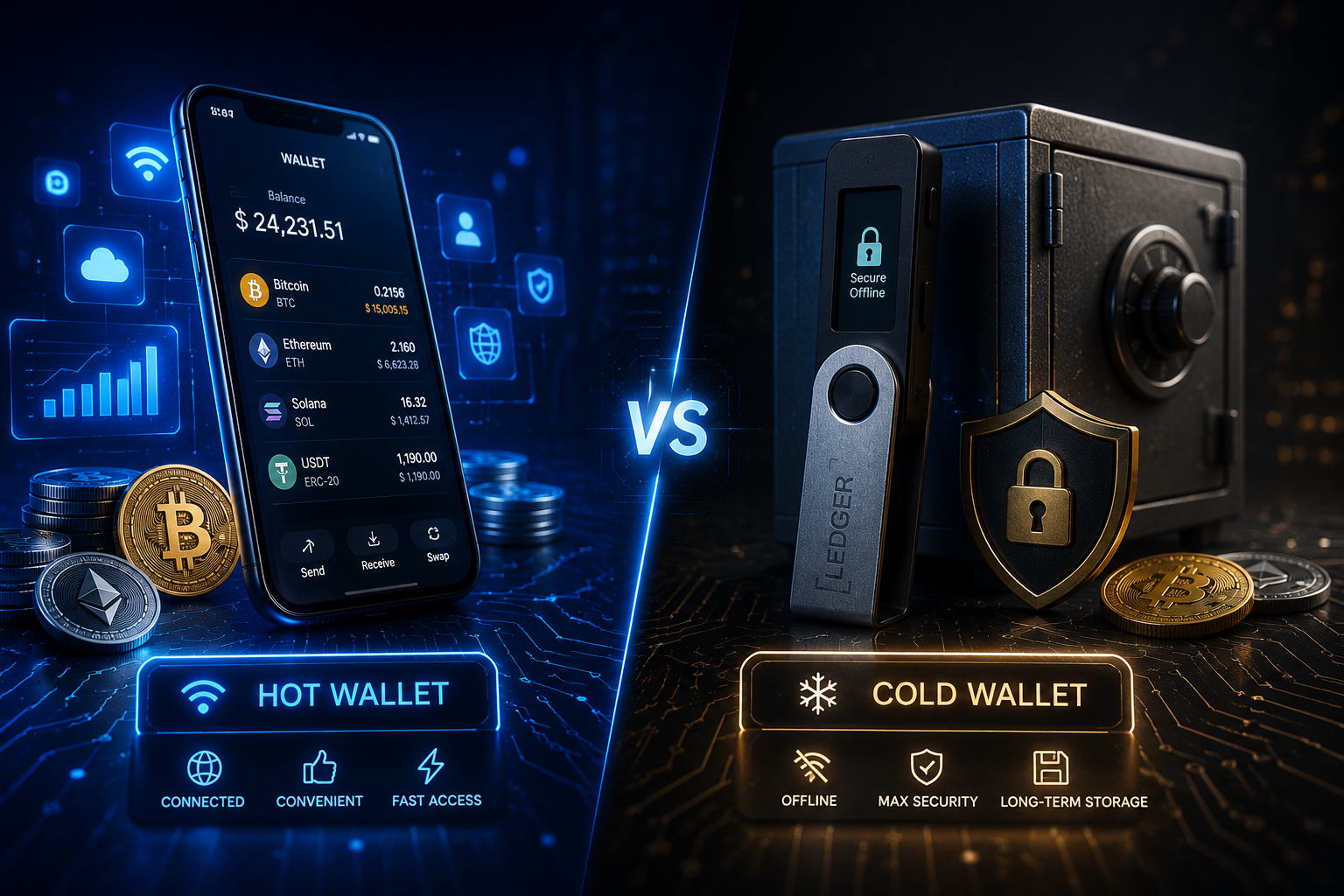
To understand how to store crypto safely 2026, you must first master the concept of a hot wallet. In the simplest terms, a hot wallet is any cryptocurrency storage tool that is directly connected to the internet. These wallets serve as your daily bridge to the decentralized web and typically take the form of browser extensions, desktop software, or mobile applications installed on your smartphone.
Because they are constantly connected to active networks, hot wallets are designed for rapid-fire interactions. Whenever you connect your wallet to a decentralized exchange (DEX), purchase a digital collectible on an NFT marketplace, or swap tokens across various layer-2 blockchains, a hot wallet facilitates these actions in seconds. However, this high-speed connectivity introduces unique trade-offs that every investor trying to figure out how to store crypto safely 2026 must carefully evaluate.
Popular Hot Wallets in 2026
The software wallet landscape is highly competitive, but a few industry giants continue to dominate the ecosystem:
-
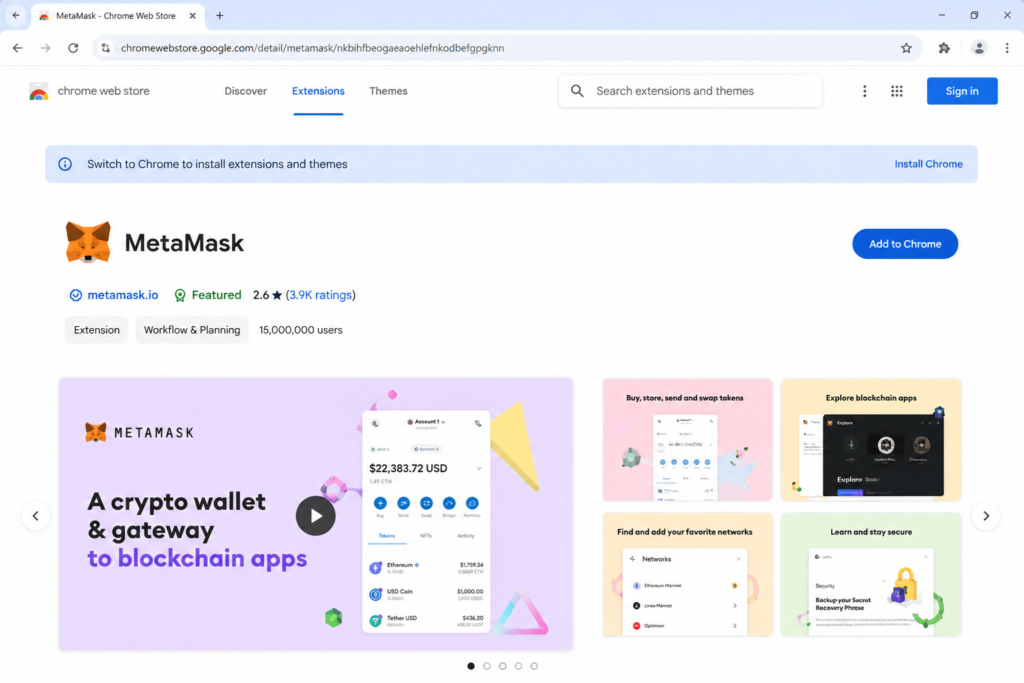
MetaMask: The undisputed king of Web3 browser extensions and mobile apps. Boasting over 100 million active users worldwide, MetaMask is the go-to gateway for interacting with Ethereum, EVM-compatible networks, and various scaling solutions.
-
Trust Wallet: A highly versatile, multi-chain mobile wallet owned by Binance. It supports a massive array of native blockchains, making it an excellent all-in-one hub for multi-asset investors.
-
Phantom: Originally built as the definitive wallet for the Solana ecosystem, Phantom has expanded into a powerhouse multi-chain application. Its highly polished interface and robust feature upgrades in 2026 make it a favorite for speed and simplicity.
The Pros of Hot Wallets
For active market participants, hot wallets offer unparalleled advantages that physical alternatives simply cannot match:
-
Maximum Convenience and Speed: Hot wallets let you interact with decentralized applications (dApps), yield farms, and Web3 games instantly. There is no physical device to plug in or buttons to press; a few clicks on your screen are all it takes to complete a trade.
-
100% Free to Use: You do not need to shell out money to download a hot wallet. Anyone with an internet connection can download MetaMask or Trust Wallet immediately without spending a single dollar.
-
Highly User-Friendly Interfaces: Modern hot wallets are built with beautiful, intuitive layouts. They make tracking your portfolio, viewing gas fees, and managing multiple public addresses straightforward even for relative beginners.
The Cons of Hot Wallets
Despite their convenience, relying solely on a hot wallet is highly risky if you do not understand how to store crypto safely 2026.
-
Always Online Means Always Exposed: Because hot wallets run on operating systems like Windows, macOS, iOS, or Android, they are only as secure as the host device. If your computer or smartphone gets infected with malware, keyloggers, or trojan horses, sophisticated hackers can easily extract your private keys or hijack your clipboard to redirect your transactions.
-
Vulnerability to Phishing and Smart Contract Exploits: Hot wallet users are prime targets for malicious links, fake software updates, and fraudulent dApps. If you connect your hot wallet to a compromised smart contract and sign a malicious transaction, your entire balance can be drained in seconds without your wallet password ever being compromised.
       [ Malicious Link / Phishing Site ]
                      │ (User signs bad transaction)
                      ▼
             ┌──────────────────┐
             │    Hot Wallet    │ ──► Drains Assets Automatically
             └──────────────────┘
If you want to know how to store crypto safely 2026 while keeping a portion of your funds in a hot wallet, your success relies entirely on strict operational hygiene. You must treat your hot wallet like a real-world physical wallet—only keeping as much cash in it as you need for daily spending.
Furthermore, you must educate yourself on the evolving tactics used by digital thieves. Always make sure you read our comprehensive guide on How to Avoid Crypto Scams 2026 to protect your hot wallets from devastating social engineering and phishing attacks.
3. What is a Cold Wallet? (The Gold Standard of Security)
If hot wallets are the cash floating in your real-world pocket, a cold wallet is an underground, bank-grade vault wrapped in reinforced concrete. To truly implement a bulletproof strategy on how to store crypto safely 2026, adding a cold wallet (also widely referred to as a hardware wallet) to your security infrastructure is non-negotiable.
A cold wallet is a dedicated, physical electronic device engineered with a singular, hyper-focused purpose: to generate and store your private keys completely offline, isolated entirely from the internet, local networks, and potentially compromised operating systems.
These physical devices often resemble compact USB thumb drives, sleek key fobs, or credit cards featuring miniature displays and manual navigation buttons. The core architectural philosophy of a cold wallet is simple yet absolute: your sensitive private keys never, under any circumstances, leave the physical boundaries of the device’s internal microchip.
       [ Internet / PC / Smartphone ]
                      │
            (Encrypted Connection)
                      │
   ▼──────────────────────────────────▼
   │           Cold Wallet            │  ◄── Private keys never leave
   │    (Physical Hardware Device)    │      this offline environment!
   ▲──────────────────────────────────▲
When you want to initiate a blockchain transaction (such as sending Bitcoin or interacting with a smart contract), your computer or smartphone formats the unsigned transaction data and sends it over to the connected hardware wallet. The cold wallet then signs the transaction internally using your offline private keys and sends back only the completed, cryptographically signed data string to be broadcast to the blockchain network.
Because of this air-gapped design philosophy, your private keys remain hidden from your web browser, computer operating system, and any remote attackers who might be lurking on your home network. For investors building long-term generational wealth, understanding how to store crypto safely 2026 means making a cold wallet the cornerstone of their asset protection plan.
Popular Cold Wallets in 2026
The physical hardware security sector has advanced significantly, offering incredibly robust, specialized chip architectures designed to defend your wealth against both digital and physical tampering:
-
Ledger (Nano S Plus, Nano X, Ledger Flex): Ledger remains a dominant titan in the hardware storage market. Their product line relies on proprietary, military-grade “Secure Element” microchips combined with their custom custom-built operating system (BOLOS). Whether using the entry-level Nano S Plus, the Bluetooth-enabled Nano X, or the advanced touchscreen Ledger Flex, managing assets is handled securely via their companion app, Ledger Live.
-
Trezor (Safe 3, Safe 5): Trezor is the legendary pioneer of commercial hardware wallets, continuing to champion a philosophy of 100% open-source transparency. Their flagship devices, the Trezor Safe 3 and the high-performance Trezor Safe 5, allow global developers and security analysts to inspect every line of code. This ensures there are no hidden vulnerabilities, data traps, or backdoors.
The Pros of Cold Wallets
When evaluating how to store crypto safely 2026, cold storage hardware offers defensive advantages that software-based tools simply cannot match:
-
Absolute Protection From Remote Hacking: Even if your laptop or phone is crawling with spyware, keyloggers, remote access trojans (RATs), or ransomware, a remote hacker cannot extract your funds. Every single transaction must be verified on the small screen of your physical cold wallet and manually approved by pressing physical buttons on the device itself.
-
Pure Offline Key Generation: When you set up a reputable hardware wallet, your master recovery seed phrase is generated directly on the device’s isolated hardware chip using an advanced random number generator. The seed phrase is displayed directly onto the device’s physical screen—never touching a screen capture tool, phone operating system, or internet-connected clipboard.
The Cons of Cold Wallets
While hardware wallets are the gold standard of safety, they do require structural sacrifices in terms of immediate access and financial investment:
-
Upfront Cost Barrier: Unlike free hot wallets, a physical cold wallet represents a direct financial investment. Prices generally range from $79 USD for standard models up to $249+ USD for premium touchscreen or biometric variants.
-
Friction and Lower Liquidity: If you are an active day-trader riding highly volatile, minute-by-minute market movements, a hardware wallet can slow you down. Having to physically find your device, plug it into a USB slot (or pair it over secure Bluetooth), type in your local PIN code, and manually verify addresses across multiple screens adds several layers of physical friction to your trading flow.
Ultimately, mastering how to store crypto safely 2026 requires recognizing that cold wallets are the single most powerful defense you have against remote digital adversaries. By introducing physical friction, you completely eliminate the vulnerability of a sudden, unexpected remote network exploit.
4. Hot Wallet vs. Cold Wallet: Head-to-Head Comparison
Choosing how to store crypto safely 2026 is not about selecting one option and discarding the other; rather, it is about understanding how these two storage philosophies complement each other. To give you a granular, bird’s-eye view of how hot and cold wallets stack up against each other, we have compiled an updated, exhaustive breakdown of their core operational differences.
Detailed Side-by-Side Comparison Matrix
| Feature | Hot Wallet (e.g., MetaMask, Trust Wallet) | Cold Wallet (e.g., Ledger, Trezor) |
| Primary State | Always Online (Connected directly to active networks) | Completely Offline (Isolated secure hardware environment) |
| Financial Cost | Free ($0) (Available as free browser extensions or mobile downloads) | $59 to $279+ USD (Varies based on model and screen style) |
| Security Architecture | Software-based (Relies on host device’s OS security) | Hardware-based (Requires physical on-device button confirmation) |
| Vulnerability Profile | Vulnerable to keyloggers, remote access trojans (RATs), and phishing | Protected against remote hacks; only vulnerable to physical seed phrase leaks |
| Primary Use Case | Day-trading, minting NFTs, quick DeFi swaps, small funds | Long-term asset holding, securing major wealth portfolios |
| Ease of Use | High (One-click execution, instantly integrated into web browsers) | Moderate (Requires physical connection, firmware updates, and PIN input) |
| Setup Process | Rapid (Takes less than 3 minutes to download and configure) | Deliberate (Takes 10–15 minutes to configure offline seed phrase) |
| DApp Integration | Native and instant via browser injects or WalletConnect | Indirect (Typically requires bridging through hot wallet software) |
Deep-Diving the Trade-Offs
When analyzing how to store crypto safely 2026, this head-to-head comparison reveals a stark truth: security and convenience exist on opposite ends of a spectrum.
    Convenience (Hot Wallet)  ◄───────────────────────────►  Security (Cold Wallet)
    - Always connected                                       - Fully offline
    - Fast, free transaction signing                         - Physical button confirmation required
    - Vulnerable to malware                                  - Immune to remote digital attacks
The Hot Wallet Reality
A hot wallet sacrifices structural defense in favor of pure speed. If you are farming micro-yields on a newly launched layer-2 network, trying to snipe a highly anticipated NFT mint, or executing split-second arbitrage trades, a hot wallet is your best friend.
However, because these software programs run on consumer computers or mobile phones, they share the vulnerabilities of those devices. A single malicious email, a cracked software download, or an accidental click on a copycat Google search ad can expose your hot wallet to remote drainer bots.
The Cold Wallet Reality
Conversely, a cold wallet actively introduces physical friction to keep your digital assets safe. Even if a malicious actor gains remote access to your computer screen, they are completely powerless to move your assets. The cold wallet’s physical microchip requires you to physically press two buttons on a device sitting on your real-world desk to verify the outgoing blockchain address and confirm the transaction.
The only true threat to a cold wallet is your own operational management—such as typing your 12-to-24-word physical recovery seed phrase into an online form, or losing your backup sheet in a home disaster.
If you are serious about how to store crypto safely 2026, you should avoid looking at these tools as competitors. Instead, think of them as an integrated, tiered defensive system. You can use your cold wallet as your primary offline vault to store the bulk of your net worth, while connecting it to a hot wallet like MetaMask to act as a secure, shielded interface for daily Web3 exploration.
5. Exchange Wallets: When and How to Use Them
Is there any scenario where keeping crypto on an exchange is acceptable? Yes, but only under specific circumstances:
-
Active Day Trading: If you are actively buying and selling assets daily, keeping your trading capital on a secure exchange is necessary to avoid high blockchain gas fees.
-
Fiat Off-Ramping: When you need to convert your crypto back into local fiat currency, you will need to temporarily deposit funds onto an exchange.
If you do use an exchange, you must implement top-tier account security. Make sure you read our guide on How to Set Up 2FA to protect your exchange accounts from unauthorized access.
However, remember that exchange storage is a temporary transit zone, not a permanent savings account. For anyone researching how to store crypto safely 2026, relying solely on an exchange is a critical mistake.
6. Step-by-Step: Setting Up a Hot Wallet (MetaMask)
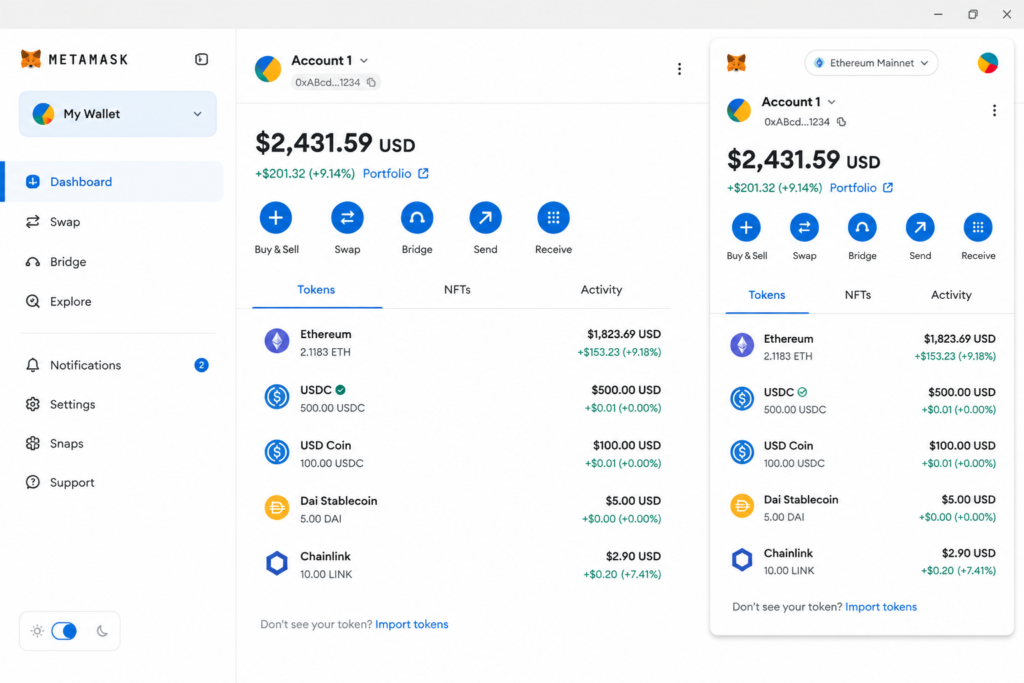
If you are ready to take your first step into self-custody, here is how to set up the most popular hot wallet in 2026:
-
Download the Extension: Visit the official MetaMask official site and download the browser extension for Chrome, Brave, or Firefox. Always verify the URL to avoid phishing sites.
-
Create a New Wallet: Open the extension and select “Create a new wallet.” Agree to the basic terms of service.
-
Secure with a Strong Password: Create a unique, complex password for your local device.
-
Write Down Your Secret Recovery Phrase: MetaMask will reveal a 12-word recovery phrase (also known as a seed phrase). Write this down physically on a piece of paper. Never take a screenshot, never save it in your notes app, and never upload it to Google Drive.
-
Confirm Your Phrase: The setup wizard will ask you to select the words in the correct order to verify you wrote them down correctly.
-
Your Wallet is Ready: You now have a unique public address (starting with
0xfor Ethereum/EVM networks) to send and receive funds.
Learning how to store crypto safely 2026 starts with keeping this newly created recovery phrase completely offline.
Hardware Wallet Spotlights: Ledger vs. Trezor in 2026
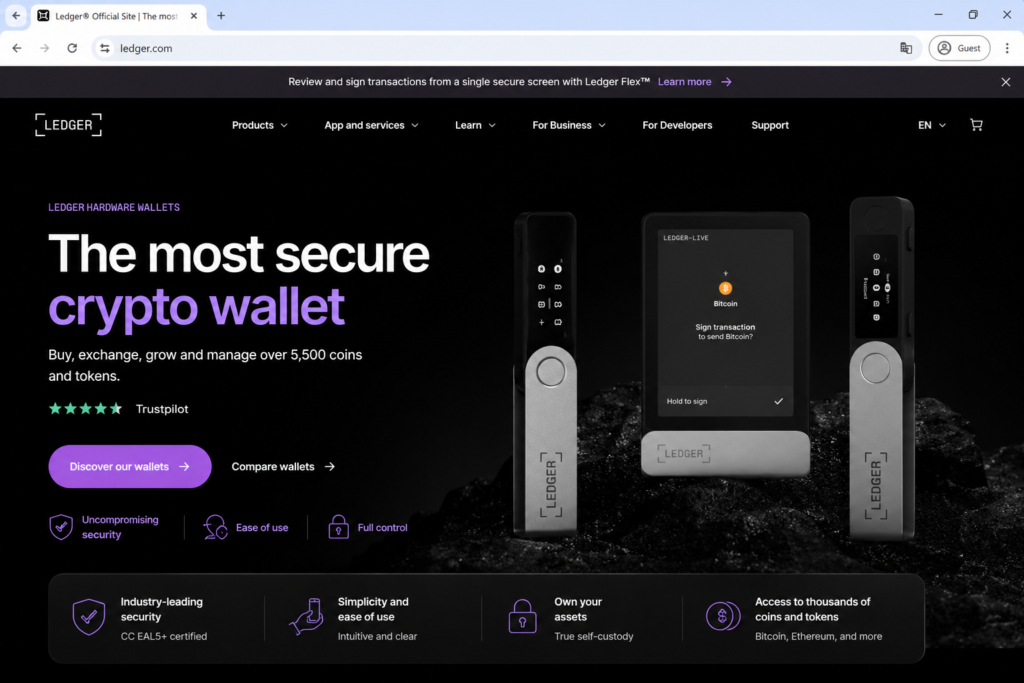
If you are committing to maximum security, choosing between Ledger and Trezor is your next step. Both are excellent, but they cater to slightly different preferences.
Ledger Overview (Closed-Source Secure Element)
Ledger devices utilize a proprietary “Secure Element” chip (similar to the technology used in passports and credit cards) to prevent physical tampering.
-
Ledger Nano S Plus (~$79 USD): The entry-level standard. Excellent security, supports thousands of coins, but lacks Bluetooth.
-
Ledger Nano X (~$149 USD): Offers Bluetooth connectivity, making it ideal for mobile users who want to manage their crypto on the go.
-
Ledger Flex (~$249 USD): A premium option featuring an E-Ink touchscreen for easier transaction verification.
Trezor Overview (Fully Open-Source)
Trezor relies on fully open-source software and hardware, allowing developers worldwide to audit their code for any hidden vulnerabilities.
-
Trezor Safe 3 (~$79 USD): Offers a physical secure element chip and excellent coin compatibility.
-
Trezor Safe 5 (~$169 USD): Features a color touchscreen, haptic feedback, and enhanced physical security features.
No matter which brand you choose, both represent the peak of how to store crypto safely 2026.
The Golden Rules of Seed Phrase Management
A physical cold wallet or a secure hot wallet is only as secure as its recovery phrase (seed phrase). Your seed phrase is the master key to your entire crypto fortune. If your hardware device breaks, gets lost, or is stolen, you can input your seed phrase into any new device to instantly recover your funds.
Conversely, if anyone else gets access to your seed phrase, they can steal all your crypto instantly—no physical device or PIN required.
To ensure you know how to store crypto safely 2026, adhere strictly to these rules:
-
Never Go Digital: Do not type your seed phrase into a computer, take a photo of it, email it to yourself, or store it on iCloud.
-
Go Physical: Write it on paper with waterproof ink, or better yet, engrave it onto a titanium steel plate (such as a Cryptosteel) to protect it from fire and water damage.
-
Dual Locations: Keep backup copies of your seed phrase in two secure, geographically separate locations (e.g., your home safe and a safety deposit box).
-
Zero Sharing: No legitimate support team from MetaMask, Ledger, Trezor, or any exchange will ever ask for your seed phrase. If someone asks for it, they are trying to rob you.
Frequently Asked Questions (FAQ)
Can a cold wallet be hacked?
Technically speaking, a remote online attacker cannot access the private keys secured inside your cold wallet. Because your keys are stored offline inside an isolated secure microchip, they are physically shielded from malware, spyware, and trojan horses infecting your computer or smartphone.
However, you can still compromise your assets through two specific human-error vulnerabilities:
-
Phishing Scams: If you physically type your 12-to-24-word seed phrase into a suspicious website, a fake software update, or an online form, you are giving the attacker direct custody of your assets.
-
Blind Signing Malicious Smart Contracts: If you connect your cold wallet to a fraudulent decentralized application (dApp) and manually approve a transaction that grants full spending permissions to a scam contract, the smart contract can drain your wallet.
The device does its job by keeping your keys offline, but it cannot stop you from manually signing a bad deal. Always double-check what you are signing directly on your hardware wallet’s physical screen before confirming.
What happens if I lose my physical hardware wallet?
If your physical Ledger or Trezor gets lost, stolen, run over by a car, or destroyed in a home disaster, your cryptocurrency remains completely safe.
A common misconception is that your digital assets are physically stored inside the hardware wallet itself. In reality, your crypto lives entirely on the decentralized blockchain. Your hardware wallet is simply an offline terminal holding the private keys required to move those assets.
To regain access to your portfolio, you do not need the physical device. You simply need to acquire a new hardware wallet (or use a secure, compatible software wallet) and input your backup 12- or 24-word recovery seed phrase. This master key will instantly rebuild your private keys, restoring complete access to your entire portfolio. For this exact reason, keeping your backup seed phrase physically secure and completely offline is the single most important rule of learning how to store crypto safely 2026.
Is MetaMask safe to use in 2026?
Yes, MetaMask remains highly secure, but it is critical to understand its operational limitations. As of 2026, MetaMask is the world’s most popular self-custodial software wallet, trusted by over 100 million users. Recent upgrades have introduced robust features, including advanced transaction previews that show you exactly what permissions you are signing, and built-in live threat surveillance to warn you of flagged phishing sites.
However, because MetaMask runs as a software application on your web browser or smartphone, its security ceiling is strictly capped by the security of your host device. If your computer gets infected with malware or a remote access trojan, your hot wallet is exposed.
To achieve maximum protection, you should connect your hardware wallet directly to MetaMask. This combines MetaMask’s world-class Web3 interface with the offline physical security of a cold wallet. When linked, MetaMask acts as a visual interface, but any outgoing transaction still requires a physical button press on your offline Ledger or Trezor device before it can execute.
Can I store all my different cryptos on one wallet?
Yes, modern cold and hot wallets are designed with multi-chain architectures. Instead of managing a different wallet for every asset, tools like Ledger, Trezor, MetaMask, and Trust Wallet allow you to manage thousands of different coins across completely separate blockchains simultaneously.
Under the hood, a single master recovery seed phrase uses a standardized cryptographic protocol (BIP-32/BIP-44) to derive individual private keys for every supported blockchain network. This means you can secure your Bitcoin, Ethereum, Solana, Layer-2 scaling tokens, and stablecoins under one unified recovery phrase. You only need to back up and protect a single seed phrase to secure your entire multi-chain portfolio, streamlining the process of how to store crypto safely 2026.
Conclusion
Understanding how to store crypto safely 2026 is not about finding a single magic tool; it is about building a habit of security hygiene. For small, active trading balances, using a hot wallet or a highly secured exchange is perfectly fine. However, as your portfolio grows, investing in a hardware cold wallet is the only logical path forward to sleep soundly at night. Take control of your private keys, keep your seed phrases offline, and secure your financial sovereignty today.
Disclaimer: Cryptocurrency investment and custody involve significant risks. The information provided in this article is for educational purposes only and does not constitute financial, legal, or investment advice. Always perform your own research, verify platform URLs, and purchase hardware wallets directly from official manufacturers to avoid counterfeits.