The digital asset ecosystem across North Africa and the Middle East (MENA) is expanding at a remarkable speed. Egypt has emerged as one of the fastest-growing cryptocurrency markets in the region, driven by a tech-savvy demographic, widespread mobile internet penetration, and a growing interest in digital assets as a store of value amidst local currency fluctuations.
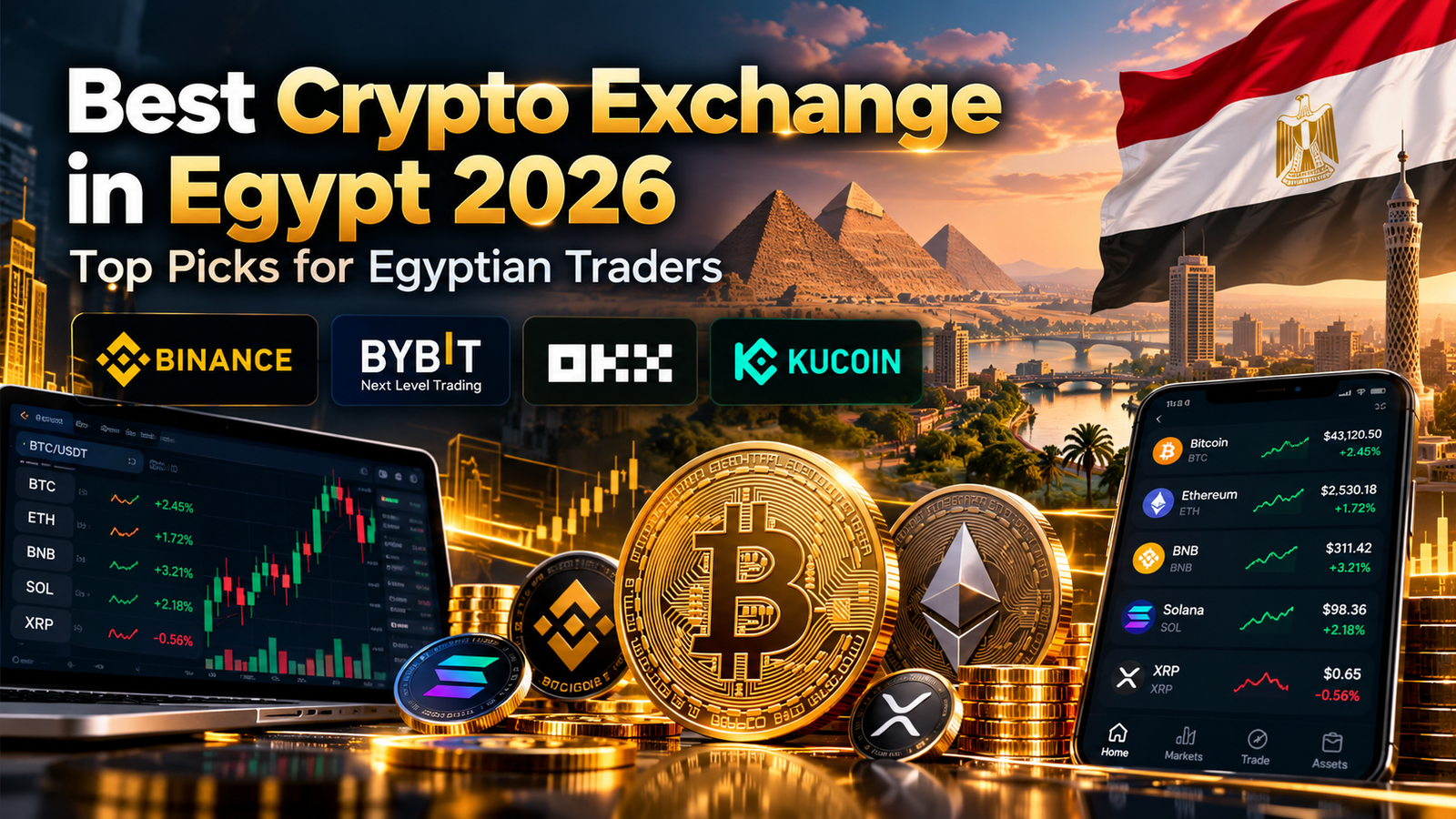
Finding a reliable trading venue requires looking closely at platform security, order book depth, payment gateway accessibility, and regulatory context. Identifying the best crypto exchange in egypt 2026 involves evaluating platforms that balance high-performance execution with peer-to-peer (P2P) localized payment integration.
Cryptocurrencies are strictly regulated and restricted under Egyptian legal frameworks. The Central Bank of Egypt (CBE) prohibits the issuance, trading, and promotion of digital currencies without explicit operational licenses under Article 206 of Law No. 194/2020. Users residing in Egypt must independently verify current local laws and operate with full awareness of financial and legal exposure prior to engaging in digital asset activities.
1. Regulatory Landscape: Central Bank of Egypt (CBE) Stance in 2026
To trade responsibly, Egyptian investors must understand the regulatory environment governing digital financial assets.
The Legal Framework & Article 206
The primary legal standard governing digital currencies in Egypt remains Law No. 194/2020 (Central Bank and Banking System Law). Under Article 206, issuing, trading, or promoting cryptocurrencies, creating trading platforms, or executing transactions without prior authorization from the CBE Board of Directors is prohibited.
┌─────────────────────────────────────────────────────────────────────────┐
│              EGYPTIAN CRYPTO REGULATORY STRUCTURE (CBE)                 │
├─────────────────────────────────────────────────────────────────────────┤
│                                                                         │
│   ┌─────────────────────────┐         ┌─────────────────────────────┐   │
│   │ Central Bank of Egypt   │ ──────► │ Law No. 194/2020            │   │
│   │ (CBE Supervisory Body)  │         │ (Article 206 Enforcement)   │   │
│   └───────────┬─────────────┘         └──────────────┬──────────────┘   │
│               │                                      │                  │
│               ▼                                      ▼                  │
│   ┌─────────────────────────┐         ┌─────────────────────────────┐   │
│   │ Unlicensed Crypto       │         │ Strict Restrictions &       │   │
│   │ Platform Operations     │         │ Banking Safeguards          │   │
│   └─────────────────────────┘         └─────────────────────────────┘   │
│                                                                         │
└─────────────────────────────────────────────────────────────────────────┘
The Central Bank of Egypt enforces these regulations due to several key factors:
-
Capital Controls and Currency Stability: Preserving stability in the Egyptian Pound (EGP) and managing foreign currency reserves.
-
Consumer Protection: Guarding non-institutional traders against market volatility, systemic counterparty risk, and unverified offshore entities.
-
Anti-Money Laundering (AML): Preventing illicit capital flight and ensuring compliance with global Financial Action Task Force (FATF) guidelines.
Institutional Compliance & Banking Oversight
Commercial banks in Egypt monitor transactions for peer-to-peer payment transfers linked to unlicensed exchanges. Repeated transfers with crypto-related memo fields can trigger account freezes, compliance reviews, or transaction rejections. Choosing a platform requiring proper Know Your Customer (KYC) identity verification and operating robust risk management frameworks is essential.
2. Selection Criteria for Egyptian Crypto Traders
Choosing the best crypto exchange in egypt 2026 requires looking beyond headline trading fees. A platform must deliver localized settlement mechanics, deep order book liquidity, and transparent security proofs.
| Evaluation Factor | Primary Considerations | Importance Level |
| EGP Settlement Methods | Active P2P desk with support for Vodafone Cash, InstaPay, and local bank transfers. | Critical |
| Proof of Reserves (PoR) | Publicly verifiable Merkle-tree cryptographic proofs of 1:1 backed user assets. | Critical |
| Arabic Language Support | Native Arabic user interfaces, web portals, and customer care documentation. | High |
| Trading Fee Schedule | Competitive Maker/Taker rates (typically $\le 0.10\%$) with native token discount tiers. | High |
| Security Architecture | Multi-Factor Authentication (2FA), cold storage reserve isolation, and insurance reserves. | High |
| Asset Diversity | Broad selection of spot markets, Layer-1/Layer-2 tokens, and USD-pegged stablecoins. | Medium |
Evaluating these criteria helps local traders avoid low-liquidity platforms and maintain seamless deposit and withdrawal workflows.
3. Top Picks for Egyptian Traders in 2026
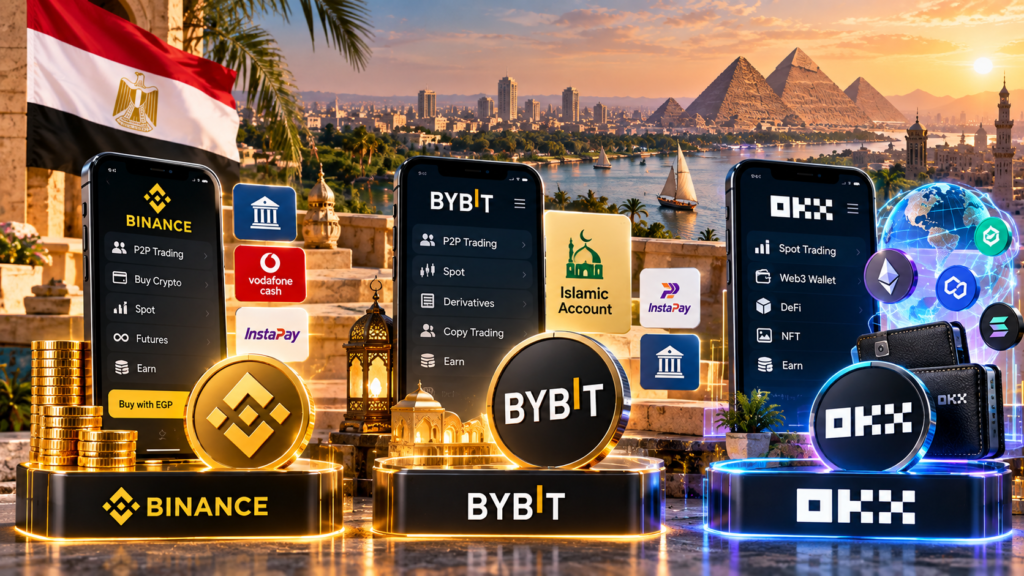
Evaluating global trading volume, local currency settlement efficiency, product availability, and long-term operating history highlights three primary exchanges serving Egyptian users in 2026. Because direct fiat bank deposits in Egyptian Pounds (EGP) are restricted under central bank mandates, the quality of an exchange’s Peer-to-Peer (P2P) clearing network, escrow security, and regional feature adaptation are the critical factors that separate top-tier platforms from low-liquidity alternatives.
                     BINANCE TRADING ECOSYSTEM
                                 │
     ┌───────────────────────────┼───────────────────────────┐
     ▼                           ▼                           ▼
[P2P Liquidity]           [Spot & Derivatives]        [Security Infrastructure]
  - EGP Bank Transfer       - 500+ Assets               - SAFU Emergency Reserve
  - Vodafone Cash           - Sub-0.10% Spot Fees       - Merkle-Tree PoR Audits
  - InstaPay Settlement     - Advanced Order Types      - Multi-Sig Cold Storage
#1 Binance: Deepest P2P EGP Liquidity & Global Market Volume
Binance remains the primary destination for international cryptocurrency liquidity, commanding the largest market share in spot and derivatives trading volume worldwide. For Egyptian traders evaluating options for the best crypto exchange in egypt 2026, Binance offers the most established localized Peer-to-Peer (P2P) trading infrastructure in the country.
-
Localized Payment Gateways: The Binance P2P platform hosts an active market for trading Tether (USDT), Bitcoin (BTC), and major crypto assets directly against EGP. The platform supports widely used Egyptian domestic payment networks, including the Instant Payment Network (InstaPay), Vodafone Cash, Orange Cash, Etisalat Cash, and traditional local bank wire transfers (such as CIB, QNB Alahli, and Banque Misr). This deep liquidity allows users to enter and exit local currency positions with tight spreads and minimal price slippage.
-
Competitive Fee Schedule: Standard spot trading fees on Binance start at a competitive baseline of $0.10\%$ for both makers and takers. Users who hold Binance Coin (BNB) receive an automatic $25\%$ fee discount, reducing spot trading costs to $0.075\%$. Higher-volume VIP tiers further compress execution costs for active algorithmic traders and institutional desks.
-
Security & Capital Protection: Binance maintains its flagship Secure Asset Fund for Users (SAFU)—a emergency insurance fund backed by capital reserves set aside to protect user funds under extreme circumstances. Furthermore, Binance routinely publishes publicly verifiable, zk-SNARKs-enabled Merkle-tree Proof of Reserves (PoR) audits, enabling traders to cryptographic verify that user assets are backed $1:1$ on-chain.
For an in-depth evaluation of platform security, advanced trading tools, and account registration procedures, read our full Binance Review 2026.
                      BYBIT REGIONAL ADVANTAGES
                                 │
     ┌───────────────────────────┼───────────────────────────┐
     ▼                           ▼                           ▼
[Local Settlement]        [Shariah Compliance]        [Product Ecosystem]
  - P2P EGP Channels        - Dedicated Islamic          - High-Frequency Spot
  - Fast InstaPay Escrow      Account Architecture       - Advanced Derivatives
  - Native Arabic UI        - Interest-Free Swaps        - Copy Trading Engine
#2 Bybit: MENA Expansion & Dedicated Islamic Accounts
Bybit has expanded aggressively across the Middle East and North Africa (MENA). Operating from its regional headquarters in Dubai, Bybit has built its ecosystem around the specific financial preferences, language requirements, and compliance standards of Arab market traders.
-
Zero-Fee P2P Trading Engine: Bybit’s P2P desk provides a zero-fee peer-to-peer clearing framework for buying and selling USDT using EGP. The platform features an automated merchant vetting system and an escrow engine designed for fast transaction processing via InstaPay and mobile telecom wallets.
-
Shariah-Compliant Islamic Account: To accommodate ethical and religious standards across the MENA region, Bybit offers a specialized Islamic Account option developed alongside certified Islamic finance advisors. This structure eliminates overnight swap charges, roll-over fees, and interest-bearing elements (riba), allowing traders to participate in spot crypto markets in accordance with Shariah principles.
-
Execution & User Experience: Bybit is recognized for its high-throughput matching engine, capable of executing orders with minimal latency during periods of extreme market volatility. Beyond spot markets covering hundreds of digital assets, the platform features an Arabic user interface, copy-trading tools, and structured yield products.
To analyze Bybit’s security framework, trading fees, and account feature set, review our complete Bybit Review 2026.
#3 OKX: Advanced Altcoin Selection & Non-Custodial Web3 Ecosystem
OKX is a strong candidate for traders seeking broad access to early-stage digital assets, decentralized finance (DeFi) tools, and non-custodial wallet infrastructure alongside standard centralized exchange liquidity.
-
Broad Altcoin Depth: OKX lists hundreds of spot trading pairs, offering deep order book depth across major Layer-1 blockchains, Layer-2 scaling solutions, and emerging DeFi protocols. This makes it an ideal platform for traders looking to diversify beyond Bitcoin and Ethereum.
-
Integrated Web3 Ecosystem: A key differentiator for OKX is its native Web3 Wallet—a multi-chain, non-custodial wallet integrated directly into the mobile and web applications. This tool allows Egyptian traders to seamlessly transition from centralized trading to decentralized finance (DeFi), cross-chain token swaps, decentralized exchanges (DEXs), and NFT marketplaces while retaining full control over their private keys.
-
Audited Proof of Reserves (PoR): OKX maintains high transparency standards by publishing monthly Proof of Reserves statements. Utilizing Merkle-tree verification, users can independently confirm that OKX maintains $1:1$ reserve backing for all user balances without relying on uncollateralized third-party debt.
Traders looking to explore broader regional crypto strategies and legal frameworks across neighboring markets can read our comprehensive analysis on the [Best Exchange in UAE 2026].
4. EGP Deposit and Withdrawal Methods
Because international card processors and domestic commercial banks restrict direct fiat credit/debit card purchases for crypto assets in Egypt, traders rely on peer-to-peer (P2P) clearing systems.
                     EGP P2P SETTLEMENT WORKFLOW

  [Trader A: Wants USDT]                      [Trader B: Local Merchant]
            │                                             │
            ├─────── 1. Initiates P2P Buy Order ─────────►│
            │          (Escrow Holds USDT)                │
            │                                             │
            ├─────── 2. Sends EGP Transfer ──────────────►│
            │        (InstaPay / Vodafone Cash)           │
            │                                             │
            │◄────── 3. Confirms EGP Receipt ─────────────┤
            │                                             │
  [USDT Released to Wallet] ◄─────────────────────────────┘
Peer-to-Peer (P2P) Trading Mechanics
P2P trading matches buyers and sellers directly while the exchange acts as an escrow agent:
-
Order Initiation: The buyer places an order for USDT on the exchange P2P platform. The system locks the seller’s USDT in an escrow vault.
-
Fiat Transfer: The buyer transfers EGP directly to the seller’s Egyptian bank account, InstaPay handle, or mobile wallet within a specified timeframe (usually 15 minutes).
-
Escrow Release: Once the seller confirms receipt of the EGP in their local account, the exchange releases the escrowed USDT to the buyer’s spot wallet.
Primary Egyptian Local Payment Channels
-
InstaPay (Instant Payment Network): Developed by the Egyptian Banks Company and operated under CBE supervision, InstaPay allows real-time, bank-to-bank transfers across Egypt. It is a fast, widely used option for P2P clearing on platforms like Binance and Bybit.
-
Vodafone Cash & Mobile Wallets: Smart wallets issued by telecom operators (Vodafone Cash, Orange Cash, Etisalat Cash) allow rapid EGP transfers using a smartphone number. They are ideal for smaller daily transactions.
-
Local Bank Wire Transfers: Transfers conducted via traditional online banking portals (e.g., CIB, QNB Alahli, Banque Misr) accommodate larger P2P transaction sizes.
What About Fawry?
Fawry is Egypt’s largest electronic payment and retail collection network. While Fawry is widely used for utilities, e-commerce, and bill payments, direct cryptocurrency purchases through Fawry kiosk terminals are not natively supported due to Central Bank guidelines. Certain third-party P2P merchants accept wallet-to-wallet transfers derived from Fawry-funded mobile accounts, but users should rely on direct InstaPay or mobile telecom wallets for reliable execution.
5. Security & Risk Mitigation for Egyptian Users
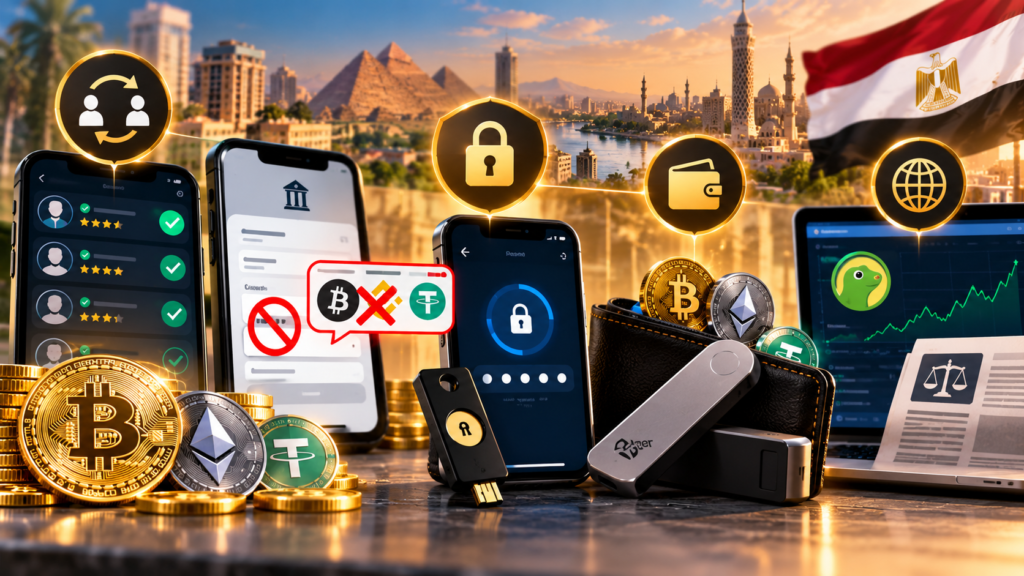
Traders operating in regions with strict regulatory frameworks and capital controls must prioritize operational security, data privacy, and strict transactional hygiene. Because peer-to-peer (P2P) trading forms the primary gateway for acquiring digital assets in Egypt, users face double exposure: technical security threats from bad actors online, and administrative banking friction from automated compliance monitoring.
Implementing a comprehensive, multi-layered risk mitigation strategy is necessary to safeguard both your digital assets and your local fiat banking access.
                  ACCOUNT SECURITY & SAFEKEEPING TIER

         ┌──────────────────────────────────────────────────┐
         │ Level 3: Cold Self-Custody (Hardware Wallets)    │
         ├──────────────────────────────────────────────────┤
         │ Level 2: Robust 2FA & Anti-Phishing Mechanics    │
         ├──────────────────────────────────────────────────┤
         │ Level 1: Platform Vetting & P2P Counterparty Risk│
         └──────────────────────────────────────────────────┘
a. Rigorous P2P Merchant Vetting & Counterparty Verification
Peer-to-peer desks eliminate central clearing houses, meaning your local payment transaction occurs directly between your personal bank account (or mobile wallet) and an individual seller. To minimize the risk of non-payment, escrow fraud, or association with illicit banking activities, apply strict filtering parameters before opening any trade order:
-
Completion Rate & Order Volume: Never trade with an unverified peer. Filter for merchants who maintain an order completion rate of at least 98% over a minimum of 200–300 completed transactions in the past 30 days. High-volume merchants with long-standing profiles are far less likely to dispute valid transfers.
-
Matched KYC Identity: Always verify that the account holder name on InstaPay, Vodafone Cash, or bank wire matches the registered name on the exchange P2P profile exactly. Reject any request from a seller asking you to transfer funds to a “friend’s account” or a third-party bank profile, as this is a common vector for triangular fraud schemes.
-
Escrow Timers & Proof of Payment: Keep all communications strictly within the platform’s official chat system. Never release escrowed USDT until you have logged directly into your banking application and confirmed cleared funds. Conversely, when buying, always upload clear, unedited PDF or screenshot payment receipts into the platform chat before marking the order as paid.
b. Operational Banking Hygiene: Memo Descriptions & Transaction Patterns
The Central Bank of Egypt (CBE) requires commercial banking institutions to run automated transaction monitoring systems under Anti-Money Laundering (AML) and foreign exchange regulation frameworks. Violating simple payment etiquette can result in immediate account holds or permanent banking blacklists.
-
Absolute Prohibition of Crypto Keywords: When executing an InstaPay transfer, Vodafone Cash transaction, or bank wire to a P2P merchant, never write crypto-related terms in the payment note, memo, or reference field. Banned terms include: “Crypto”, “Bitcoin”, “BTC”, “Binance”, “Bybit”, “USDT”, “P2P”, “Exchange”, or platform transaction IDs. Leave the memo blank or use simple, generic descriptions like “Personal transfer” or “Service payment” if a field is mandatory.
-
Transaction Velocity & Structuring Controls: Avoid sending dozens of repetitive round-number transactions (e.g., exactly 10,000 EGP five times in one hour) to different unverified individuals. Commercial bank algorithms flag unusual velocity and pattern anomalies for manual compliance review.
-
Separate Dedicated Account: Serious traders often maintain a separate, non-primary bank account dedicated exclusively to P2P transactions. This ensures that in the event of an administrative inquiry or temporary hold by a bank, your primary salary or operational living expenses remain unaffected.
c. Advanced Two-Factor Authentication (2FA) & Anti-Phishing Controls
Centralized exchanges provide deep liquidity, but they are high-value targets for credential stuffing, SIM-swapping, and phishing attempts. Securing your exchange login credentials requires moving beyond standard mobile phone authentication.
-
Disable SMS-Based 2FA: SMS authentication is inherently vulnerable to SIM-swapping attacks, where malicious actors trick telecom operators into reassigning your mobile phone number. Disable SMS verification for login and withdrawal approvals immediately.
-
Deploy Hardware or Time-Based 2FA: Upgrade to time-based one-time password (TOTP) authenticator applications like Google Authenticator or Microsoft Authenticator. For maximum institutional-grade security, bind physical FIDO2 security keys (such as YubiKey) to your exchange accounts.
-
Anti-Phishing Codes: Enable personalized Anti-Phishing Codes within your exchange account settings. Once configured, every genuine email sent by the platform (withdrawal confirmations, security alerts, system notices) will display your unique custom code, allowing you to instantly identify malicious phishing emails.
d. Cold Self-Custody for Long-Term Asset Preservation
A foundational rule in digital asset security is: “Not your keys, not your coins.” Centralized trading platforms are trading venues, not custodial savings institutions. While exchange insurance funds exist, storing large capital balances on centralized platforms leaves you exposed to counterparty risk, insolvency, or sudden account restrictions.
-
Exchange Hot Wallets vs. Cold Storage: Use centralized platforms like Binance or Bybit primarily for liquid trading, P2P clearing, and short-term execution.
-
Self-Custody Hardware Solutions: For medium- to long-term asset preservation, transfer your assets out of centralized exchanges into non-custodial hardware wallets (e.g., Ledger, Trezor). Hardware wallets keep your private keys isolated offline inside a secure element chip, protecting your funds from remote network malware, exchange hacks, or account freezes.
-
Backup Seed Phrase Security: Store your 12- or 24-word recovery seed phrase on physical, offline media (preferably stamped stainless steel plates) hidden in secure locations. Never record recovery phrases in cloud notes, photos, or password managers connected to the internet.
5. Independent Information Verification & Regulatory Monitoring
Operating safely requires staying informed through verified external market data and official regulatory updates rather than unvetted social media channels.
-
Market & Liquidity Verification: Track real-time global trading volume, verified exchange reserves, and order book depth on independent aggregation platforms such as CoinGecko exchange rankings.
-
Regulatory Compliance Tracking: To keep up with regulatory shifts, official decrees, and legal frameworks across neighboring regional hubs, follow updated market guides such as the [Best Exchange in UAE 2026] and [Best Exchange in Turkey 2026]. Staying proactive on legal developments across the Middle East helps you adjust your trading workflow before regulatory changes take effect.
Frequently Asked Questions (FAQ)
Is cryptocurrency trading legal in Egypt?
Cryptocurrency trading operates under strict statutory prohibitions within the Arab Republic of Egypt. Under Article 206 of the Central Bank and Banking System Law No. 194 of 2020, it is strictly forbidden to issue, trade, market, or establish trading platforms for digital currencies without a specialized license issued directly by the Central Bank of Egypt (CBE) Board of Directors.
To date, the CBE has not granted an operational license to any domestic or foreign cryptocurrency exchange. Operating outside these parameters carries legal consequences, including custodial sentences (imprisonment) and administrative fines ranging from 1,000,000 to 10,000,000 Egyptian Pounds (EGP). Beyond statutory law, religious authority also reinforces this stance: Egypt’s official Islamic decree body, Dar al-Iftaa, issued an official fatwa declaring commercial crypto dealing forbidden (haram) under Shariah principle due to high systemic volatility, counterparty risk, and capital flight concerns.
What is the best crypto exchange in Egypt for EGP peer-to-peer trading?
Because direct access to centralized exchanges via local banking pipelines is blocked, local traders rely heavily on decentralized Peer-to-Peer (P2P) settlement mechanisms. The primary platforms serving this liquidity demand include:
-
Binance P2P: Hosts the highest liquidity depth for EGP-denominated pairs. It acts as an escrow service where local merchants list buy/sell orders for stablecoins like USDT against local payment clearing channels.
-
Bybit P2P: Has rapidly grown its presence across the Middle East and North Africa (MENA) region by offering zero-fee P2P order matching alongside integrated escrow security and localized user interfaces.
These platforms do not maintain local fiat bank deposits in Egypt; instead, they operate strictly as neutral third-party escrow facilitators for buyer-seller direct clearing.
Can I deposit Egyptian Pounds (EGP) directly using a debit or credit card?
No. Direct fiat processing—including credit cards, debit cards, international wire transfers, or domestic payment gateways—for purchasing digital assets in EGP is restricted across all Egyptian commercial banking institutions.
To get around fiat deposit restrictions, local market participants utilize localized digital clearing networks through P2P exchange counters:
-
InstaPay (Instant Payment Network): Operated under the oversight of the CBE, InstaPay allows real-time interbank account clearing and is widely used for settling P2P transactions.
-
Mobile Telecom Wallets: Smart payment wallets such as Vodafone Cash, Orange Cash, and Etisalat Cash allow instant P2P transfers using a local phone number.
-
Local Bank Transfers: Online banking transfers (e.g., CIB, QNB Alahli, Banque Misr) are used for settling larger transaction sizes.
How does the Central Bank of Egypt (CBE) monitor crypto transactions?
The Central Bank monitors financial flows through commercial bank compliance departments using automated anti-money laundering (AML) protocols and transaction surveillance tools:
-
Keywords and Memos: Automated banking filters scan electronic fund transfers for payment descriptions containing crypto terminology (e.g., “Crypto,” “Binance,” “USDT,” “Bitcoin”). Including these terms in transaction notes triggers automated holds, flag notices, or direct account freezes.
-
Structuring & Velocity Monitoring: Commercial accounts receiving rapid, high-frequency transfers from multiple unverified third parties—typical of active P2P merchant behavior—are regularly flagged for compliance reviews under foreign exchange control mandates.
-
Capital Control Enforcement: To preserve national foreign exchange reserves and stabilize the Egyptian Pound, the banking system monitors suspicious outward capital transfers or rapid conversions into foreign currency-pegged stablecoins.
Conclusion
Determining the best crypto exchange in egypt 2026 depends on balancing liquidity, local settlement efficiency, and platform safety. Binance offers deep EGP peer-to-peer liquidity and a broad suite of spot products, while Bybit provides strong regional support with Shariah-compliant Islamic accounts and zero-fee P2P settlement. Meanwhile, OKX serves users seeking extensive altcoin selection and Web3 integration.
Because local banking rules and Central Bank mandates remain strict, traders should use peer-to-peer settlement channels carefully, avoid crypto-related transaction memos, and transfer long-term assets to secure self-custody hardware wallets.
Disclaimer: The information provided in this guide is for educational and informational purposes only and does not constitute financial, legal, or investment advice. Cryptocurrencies are volatile digital assets that carry a high degree of capital risk. The regulatory framework governing digital assets in Egypt is strictly controlled by the Central Bank of Egypt (CBE) under Law No. 194/2020. Readers must independently verify current local regulations, consult qualified legal and financial counsel, and assess their personal risk tolerance before engaging in any digital asset transactions.