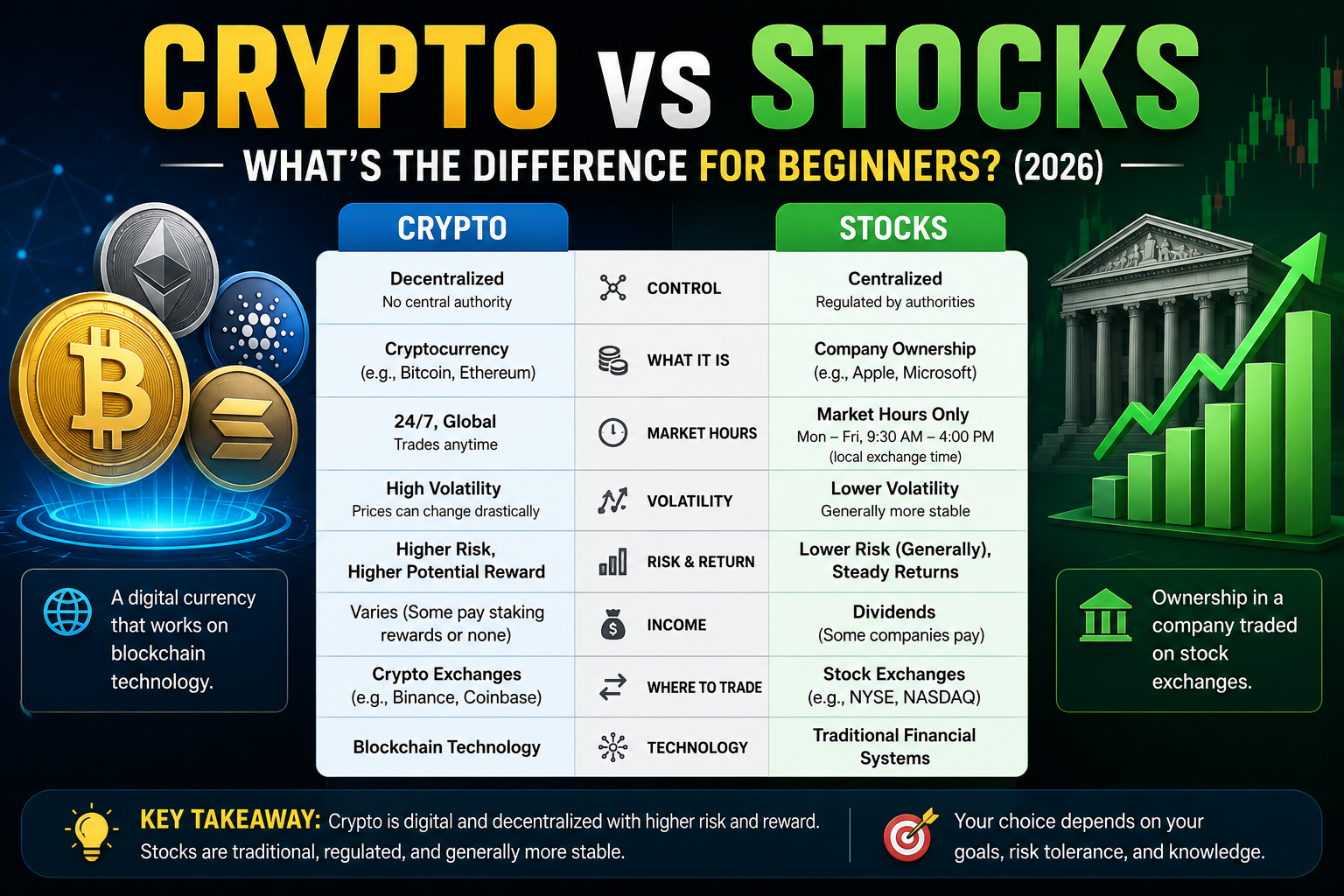
Deciding between crypto vs stocks beginners 2026? Learn the 5 core differences, risk profiles, and market caps to build your portfolio safely.
Entering the world of investing can feel like stepping into a foreign country where everyone speaks a different language. If you are just starting out, your attention is likely divided between two massive financial arenas: traditional stocks and the fast-moving world of cryptocurrency. Both offer paths to grow your wealth, but they operate on completely different rules, technologies, and risk levels.
Choosing where to put your hard-earned money means understanding how crypto vs stocks beginners 2026 dynamics apply to your personal financial goals. Neither asset class is inherently “better” than the other; rather, they serve different purposes within a modern portfolio. This unbiased guide breaks down everything you need to know to make an informed, confident decision.
1. What Are Stocks and Crypto? The Absolute Basics

Before comparing them side-by-side on a spreadsheet, let’s strip away the overwhelming financial jargon and look at what you are actually purchasing when you deploy your capital into these asset classes. When navigating the foundational differences of crypto vs stocks beginners 2026 dynamics, the very first step is mastering the underlying mechanics of what these instruments represent. They are powered by completely different technologies, legal structures, and economic principles.
What Is a Stock? (Buying Corporate Ownership)
When you buy a stock—also widely referred to as shares or corporate equity—you are purchasing a legally backed, fractional piece of ownership in a real-world, operating corporation. For example, if you allocate funds to buy a share of public giants like Apple, Microsoft, or Coca-Cola, you legally own a micro-fraction of that specific enterprise. This includes their physical real estate, factories, proprietary patents, product inventory, and, most importantly, a claim on their future financial earnings.
How Stock Value Is Generated:
[Corporate Innovation & Efficiency] ──> [Increased Revenue & Profits] ──> [Stock Price Appreciation & Dividends]
As the corporation hires talented executives, scales its global operations, beats its market competitors, and generates greater net profits, the underlying intrinsic value of the company increases. Consequently, other investors are willing to pay more for your shares, causing the stock price to rise.
Furthermore, many established, mature corporations share a portion of their excess quarterly profits directly with their investors through regular cash payouts known as dividends. To explore the long-running history of how traditional corporate equity is valued, analyzed, and audited by financial regulators, legacy education platforms like Investopedia provide deep foundational guides on corporate structures.
What Is Cryptocurrency? (Buying Network Protocol Assets)
Cryptocurrency is a fundamentally distinct financial instrument born out of computer science and cryptography rather than traditional corporate law. Instead of representing equity shares in a physical brick-and-mortar business with a CEO and a board of directors, a cryptocurrency is a native digital token or cryptographic coin that operates autonomously across a decentralized digital ledger called a blockchain.
When you buy a cryptocurrency, you are not buying into a company’s balance sheet; you are purchasing a digital asset that grants you utility, access, or transactional rights within an open-source software network.
How Crypto Value Is Generated:
[Open-Source Development] ──> [Network Adoption & Security] ──> [Token Utility & Scarcity Demand]
The digital asset space is highly diverse, meaning different tokens serve entirely different functions:
-
Store of Value Coins: Assets like Bitcoin (BTC) function primarily as decentralized digital money or “digital gold.” Bitcoin operates on a strictly hard-coded math limit of 21 million coins, protecting it from the artificial inflation that devalues traditional fiat currencies.
-
Smart Contract & Utility Tokens: Assets like Ethereum (ETH) or Solana (SOL) serve as the underlying “fuel” required to pay for computational power on decentralized global networks. These networks host automated applications, decentralized finance (DeFi) lending markets, and digital identity registries.
Because cryptocurrency relies on community adoption, decentralized consensus mechanisms, and network utility rather than quarterly corporate earnings reports, understanding its structural foundations requires a clean slate. To build a rock-solid, comprehensive baseline on these digital instruments before comparing them further to traditional equities, it is highly beneficial to read our detailed introductory primers on What Is Cryptocurrency 2026 and What Is Bitcoin 2026.
Here is the expanded and fully optimized version of section two, designed with analytical depth and precise terminology while ensuring the primary keyword remains seamlessly integrated throughout the text.
2. 5 Key Differences Between Crypto and Stocks
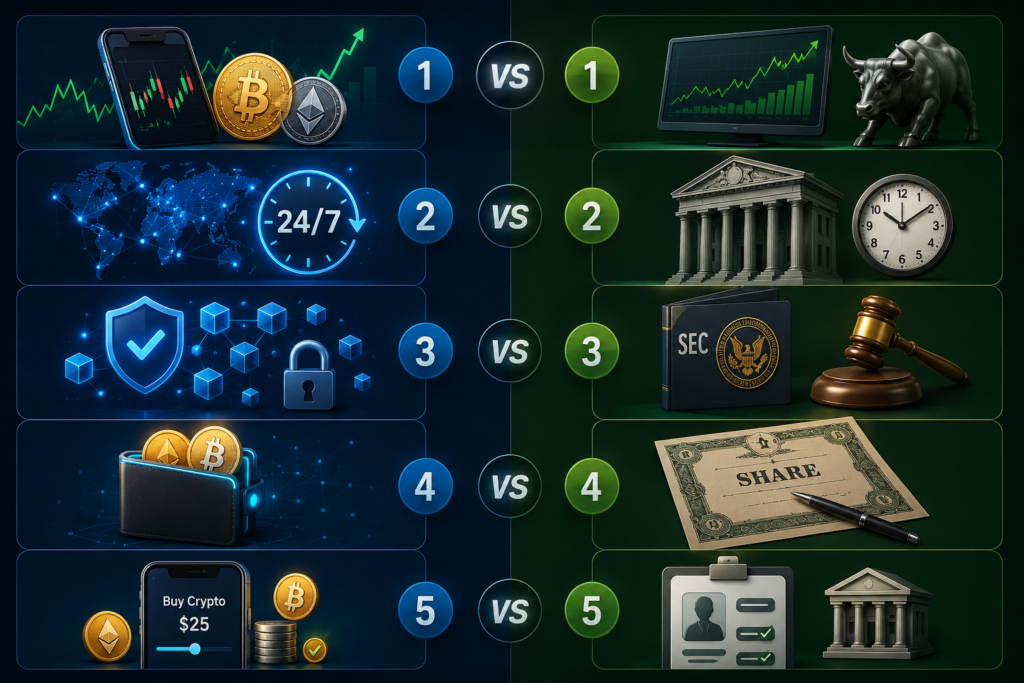
To build a clear, accurate picture of how crypto vs stocks beginners 2026 comparison points impact your daily capital allocation decisions, we need to carefully dissect five foundational pillars. These pillars dictate how trades execute, how assets are legally held, and how much risk your capital is exposed to on any given day.
By analyzing these structural realities, you can move past simple market hype and understand the exact operational rules governing both the traditional brokerage system and the decentralized digital frontier.
Key Comparison Pillars:
├── 1. Volatility Profiles (Calculated Risk vs. Aggressive Price Discoveries)
├── 2. Market Execution Hours (Fixed Regional Windows vs. Non-Stop Global Settlement)
├── 3. Regulatory Guardrails (Century-Old Legal Mandates vs. Evolving Multi-Jurisdictional Codes)
├── 4. Asset Architecture (Tangible Corporate Equity vs. Decoupled Ledger Records)
└── 5. Entry Friction (Legacy Brokerage Inbound Pipelines vs. Native Hyper-Fractional Flows)
1. Volatility and Price Action Profiles
Volatility represents the velocity and magnitude of price fluctuations over a given period. This factor is a critical focal point when comparing crypto vs stocks beginners 2026 metrics because it dictates the emotional endurance required by an everyday investor.
-
Traditional Stocks: The legacy equity market generally moves in structured, predictable trends. While individual growth stocks can experience sharp movements, diversified blue-chip indexes like the S&P 500 typically move in smaller, single-to-double-digit percentage boundaries over a calendar year. Price adjustments are heavily anchored to real-world financial realities like debt-to-equity ratios, product profit margins, and macro interest rate updates.
-
Cryptocurrency: The digital asset arena functions in an ongoing state of hyper-aggressive price discovery. Because the asset class is relatively young, major cryptocurrencies like Bitcoin can easily fluctuate between 10% to 20% within a single 24-hour trading window. For newer altcoins or niche protocol tokens, it is quite common to see sudden multi-hundred-percent spikes or intense 80%+ retracements over a short timeframe, driven purely by shifting social sentiment and protocol liquidity flows.
2. Market Operating and Settlement Hours
The temporal mechanics of when you can buy or sell assets completely alters how investors manage their mental health and monitor portfolio drawdowns.
-
Traditional Stocks: Legacy equity exchanges operate on rigid, centralized, localized business schedules. For instance, the New York Stock Exchange (NYSE) and Nasdaq process orders exclusively Monday through Friday, from 9:30 AM to 4:00 PM Eastern Time. Trading desks are entirely dark on weekends and official national holidays. If a major economic event occurs on a Saturday, stock investors cannot protect their capital until the opening bell rings on Monday morning.
-
Cryptocurrency: The blockchain never pauses for holidays, time zones, or central banking closures. The entire digital asset ecosystem functions as a borderless network operating 24 hours a day, 7 days a week, 365 days a year. An investor sitting anywhere in the world can seamlessly swap a stablecoin for an altcoin or settle a multi-million dollar transaction at 3:00 AM on a Sunday just as efficiently as they can on a Thursday afternoon.
3. Regulatory Oversight and Consumer Protection Frameworks
The depth of government oversight establishes a vital security baseline for your capital, acting as an institutional buffer against systemic platform failure.
-
Traditional Stocks: Mainstream equities operate within a deeply entrenched, highly policed legal ecosystem. In major markets, regulatory giants like the Securities and Exchange Commission (SEC) force public corporations to publish heavily audited quarterly balance sheets, comprehensive income statements, and transparent risk declarations. Furthermore, if a licensed, regulated legacy brokerage firm faces insolvency, national investor insurance corporations typically provide safety nets to protect client cash and securities up to substantial legal thresholds.
-
Cryptocurrency: While the structural maturation of crypto has accelerated immensely through the introduction of spot crypto ETFs, the decentralized asset landscape remains an emerging digital frontier. Rules can change drastically from one jurisdiction to another, and the market lacks widespread, state-backed insurance protections for retail balances. In this space, self-preservation rules supreme; if a trader inadvertently routes tokens to an incorrect wallet address or misplaces their private seed phrase, there is no centralized helpline or institutional insurance policy to restore the lost assets.
4. Core Asset Architecture and Economic Substance
What are you actually holding inside your investment account? This structural difference reveals what backs the value of your portfolio.
-
Traditional Stocks: Purchasing equity represents an ironclad legal contract. Your capital grants you absolute fractional ownership of a company’s tangible machinery, real estate, cash reserves, and intellectual property. Your financial instrument is fundamentally backed by human productivity, corporate revenue streams, and corporate voting protocols.
-
Cryptocurrency: Holding a token means owning specific cryptographic data verified on a public ledger. You possess a private key that dictates moving a token allocation from one point to another on the network. A cryptocurrency’s value is completely independent of corporate earnings; instead, its worth is determined entirely by decentralized consensus, mathematics, programmatic scarcity, community adoption, and open-source network utility.
5. Onboarding Friction and Barriers to Entry
The physical process of transforming raw fiat currency into an income-generating asset is a final key differentiator in the crypto vs stocks beginners 2026 assessment.
-
Traditional Stocks: Onboarding into the legacy financial market often involves standard institutional friction. Opening a standard brokerage account typically requires extensive identity verification checks, proof of address uploads, and complex domestic tax documentation. Furthermore, while fractional share purchasing is becoming more accessible, some high-tier equities still require notable minimum capital to purchase a single whole share.
-
Cryptocurrency: While mainstream centralized platforms require strict verifications to comply with anti-money laundering regulations, the digital asset ecosystem is highly accessible by design. Cryptocurrencies are natively hyper-fractionalized. For instance, a single Bitcoin can be broken down to eight decimal places into units called Satoshis. This structural elasticity means a absolute beginner can begin testing their trading thesis by purchasing a minor fraction of a digital asset with as little as $5, providing an ultra-low-friction gateway to learning the ropes of live market execution.
Here is the expanded and optimized version of section three, presenting deeper financial analysis while ensuring the primary keyword is natively integrated.
3. Comparing Market Sizes and Real-World Performance
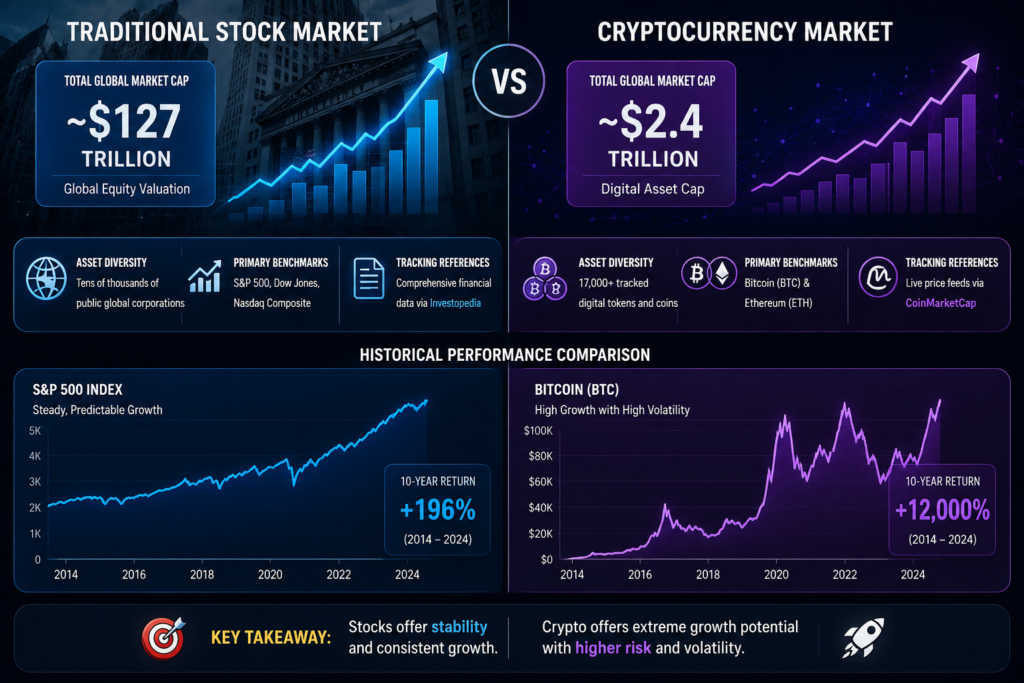
To truly understand how the dynamics of crypto vs stocks beginners 2026 function in the real world, we must put the raw scale of these two distinct financial ecosystems into clear perspective. For anyone just entering the investing space, the macroeconomic size of an asset market is not just a random statistic—it is a vital indicator of structural liquidity.
The overall market capitalization of an asset class directly determines its market stability, the depth of its order books, and how easily large volumes of capital can be traded daily without violently moving the current market price.
Visualizing Global Capital Scale:
┌─────────────────────────────────────────────────────────────────────────────┐
│ Traditional Global Equity Market (~$127 Trillion)                            │
│ 🟩🟩🟩🟩🟩🟩🟩🟩🟩🟩🟩🟩🟩🟩🟩🟩🟩🟩🟩🟩🟩🟩🟩🟩🟩🟩🟩🟩🟩🟩🟩🟩🟩🟩🟩🟩🟩 │
└─────────────────────────────────────────────────────────────────────────────┘
  vs.
┌────────────────────────┐
│ Global Crypto (~$2.4T) │
│ 🟦                     │
└────────────────────────┘
To give you an institutional-grade birds-eye view before deploying your hard-earned money, consider this up-to-date structural breakdown of both asset sectors:
| Core Financial Metric | Traditional Stock Market | Cryptocurrency Market |
| Total Global Market Capitalization | ~$127 Trillion in total global equity valuation across all combined international exchanges | ~$2.4 Trillion in total digital asset capitalization across decentralized networks |
| Asset Variety & Microscopic Diversity | Tens of thousands of publicly traded corporate entities, ETFs, and regional sector trusts | 17,000+ cryptographically tracked digital utility tokens, protocol coins, and stablecoins |
| Primary Structural Benchmarks | S&P 500 Index, Dow Jones Industrial Average, Nasdaq Composite Index | Bitcoin (BTC) Domain Market Share & Ethereum (ETH) Ecosystem Metric |
| Primary Data Tracking References | Comprehensive macroeconomic and equity data via corporate resources like Investopedia | Real-time on-chain network statistics and global price feeds via platforms like CoinMarketCap |
The Reality of Historical Performance Cycles
Evaluating historical performance charts reveals a stark contrast that every beginner must grasp. The traditional stock market represents a centuries-old financial engine designed to capture aggregate corporate efficiency and global economic growth.
When you track diversified index benchmarks like the S&P 500, you are looking at an asset class that has historically generated steady, compounding, predictable long-term growth. This smooth trajectory makes it highly attractive for conservative capital allocators who prioritize steady wealth preservation over rapid capital appreciation.
Conversely, the digital asset ecosystem operates on intense, highly accelerated multi-year halving cycles. When analyzing crypto vs stocks beginners 2026 growth metrics over a multi-year horizon, Bitcoin has historically delivered unprecedented, exponential outperformance that completely eclipses traditional stock indexes. However, this massive upside is structurally punctuated by aggressive crypto winters—severe multi-year market corrections where asset valuations can rapidly contract by 70% to 80% from their all-time highs.
Divergent Responses to Macroeconomic Shocks
Another fascinating element of the crypto vs stocks beginners 2026 relationship is how each market responds to global economic pressure. Because traditional equities are bound to corporate supply chains, debt interest rates, and physical consumer spending patterns, a single negative macroeconomic event—such as a surprise interest rate hike by a central bank or an unexpected labor report—can immediately trigger a flat year or a sharp correction for the entire global stock market.
Cryptocurrency, however, often behaves according to completely independent network characteristics. While a major macro crisis can cause short-term panic across all risk assets, digital assets are primarily driven by on-chain transaction volume, programmatic supply scarcity, global internet adoption rates, and liquidity flows into decentralized protocols.
This decoupling means that even when traditional corporate stocks are trapped in a slow, sideways trading channel, the crypto market can simultaneously launch into a completely independent bull cycle. This makes it an intriguing asset class for those looking to diversify away from purely legacy financial systems.
4. Understanding the Unique Risk Profiles
Every investment carries a degree of risk. If a platform promises high returns with zero risk, it is likely a scam. When analyzing crypto vs stocks beginners 2026 models, you must understand the unique failure points of each market.
Investment Risk Framework:
├── Stock Risks: Corporate Bankruptcy, Inflation Drag, Industry Disruption
└── Crypto Risks: Smart Contract Vulnerabilities, Lack of Legal Recourse, Volatility Shocks
Traditional Stock Market Risks
The primary risk in the stock market is corporate performance and broader economic shifts. If a company suffers from bad management, product failures, or intense industry competition, its stock value can permanently drop.
Additionally, systemic economic risks like rising inflation, sudden interest rate hikes by central banks, or geopolitical conflicts can cause entire stock indexes to slide into a bear market that takes years to recover from.
Cryptocurrency Market Risks
Crypto risks are heavily structural and technical. Beyond market volatility, digital asset investors face unique challenges such as smart contract vulnerabilities (bugs in a project’s code that hackers can exploit) and project failures.
Because the space moves incredibly fast, thousands of speculative altcoins lose 99% of their value over time when their community or development team abandons them. Finally, because self-custody requires personal responsibility, losing access to your digital wallet password or getting tricked by a phishing link results in an irreversible loss of your capital.
5. Which Option Is Best for Your Investment Style?
There is no one-size-fits-all answer to this question. The ideal choice depends entirely on your personal risk tolerance, financial timeline, and how much time you want to spend managing your portfolio.
      [ Your Investment Profile ]
                   │
         ┌─────────┴─────────┐
         ▼                   ▼
  [ Conservatively Balanced ] [ Growth & Risk Oriented ]
         │                   │
         ▼                   ▼
  Mainstream Stocks   Digital Crypto Assets
You might prefer traditional stocks if:
-
You want a slow, steady path to long-term wealth accumulation and retirement planning.
-
You prefer investing in established, highly transparent businesses with physical assets and real corporate revenue streams.
-
You want peace of mind knowing your brokerage account operates under tight government regulatory guardrails.
-
You do not want to check prices daily and are comfortable leaving your investments untouched for decades.
You might prefer cryptocurrency if:
-
You have a high risk tolerance and are entirely comfortable seeing your portfolio value experience huge daily price swings.
-
You are fascinated by emerging technologies, decentralized networks, and the future of open-source financial technology.
-
You want to maintain direct, personal control over your digital wealth via cryptographic wallets without relying on legacy banking systems.
-
You enjoy being an active market participant, taking advantage of a market that trades continuously around the clock.
Can You Invest in Both?
Absolutely. In fact, many modern investors choose a balanced approach called asset allocation. By allocating a large foundation of your portfolio to conservative, diversified stock index funds and setting aside a small, controlled percentage (such as 1% to 5%) for high-growth digital assets, you can enjoy the stability of traditional finance while maintaining exposure to the massive upside potential of new financial technologies.
Conclusion
When weighing crypto vs stocks beginners 2026 factors, remember that successful investing is never about finding a single “magic” asset class; it is about managing your personal risk effectively. Stocks offer a time-tested, legally protected framework tied directly to corporate productivity. Cryptocurrency represents a highly innovative, incredibly fast-moving digital frontier with immense upside potential and matching downside risks.
Assess your personal financial situation, never invest money that you cannot afford to lose entirely, and take the time to learn the structural rules of whichever market you choose to enter.
Ready to Take Your Next Step?
If you have carefully evaluated your risk tolerance and decided that traditional equities fit your financial goals, your next step is to research established, government-regulated domestic stock brokerages.
If you have decided that digital assets align with your strategy and you want to start exploring the Web3 ecosystem, your first priority should be choosing a safe, liquid, and user-friendly platform to trade securely. Check out our curated, comprehensive guide to the [Best Crypto Exchanges 2026] to compare top platforms, security track records, and fee structures.
Disclaimer: Investing in financial instruments, including traditional stocks and cryptocurrencies, involves a high level of risk and the potential loss of capital. Cryptocurrency markets are highly unregulated in various jurisdictions and can experience extreme price volatility. Past performance is never an indicator of future financial results. The content provided in this article is strictly for informational and educational purposes and must not be construed as professional financial, investment, or legal advice. Always consult with a certified financial planner before making any capital allocation decisions.