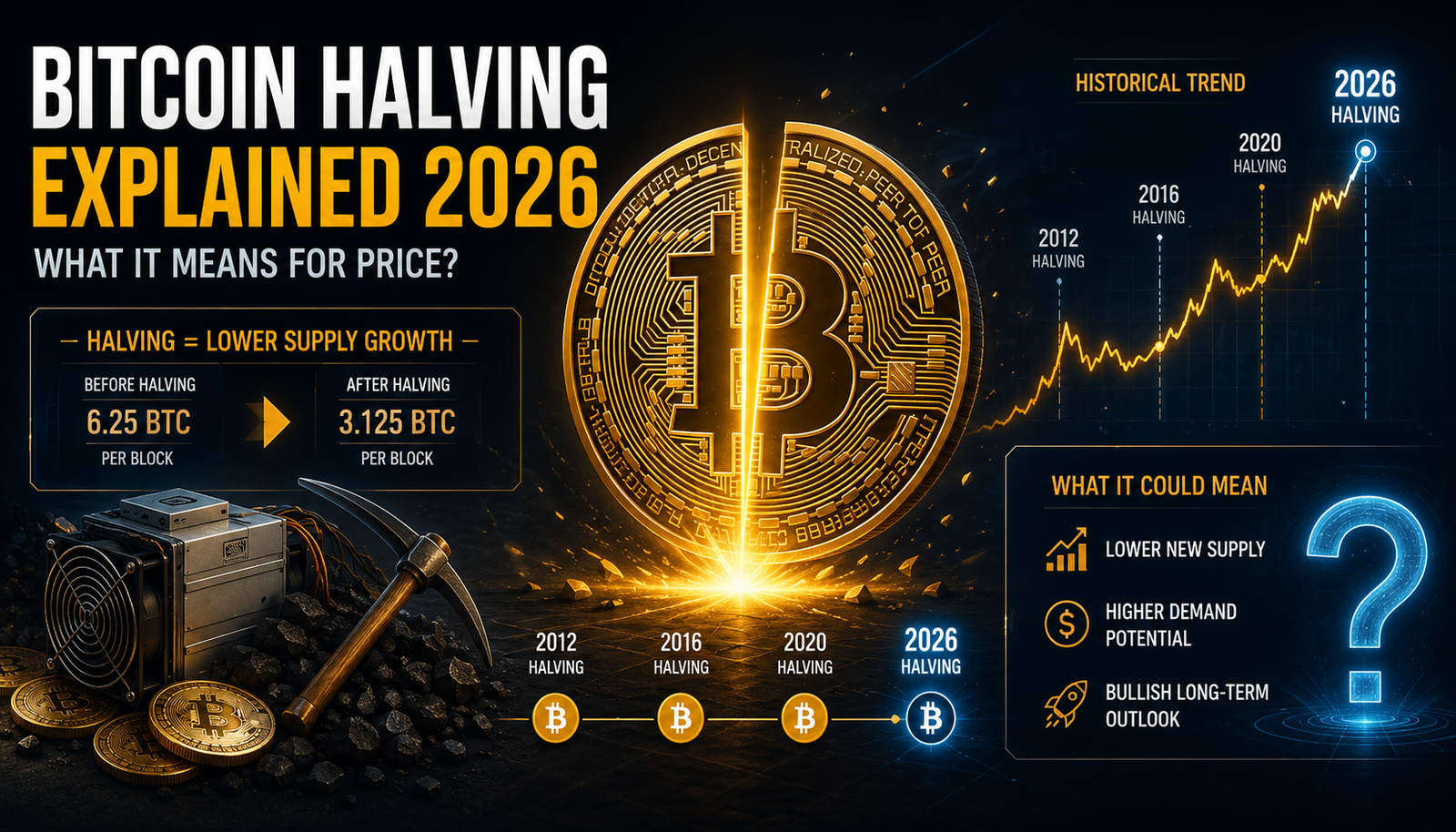
Discover our comprehensive bitcoin halving explained 2026 guide. Learn how this supply-cut event impacts BTC’s scarcity, historical price patterns, miner economics, and what it actually means for the market in 2026.
The world of cryptocurrency moves at a breakneck pace, yet its most fundamental economic engine is governed by a strict mathematical countdown written into its code over fifteen years ago. If you want to understand why Bitcoin behaves the way it does, you must understand the “Halving.”
In this comprehensive guide, we will dive deep into a complete bitcoin halving explained 2026 analysis to help you understand how these supply-side shocks alter the global financial landscape. We will strip away the complex jargon, look back at history, examine the current post-2024 halving environment, and explore what all of this actually means for Bitcoin’s price and ecosystem in 2026.
1. What Is Bitcoin Halving Explained 2026? A Simple, Everyday Explanation
To embark on our journey of understanding the comprehensive bitcoin halving explained 2026 framework, we must first establish a crystal-clear, rock-solid definition of what this event actually is. While the cryptocurrency space is often filled with complex financial jargon, cryptographic proofs, and dense software engineering terms, the fundamental core of a Bitcoin halving is elegant, straightforward, and deeply rooted in classic economic theory.
The Core Concept: What is Halving?
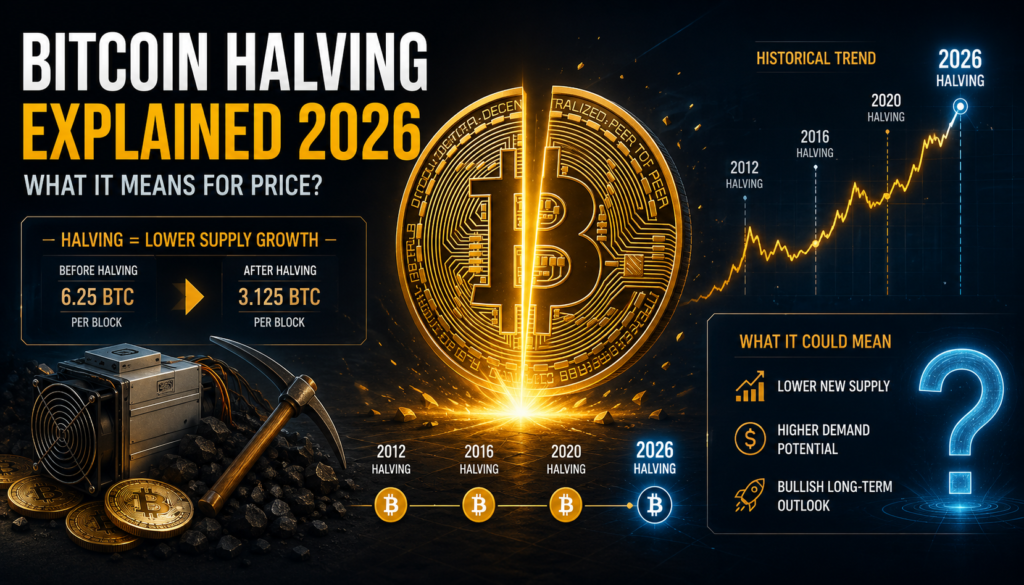
At its absolute heart, a Bitcoin halving (sometimes referred to in crypto circles as “the halvening”) is a pre-programmed, automated event that cuts the rate at which newly minted Bitcoins are introduced into circulation by exactly 50%. This is not a decision made by a board of directors, a central bank, or a government decree. Instead, it is an immutable, mathematical law written directly into the genesis block of Bitcoin’s open-source code by its mysterious creator, Satoshi Nakamoto, back in 2009.
This supply-slashing event occurs automatically every time the network processes exactly 210,000 blocks of transactions. Because it takes the global network of computers approximately 10 minutes to verify and add a single block to the public ledger (the blockchain), these 210,000-block milestones are reached roughly once every four years.
To fully grasp this, it helps to understand the foundational mechanics of the underlying asset itself. If you are completely new to this space, you can read our detailed, easy-to-digest foundational guides on What Is Cryptocurrency 2026 and What Is Bitcoin 2026 to get up to speed on the broader ecosystem before diving deeper.
In simple terms, traditional money like the US Dollar, the Euro, or the Vietnamese Dong relies entirely on central banks. If a government or a central banking system decides the economy needs more liquidity, they can print more currency. While this can provide short-term economic relief, it inevitably dilutes the value of the existing money in your bank account—a process we all know as inflation.
Bitcoin, however, operates on a completely decentralized, trustless architecture. It does not rely on a central authority to issue new currency. Instead, transactions are constantly broadcast to a global, peer-to-peer network where they are grouped into “blocks” and verified by specialized high-performance computers. This verification process is known as “mining”, and the individuals or entities running these computational powerhouses are called “miners.”
Miners are not doing this work out of charity. It requires immense amounts of electrical energy, expensive hardware, and continuous maintenance. To incentivize them to secure the network and validate transactions, the Bitcoin protocol rewards the first miner who successfully solves a complex mathematical puzzle with a batch of brand-new, freshly minted Bitcoins. This reward is technically referred to as the “block reward.”
When a halving event occurs, this block reward is sliced clean down the middle. Consequently, the rate of inflation for new coins entering the open market instantly drops by 50%, altering the supply landscape overnight.
A Real-World Analogy: The Magical Gold Mine
Because blockchain technology can feel abstract, let’s bring this concept down to earth using a physical, real-world analogy: The Magical Gold Mine.
[Phase 1: Early Years]
  Mining Effort: 100% ────► Output: 100 Ounces/Day ────► Stable Market Price

[Phase 2: The Halving Trigger]
  Mining Effort: 100% ────► Output: 50 Ounces/Day  ────► Scarcity Squeeze
                                                        (Same demand, half the supply)
Imagine a highly productive, magical gold mine that supplies a significant portion of the world’s precious metal. For the first four years of its operation, this mine yields exactly 100 ounces of pure gold every single day. Jewelers use it for rings, investors buy it to hedge against inflation, and central banks store it in vaults. Based on this steady, predictable inflow of 100 ounces of new gold per day, the global market establishes a stable, balanced price floor.
Suddenly, a physical law of nature kicks in. On a specific, predetermined day, the mine’s daily output is permanently, unalterably cut to 50 ounces per day.
Consider the operational dynamics of this scenario:
-
The Labor: The miners must still wake up at the same time, sweat just as hard, and run their heavy machinery for the exact same number of hours.
-
The Energy: The mine consumes the same amount of fuel and electricity to keep the tunnels lit and the drills running.
-
The Demand: The global desire for gold—from tech manufacturers, jewelry designers, and wealth managers—remains completely unchanged, or perhaps even increases due to growing population and wealth.
With half as much new gold entering the market daily, what happens next? Simple, grade-school economics of supply and demand dictates that the structural scarcity of the asset sky-rockets. If global buyers still want to acquire 100 ounces of new gold a day, but the mine is only producing 50 ounces, buyers will begin to outbid one another to secure their share of the dwindling supply. This competition places intense, upward pressure on the asset’s overall market value.
This elegant, highly predictable scarcity model is precisely why many prominent financial analysts, institutions, and everyday investors refer to Bitcoin as “digital gold.” The core bitcoin halving explained 2026 thesis relies heavily on this fundamental, unyielding relationship between programmed supply reduction and persistent market demand. It is a monetary policy written in math, completely immune to human greed, political influence, or economic mismanagement.
2. Why Does the Halving Occur? Satoshi’s Scarcity Design
To truly appreciate the bitcoin halving explained 2026 dynamics, we must look back at the philosophical and technical origins of Bitcoin.
When the pseudonymous creator Satoshi Nakamoto released the Bitcoin whitepaper, they aimed to solve a critical flaw inherent in fiat currencies (like the US Dollar, Euro, or Vietnamese Dong): inflation.
Standard Fiat Currency: Unlimited Supply ──> Central Bank Printing ──> Inflation & Loss of Purchasing Power

Bitcoin Economy: Hard Cap (21,000,000) ──> Halving Every 4 Years ──> Deflationary Scarcity
The 21 Million Hard Cap
Unlike traditional currencies, which central banks can print in infinite quantities, Bitcoin has a hard coded, immutable supply limit: 21 million BTC. There will never, under any circumstances, be more than 21,000,000 Bitcoins in existence.
At the time of writing in 2026, over 19.7 million Bitcoins have already been mined and are circulating. The halving mechanism is the brilliant monetary policy design that controls the distribution of the remaining supply.
Why Didn’t Satoshi Just Release All 21 Million at Once?
If all 21 million Bitcoins had been released on day one in 2009, several problems would have emerged:
-
No Incentive for Network Security: Miners would have had no newly minted coins to earn, leaving them with only transaction fees. In the early days, transaction volume was too low to sustain a secure, global network of miners.
-
Hyper-inflationary Launch: Dumping 21 million units of an unproven asset onto a tiny market would have driven its value to zero, preventing it from ever establishing a stable price floor.
-
Uneven Distribution: A tiny group of early adopters would have held the entire supply, destroying the decentralized, global vision of the network.
By spacing out the distribution over roughly 130 years via four-year halvings, Satoshi created a predictable, deflationary schedule. This brings us to why studying a bitcoin halving explained 2026 perspective is vital: it shows us how Bitcoin transitions from a highly inflationary young asset to an ultra-scarce global reserve asset.
3. The Historical Blueprint: Exploring Past Halvings (2012–2024)
History doesn’t always repeat itself, but in financial markets, it often rhymes. To evaluate the market in 2026, we must look at the historical data points of the previous four halvings.
| Halving Event | Date | Block Reward (Pre -> Post) | BTC Price on Halving Day | Peak Price of the Cycle | Time to Peak (Approx.) |
| 1st Halving | Nov 28, 2012 | $50 \rightarrow 25$ BTC | ~$12.35 | ~$1,150 | 12 Months |
| 2nd Halving | July 9, 2016 | $25 \rightarrow 12.5$ BTC | ~$650 | ~$19,600 | 17 Months |
| 3rd Halving | May 11, 2020 | $12.5 \rightarrow 6.25$ BTC | ~$8,820 | ~$69,000 | 18 Months |
| 4th Halving | April 20, 2024 | $6.25 \rightarrow 3.125$ BTC | ~$63,900 | See analysis below | Variable |
The First Halving (2012)
The inaugural halving cut the block reward from 50 to 25 BTC. At this point, Bitcoin was largely an underground experiment, unknown to the broader public. The asset was highly volatile, but the supply shock triggered a massive bull run that took Bitcoin from a modest $12.35 to a staggering peak of around $1,150 a year later.
The Second Halving (2016)
By 2016, retail interest was beginning to awaken. The reward dropped from 25 to 12.5 BTC. Following the halving, a sustained upward march began, culminating in the historic December 2017 bull market where Bitcoin approached $20,000 for the first time, establishing itself as a global phenomenon.
The Third Halving (2020)
Occurring during the peak of the global pandemic and macro-economic uncertainty, the 2020 halving saw the reward drop to 6.25 BTC. Driven by unprecedented institutional interest, low interest rates, and the halving’s supply pressure, Bitcoin climbed from roughly $8,800 on halving day to an all-time high of nearly $69,000 in late 2021.
The Fourth Halving (2024)
The fourth halving took place on April 20, 2024, cutting the reward from 6.25 to 3.125 BTC. This halving was structurally unique because, for the first time, Bitcoin reached a new all-time high before the halving occurred, largely fueled by the launch of Spot Bitcoin ETFs in the United States.
Evaluating the aftermath of the 2024 event is essential to understand our bitcoin halving explained 2026 current reality, as the multi-year macro effects of that supply cut are actively playing out in the current 2026 market.
4. The 2024 Halving Aftermath: How It Shapes the Market in 2026
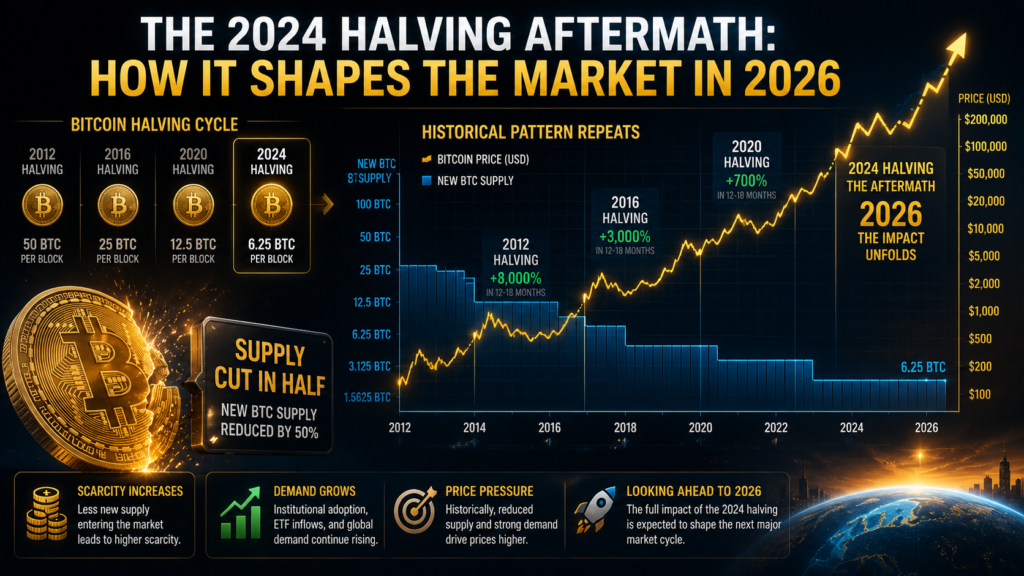
We are currently living in 2026, roughly two years removed from the landmark April 2024 halving event. For seasoned market participants and newcomers alike, analyzing the delayed, multi-year ripple effects of this specific supply cut is absolutely crucial to any robust bitcoin halving explained 2026 analysis.
To understand why the market behaves the way it does today, we must look past the initial media hype of 2024 and examine the quiet, relentless structural shift that has occurred behind the scenes over the last 24 months.
The Delayed Impact Phenomenon: Why Patience is Key in Crypto
One of the most common pitfalls for retail investors is the expectation of immediate gratification. Many newcomers enter the space believing that the very second the halving block is mined, a giant green candle will shoot up on the price charts, sending Bitcoin to the moon overnight.
Historically, this has never happened, and for a very good reason. The halving is not a sudden demand-driven pump; it is a slow-burn, systemic supply squeeze.
[Day of Halving] ────────────────► No immediate price change (Market has inventory)
       │
       ▼
[3 - 6 Months Post-Halving] ─────► Exchange reserves begin to trend downward
       │
       ▼
[12 - 18 Months Post-Halving] ───► Cumulative deficit forces buyers to bid higher
       │
       ▼
[24 Months Post-Halving (2026)] ─► Market reaches mature equilibrium / price discovery
When the halving occurs, exchanges, over-the-counter (OTC) desks, and large-scale market makers still hold significant liquid reserves of Bitcoin. They have inventory to sell to meet daily demand. Because of this buffer, the immediate physical shortage is not felt on day one, or even in week one.
However, as the weeks turn into months, the daily reduction in newly minted coins quietly eats away at these liquid reserves. The “sell-side liquidity” begins to dry up. When global demand eventually collides with this hollowed-out supply chain, the price is forced to adjust upward to find new sellers. By 2026, we are no longer dealing with anticipation; we are dealing with the physical reality of a dry supply pipeline.
The Compounding Supply Deficit: Breaking Down the Numbers
To put the magnitude of this supply squeeze into perspective, let’s look at the math. When the 2024 halving occurred, the daily issuance of new Bitcoin dropped from approximately 900 BTC per day to just 450 BTC per day.
On any single day, a difference of 450 BTC might seem like a drop in the ocean of global financial markets. However, the true power of the halving lies in its relentless compounding effect.
| Time Elapsed Post-2024 Halving | Reduction in New Supply (BTC) | Cumulative Market Deficit (Approximate Value at $60k/BTC) |
| 1 Day | 450 BTC | $27,000,000 |
| 1 Week | 3,150 BTC | $189,000,000 |
| 1 Month | 13,500 BTC | $810,000,000 |
| 1 Year (2025) | 164,250 BTC | $9,855,000,000 |
| 2 Years (Current 2026) | 328,500 BTC | $19,710,000,000 |
By 2026, the global market has had to absorb a staggering deficit of over 328,000 Bitcoins that would have otherwise been minted and sold by miners to pay for their operational expenses. This massive cumulative supply vacuum has now fully permeated the global liquidity pool. The cushion of excess exchange reserves has been stripped away, leaving the market highly sensitive to any sudden influx of buying pressure.
The Institutional Demand Multiplier: A Perfect Storm in 2026
What makes the post-2024 era uniquely different from any previous cycle in Bitcoin’s history is the nature of the demand. In earlier cycles (2012, 2016, and even 2020), the demand side was heavily dominated by retail speculation, offshore exchanges, and highly volatile trading narratives.
Today in 2026, the supply-side shock is interacting with a highly sophisticated, institutionalized demand engine:
-
Spot Bitcoin ETFs: The introduction of Spot Bitcoin ETFs in major global markets has created a permanent, regulated gateway for pension funds, wealth managers, and retail brokerage accounts to allocate capital directly to Bitcoin. These institutional vehicles operate on a continuous buying schedule, systematically absorbing coins from the market.
-
Corporate Balance Sheets: Following the lead of pioneering tech companies, a growing number of corporate treasuries now allocate a portion of their cash reserves to Bitcoin as a hedge against fiat debasement.
-
Sovereign and State Interest: The conversation around Bitcoin has officially reached the governmental level, with various jurisdictions exploring Bitcoin as a strategic reserve asset.
When you cross-reference this unprecedented institutional demand with a daily mining output that was cut in half two years ago, you get a structural supply-demand mismatch. This dynamic is a core pillar of our bitcoin halving explained 2026 macro thesis: never before has so much capital chased so few newly minted coins.
Where We Stand in 2026: Navigating the Market Phase
As we evaluate the market today, the year 2026 represents the mature, late-stage phase of the post-2024 halving cycle.
Historically, the four-year Bitcoin cycle follows a fairly consistent psychological pattern. The first year post-halving is typically characterized by explosive price discovery and parabolic bull runs as the supply shock is felt. The second year post-halving—which is where we find ourselves in 2026—is historically a transition period.
The 2026 Market Reality: Having absorbed both the manic highs of the post-halving run and the subsequent cooling-off periods, the market in 2026 is finding its structural equilibrium. It is a period characterized by intense consolidation, deep liquidity rotations, and strategic accumulation.
Understanding this phase is vital for managing risk. Depending on broader macroeconomic factors—such as inflation data, global interest rates, and regulatory updates—the market in 2026 is actively navigating the delicate transition between a Bull vs Bear Market cycle. For long-term investors, this phase is often viewed not as a time for reckless speculation, but as a critical window to analyze network health, miner stability, and on-chain accumulation patterns before the next supply-cut cycle begins to loom on the horizon.
5. Why the Halving Does Not Automatically Guarantee a Price Surge
One of the most important lessons in our bitcoin halving explained 2026 guide is to debunk the myth of guaranteed price appreciation. A reduction in supply is only one-half of the economic equation.
If supply is cut in half, but demand simultaneously drops by 80%, the price of the asset will fall, regardless of how scarce it is. The halving is not a magic wand; its success depends entirely on the world continuing to demand and adopt Bitcoin as a store of value.
Factors that Counteract the Halving Effect
-
The “Priced In” Theory: Efficient market theorists argue that because the halving schedule is public knowledge and written into open-source code, the market has already factored these future supply cuts into the current price years in advance.
-
Macroeconomic Liquidity: Bitcoin does not exist in a vacuum. It is deeply connected to global liquidity, interest rates set by central banks (like the Federal Reserve), and geopolitical stability. If global liquidity shrinks, speculative and risk-on assets like crypto face headwinds, regardless of a halving.
-
Regulatory Changes: Sudden regulatory crackdowns on digital assets can temporarily suppress demand, overriding the positive supply dynamics of the halving.
Therefore, when studying the bitcoin halving explained 2026 landscape, you must look at both sides of the scale. Scarcity is a powerful catalyst, but global adoption, regulatory clarity, and macroeconomic health are the engines that drive sustainable demand.
6. The Behind-the-Scenes Engine: Miner Economics Post-2024
We cannot talk about a bitcoin halving explained 2026 overview without looking at the backbone of the entire network: the miners.
When the block reward was cut to 3.125 BTC in 2024, miners saw their primary source of revenue cut in half overnight. Yet, their operational costs—such as electricity, warehouse rent, and hardware maintenance—remained exactly the same or even increased.
[Post-Halving Miner Squeeze]
      │
      ├─► Revenue: Cut by 50% (3.125 BTC per block)
      ├─► Costs: Electricity & Hardware remain high/fixed
      │
      ▼
[The Great Filtering]
      │
      ├─► Weak/Inefficient Miners ──► Shut down operations (Sell off reserves)
      └─► Strong/Efficient Miners ──► Upgraded ASICs, cheap power ──► Retain market share
The “Great Filtering” of Miners
This sudden reduction in revenue creates what is known in the industry as a miner shakeout.
-
Inefficient Miners: Those operating with older, less efficient hardware or paying high electricity rates find themselves mining at a loss. To survive, they are forced to shut down their machines and sell off their accumulated Bitcoin reserves to cover expenses, creating temporary market selling pressure.
-
Efficient Miners: Highly capitalized, industrial-scale mining operations that have secured ultra-low-cost renewable energy and pre-ordered next-generation ASIC (Application-Specific Integrated Circuit) chips survive and thrive. They capture the hash rate left behind by departing competitors.
Hash Rate and Network Difficulty Adjustment
You might wonder: if miners shut off their machines, will the Bitcoin network slow down or stop working?
No. Satoshi Nakamoto elegantly accounted for this through the Difficulty Adjustment. Every 2,016 blocks (roughly every two weeks), the Bitcoin network evaluates how fast blocks are being mined. If many miners have shut down and blocks are being processed too slowly, the network automatically lowers the computational difficulty. This makes mining easier and more profitable for the remaining participants, ensuring the network remains secure and operational.
By 2026, the mining sector has fully completed this post-2024 filtering process, leading to a leaner, more energy-efficient, and highly resilient mining ecosystem.
7. Looking Ahead: When Is the Next Halving?
As we look at the bitcoin halving explained 2026 macro picture, we must also look forward to the horizon.
Because blocks are mined roughly every 10 minutes, we can calculate the approximate timeline for the next supply-cut events. The fifth Bitcoin halving is estimated to occur in early 2028 (at block 1,050,000). At that moment, the block reward will drop from 3.125 BTC to 1.5625 BTC.
  2024 Halving           2026 (Now)           2028 Halving
(3.125 BTC/block)  ──► [Market Maturity] ──► (1.5625 BTC/block)
As the nominal emission rate of new Bitcoin continues to drop lower with each cycle, the inflation rate of Bitcoin becomes significantly lower than that of gold and almost all fiat currencies. This structural certainty is what keeps long-term accumulators focused on the multi-cycle horizon, viewing the current 2026 market as a key bridge between supply epochs.
8. Frequently Asked Questions (FAQ)
What is the exact date of the 2024 halving?
The fourth Bitcoin halving took place on April 20, 2024 at Block 840,000.
What did the block reward change to in the 2024 halving?
The block reward was cut from 6.25 Bitcoins per block to 3.125 Bitcoins per block.
Will there ever be a 21,000,001st Bitcoin?
No. The 21 million supply limit is hardcoded into the Bitcoin protocol’s rules. Changing this limit would require a hard fork consensus of almost all nodes, miners, and users worldwide—an event that is virtually impossible given the economic self-interest of network participants to preserve scarcity.
What happens when all 21 million Bitcoins are mined?
It is estimated that the last fraction of a Bitcoin will be mined around the year 2140. After this point, no new Bitcoins will be created. Miners will be compensated solely through transaction fees paid by users to have their transactions included in blocks.
Where can I track the live countdown to the next halving?
You can monitor the live estimation on the CoinMarketCap Bitcoin halving countdown or directly via decentralized node trackers on Bitcoin.org.
Summary and Key Takeaways
Understanding a comprehensive bitcoin halving explained 2026 analysis is vital for anyone navigating the digital asset space. Let’s review the key concepts:
-
Scarcity by Design: The halving is a programmed event occurring every four years that slashes new Bitcoin supply by 50%, maintaining its absolute limit of 21 million coins.
-
Delayed Impact: Halvings do not immediately pump the price on day one. Instead, they trigger a cumulative supply deficit that historically shows its full impact in the years following the event, including 2026.
-
No Guarantees: Price action is determined by both supply and demand. Scarcity alone is not enough; sustained adoption and favorable global liquidity are crucial for price growth.
-
System Resilience: The network’s built-in difficulty adjustment ensures that even when miners face economic pressure, the security and stability of the blockchain remain perfectly intact.
The four-year halving cycle remains one of the most fascinating experiments in economic history—a predictable, mathematical clock ticking forward in a world of unpredictable financial policies.
Disclaimer: The information provided in this article is for educational and informational purposes only. It does not constitute financial, investment, or legal advice. Cryptocurrency investments are highly volatile and carry a high degree of risk. You should conduct your own research or consult with a licensed financial advisor before making any investment decisions. Past performance of Bitcoin’s price cycles is not indicative of future results.