Have you ever sat at a dinner table while everyone talked about their “portfolio,” feeling like you missed a memo written in a secret language? You’re not alone. Understanding what is bitcoin 2026 doesn’t require a degree in computer science — and that’s exactly what this guide is here to fix. For over a decade, Bitcoin has transitioned from a niche experiment for tech geeks into a global financial powerhouse. Yet, despite being a household name, if you ask ten people to explain how it actually works, you’ll likely get ten very confused answers involving “mining” or “clouds.”
At its core, Bitcoin is just a way to send value to anyone in the world without needing a bank to say “okay.” It is the first time in history we have a form of money that is purely digital, globally accessible, and owned by no one. In practice, it functions much like “digital gold” — something that is scarce, durable, and increasingly used as a hedge against the rising costs of traditional living. By the end of this guide, you’ll understand the “why” behind the hype, the “how” behind the tech, and the very real risks you should consider before jumping in.
What is Bitcoin? The Simplest Explanation
If we strip away all the complex jargon, Bitcoin is a digital currency. Unlike the dollars or euros in your bank account — which are managed by a central authority — Bitcoin exists on a decentralized network of computers. Think of it as “cash for the internet.”
When you send a physical $20 bill to a friend, you don’t need a middleman. You hand it over, and the transaction is done. Before Bitcoin, doing this digitally was impossible. You always needed a bank, PayPal, or a credit card company to verify that you actually had the money and to move it to the other person’s account.
Bitcoin changed that. It’s a system that allows two people to exchange value directly, anywhere in the world, 24/7, without a central bank. In 2026, Bitcoin has matured into a mainstream asset class, with a total market cap of approximately $1.5 trillion, proving it’s far more than just a passing trend. It is a borderless, permissionless way to store and move wealth.
I remember the first time I bought Bitcoin on Bybit back in 2021. I kept refreshing the screen thinking I’d done something wrong — sending money into thin air felt completely insane. But that was the point: it worked, and no bank was involved.
The Origin Story: Why Satoshi Created Bitcoin in 2009
To understand Bitcoin, you have to understand the problem it was designed to solve. In 2008, the world was in the grip of a massive financial crisis. Banks were failing, and governments were printing billions of dollars to bail them out. This highlighted a fundamental flaw: our entire financial system relies on “trusting” third parties — banks to hold our money and governments to not devalue it.
On January 3, 2009, an anonymous person (or group) named Satoshi Nakamoto released the Bitcoin software. Satoshi’s goal was simple but revolutionary: create a financial system that doesn’t require a “trusted” intermediary.
The first Bitcoin block, known as the “Genesis Block,” contained a hidden message referencing a UK newspaper headline about bank bailouts. This wasn’t a coincidence. Bitcoin was built to be a transparent alternative to the traditional banking system — where no single entity could freeze your account or print more money to solve a debt crisis.
Who is Satoshi? We still don’t know. They disappeared in 2011, leaving the network in the hands of the community — making Bitcoin the only truly leaderless financial system in existence. For a deeper look at Bitcoin’s history, CoinMarketCap’s Bitcoin overview is a solid starting point.
How Bitcoin Works: Think of it Like a Shared Notebook
What most beginners don’t realize is that Bitcoin isn’t actually a “coin” or a “file” on your computer. Instead, it’s a record on a massive, shared digital notebook called a Blockchain.
Imagine a group of 10 friends. They decide to stop using cash and instead use a notebook to track who owes what.
- If Alice gives Bob $5, the group writes it down: “Alice → Bob: $5.”
- Everyone in the group has a copy of this notebook.
- If Alice tries to spend $10 she doesn’t have, the group checks their notebooks, sees she only has $5, and rejects the transaction.
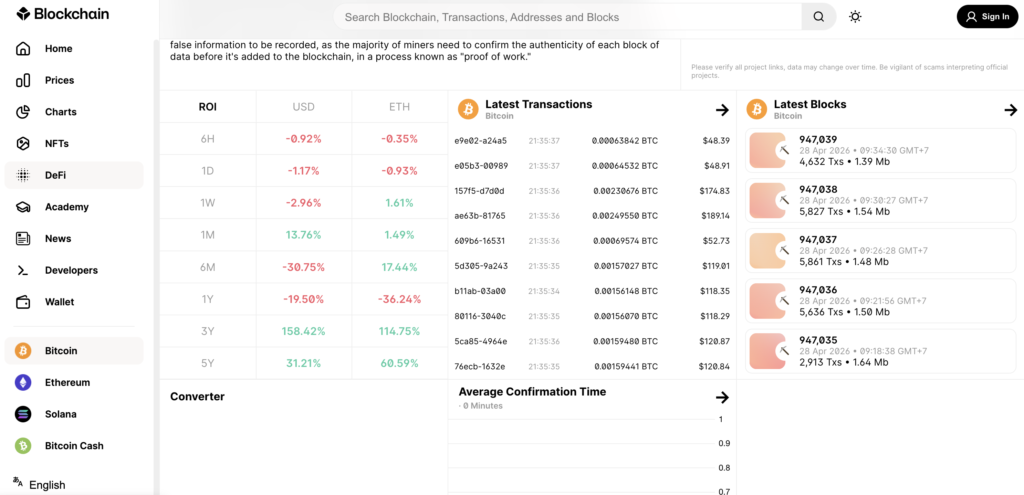
In the Bitcoin world, the “friends” are thousands of computers (called nodes) spread across the globe. The “notebook” is the blockchain.
When a transaction happens, it is broadcast to the network. “Miners” — powerful computers — compete to solve complex math puzzles to verify these transactions. Once verified, the transaction is bundled into a “block” and added to the “chain.” This is why it’s called a blockchain. Because everyone has a copy of the ledger, it is nearly impossible to cheat. To change a past transaction, you would have to hack more than half of the computers in the network simultaneously — practically impossible and prohibitively expensive.
Bitcoin vs. Fiat Money: What Makes it Different?
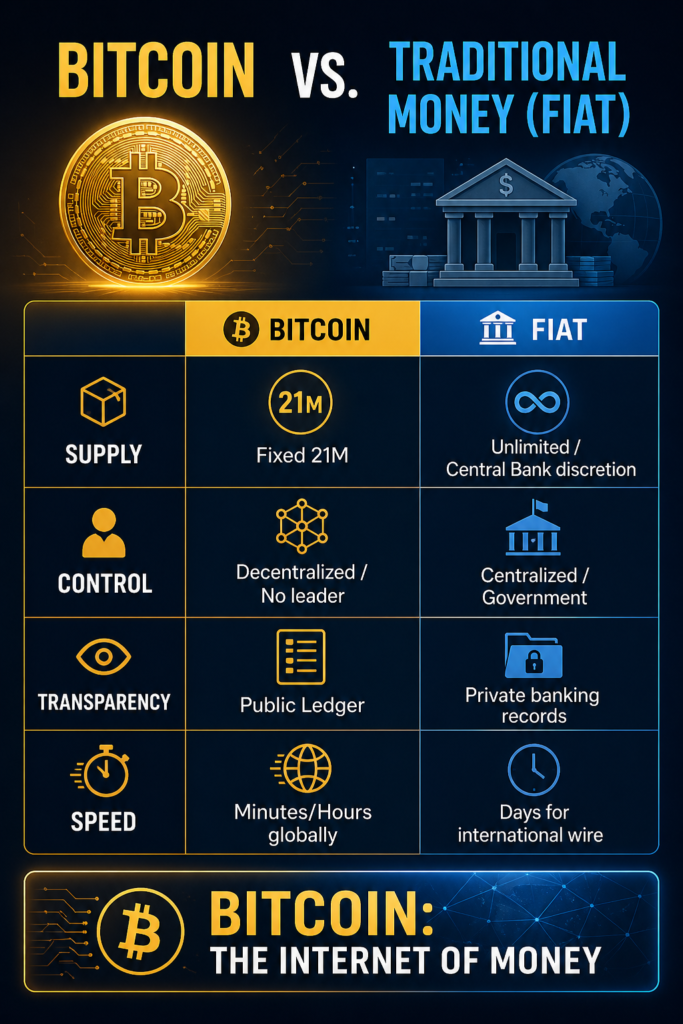
In 2026, the contrast between Bitcoin and “fiat” money (like USD, EUR, or VND) has never been clearer. Here are the three primary differences that define what is bitcoin 2026:
- Decentralization: Traditional money is controlled by central banks. They can decide to lower interest rates or print more money. Bitcoin has no CEO. It is governed by code that no one person can change.
- Fixed Supply: This is the big one. Governments can print an infinite amount of money, which leads to inflation (your money buying less over time). Bitcoin is hard-coded to have a maximum supply of 21 million BTC. As of April 2026, roughly 19.85 million Bitcoins have already been mined. This scarcity is a major reason why people call it “Digital Gold.”
- Transparency: While bank records are private and often opaque, every single Bitcoin transaction ever made is visible on a public ledger. You might not know who owns a specific wallet, but you can see exactly how much is in it and where the money is moving.
Why Does Bitcoin Have Value in 2026?
A common question is: “If I can’t touch it, why is it worth thousands of dollars?” Value is a social construct. A $100 bill only has value because we all agree it does and the government backs it.
Bitcoin has value for several practical reasons:
- Scarcity: There will never be more than 21 million. In a world of infinite money printing, something that is finite becomes very attractive.
- Portability: You can carry $1 billion worth of Bitcoin on a USB stick or a 12-word seed phrase in your head. Try doing that with gold or stacks of cash.
- Divisibility: You don’t have to buy a whole Bitcoin (which costs around $76,000 as of April 2026). You can buy a tiny fraction called a “Satoshi.” One Bitcoin is divisible into 100 million Satoshis.
- Censorship Resistance: No government can “turn off” your Bitcoin wallet or prevent you from sending it to someone else — provided you hold your own private keys.
As more institutions and individuals adopt it, the “network effect” grows. The more people use it, the more valuable it becomes. In 2026, over 169 publicly traded companies now hold Bitcoin on their balance sheets as a reserve asset — including Strategy Inc. (818,000+ BTC) and Tesla (11,500+ BTC). For a full list, see Bitcoin Treasuries.
![bitcoin market cap and price April 2026 — CoinMarketCap]](https://ocbcrypto.com/wp-content/uploads/2026/04/Anh-man-hinh-2026-04-28-luc-21.42.55-1024x432.png)
The Risks: What You Need to Know Before Buying
⚠️ Risk Warning: Bitcoin and other cryptocurrencies are highly volatile assets. Their value can drop significantly in a short period. Never invest more than you can afford to lose. Past performance is not indicative of future results. This article is for educational purposes only and does not constitute financial advice.
We wouldn’t be doing you any favors if we only talked about the upside. Investing in Bitcoin is not a guaranteed “get rich quick” scheme. In fact, it can be a serious rollercoaster.
- Volatility: Bitcoin’s price can swing 10–20% in a single day. During the 2022 bear market, Bitcoin fell from nearly $70,000 to under $16,000 within months. If you have a low tolerance for seeing your investment drop dramatically, this can be very stressful.
- Security: With great power comes great responsibility. If you lose your “private keys” (the password to your wallet) or send Bitcoin to the wrong address, your money is gone forever. There is no “Forgot Password” button and no bank manager to call.
- Regulation: While many countries have established frameworks for Bitcoin, laws vary widely. Sudden regulatory shifts can impact the price and how you are allowed to sell your coins.
- Market Risk: Like any asset, Bitcoin’s price is determined by supply and demand. If global interest fades or a superior technology emerges, the price could drop significantly.
💡 Pro Tip: Never store large amounts of Bitcoin on an exchange. Move your coins to a hardware wallet like Ledger or Trezor for full ownership and security.
How to Get Started: Where to Buy Bitcoin Safely
If you’ve weighed the risks and want to try it out, getting started is much easier in 2026 than it was five years ago. Most beginners start with a “Centralized Exchange” (CEX) — platforms that work a bit like a stock brokerage or a banking app. You create an account, verify your identity (KYC), deposit your local currency, and click “Buy.”
The most popular and trusted platforms currently include:
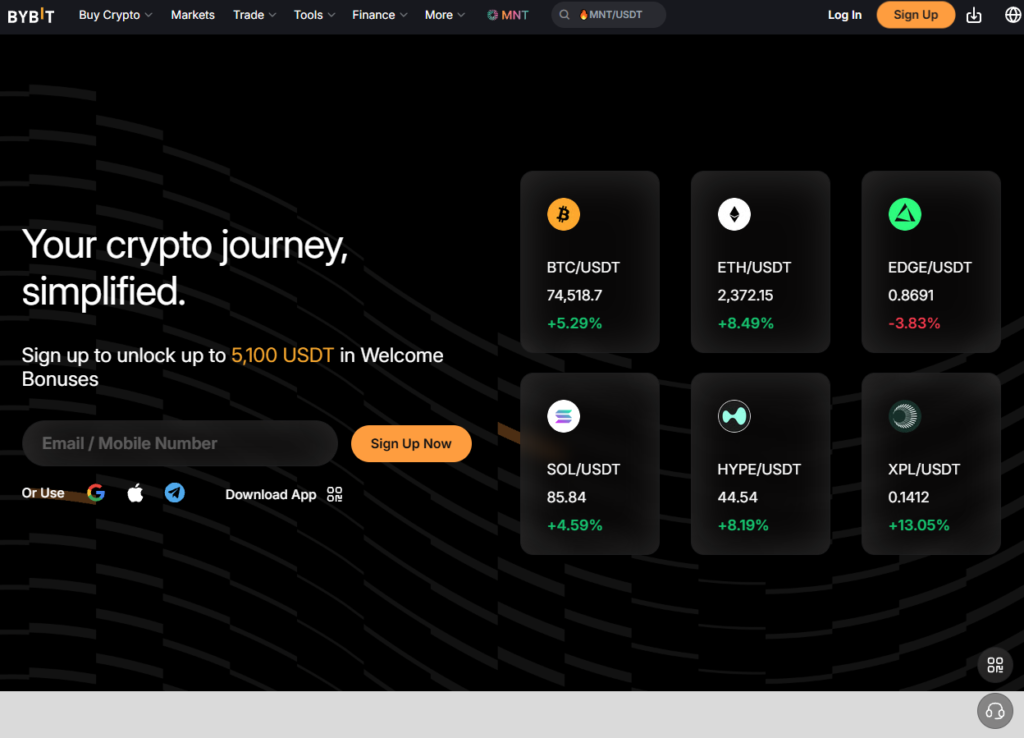
- Bybit: Excellent user interface, very beginner-friendly, and strong security. 👉 Sign up on Bybit
- Binance: Great for variety and some of the lowest trading fees available. 👉 Sign up on Binance
- Coinbase: Highly regulated and simple for those in the US/Europe.
Once you buy your Bitcoin, you have a choice: leave it on the exchange (convenient but less secure) or move it to a “Cold Wallet” — a hardware device that keeps your Bitcoin completely offline and under your total control.
Ready to take the next step? Check out our detailed guide on the Best Crypto Exchanges for Beginners 2026 to compare platforms side by side.
Also see: Bybit Review 2026 | Binance Review 2026
Frequently Asked Questions
Is Bitcoin legal in 2026?
In most parts of the world, yes. Countries like the US, UK, and most of Europe have established frameworks for Bitcoin. Note that El Salvador, which was historically the first country to adopt Bitcoin as legal tender in 2021, removed that mandatory status in early 2025 under IMF pressure — Bitcoin remains legal to use there, but acceptance is now voluntary. Always check your local laws before investing.
Can Bitcoin be hacked?
The Bitcoin network itself has never been hacked — it is protected by an enormous amount of computing power. However, individual exchanges or personal wallets can be compromised if they aren’t secured properly. This is why using 2FA (Two-Factor Authentication) and a hardware wallet for large holdings is non-negotiable.
What happens when all 21 million Bitcoins are mined?
This won’t happen until roughly the year 2140. When it does, miners will no longer receive new Bitcoins as a block reward. Instead, they will be compensated entirely through transaction fees paid by users. The network is designed to remain self-sustaining long after the last Bitcoin is created.
Is it too late to buy Bitcoin in 2026?
While you missed the $10 Bitcoin era, many analysts believe Bitcoin is still in the early stages of global adoption. The safest approach for beginners is Dollar-Cost Averaging (DCA) — investing a fixed amount every month regardless of price. This removes the stress of trying to “time the market” and reduces the impact of volatility over time.
Final Thoughts
Bitcoin is more than just a ticker symbol on a screen — it’s a shift in how humanity thinks about value. It’s the “Internet of Money”: a system that is open to everyone, regardless of where you were born or how much money you have. While the technology can seem daunting, the core concept is simple: a limited supply of digital gold that you, and only you, control.
If you’re feeling overwhelmed, don’t worry. The best way to learn is by doing. Start small, read a lot, and never invest more than you are willing to lose.
💬 Join Our Community Have more questions? Hop into our Telegram Community to chat with other learners and get real-time updates on crypto news and opportunities. We’d love to have you there!
📖 Keep Learning: Not sure about the difference between Bitcoin and other coins? Read our guide on What Is Cryptocurrency 2026.
Disclaimer: This article is for educational purposes only and does not constitute financial advice. Cryptocurrency investments carry significant risk, including the possible loss of principal. Always conduct your own research (DYOR) and consult a qualified financial advisor before making any investment decisions.