The digital asset ecosystem in the Kingdom of Saudi Arabia (KSA) has evolved rapidly entering 2026. Driven by Vision 2030’s overarching goal to digitize financial services and advance modern fintech solutions, thousands of retail and institutional traders in Riyadh, Jeddah, and across the Kingdom actively engage in cryptocurrency trading.
However, navigating the crypto landscape in Saudi Arabia requires clear insight into local regulations, payment rails, security assurances, and asset accessibility. Choosing the best crypto exchange in saudi arabia 2026 depends heavily on how smoothly you can fund your account with Saudi Riyals (SAR), access deep trading liquidity, and navigate local regulatory frameworks safely.
In this comprehensive guide, we review the top platforms for Saudi Arabian traders, outline practical SAR deposit and withdrawal mechanisms, and clarify the current stance of Saudi financial regulators.
Overview of the Saudi Arabia Crypto Market in 2026

Saudi Arabia represents one of the largest financial markets in the Middle East and North Africa (MENA) region. Crypto adoption across the Kingdom is fueled by a tech-savvy demographic, robust digital infrastructure, and a high mobile-first payment usage rate.
Key market characteristics in 2026 include:
-
High Liquidity & Active P2P Trading: Because direct fiat bank rails from local institutions to offshore exchanges remain restricted, peer-to-peer (P2P) trading using native banking apps (Al Rajhi Bank, SNB, Alinma) and digital wallets (stc pay, urpay) is the primary method for fiat funding.
-
Strong Appetite for Spot, Derivatives, and Web3: Local traders range from spot investors seeking major assets like Bitcoin (BTC) and Ethereum (ETH) to advanced traders seeking high-volume futures, copy trading, and decentralized finance (DeFi) Web3 ecosystems.
-
Demand for Shariah-Compliant Solutions: Faith-aligned investment features—such as fee-free Islamic subaccounts and Shariah-certified token listings—play a pivotal role when traders evaluate international platforms.
Critical Criteria for Selecting a Crypto Exchange in Saudi Arabia
To identify the best crypto exchange in saudi arabia 2026, traders must evaluate platforms across five key parameters:
+-----------------------------------------------------------------------+
|                CRITICAL SELECTION CRITERIA FOR KSA                    |
+-----------------------------------------------------------------------+
| 1. SAR Payment Support   : P2P with Al Rajhi, SNB, stc pay, urpay     |
| 2. Regulatory Compliance : Clear operational status for KSA residents |
| 3. Security & Reserves   : Hacken-verified Proof of Reserves (PoR)    |
| 4. Product Diversity     : Spot, Futures, Copy Trading, Web3 Wallets  |
| 5. Islamic Accounts      : Shariah-compliant, interest-free trading  |
+-----------------------------------------------------------------------+
-
SAR Payment On-Ramps & Off-Ramps: The availability of active SAR P2P merchants accepting Saudi bank transfers (Al Rajhi, SNB, Alinma, SAB) and local e-wallets (stc pay, urpay) without high markup fees.
-
Regulatory Status & Restrictions: Ensuring the platform actively accepts Saudi national IDs/Iqamas for KYC verification without geographic restrictions on residents.
-
Liquidity & Asset Selection: High order-book depth to minimize slippage on spot and futures trades across a wide range of cryptocurrencies.
-
Local User Experience: Arabic language support across mobile/web interfaces and customer service desks.
-
Proof of Reserves (PoR): Verifiable cryptographic proof confirming the exchange holds 1:1 backing for all customer deposits.
Top Crypto Exchanges in Saudi Arabia for 2026
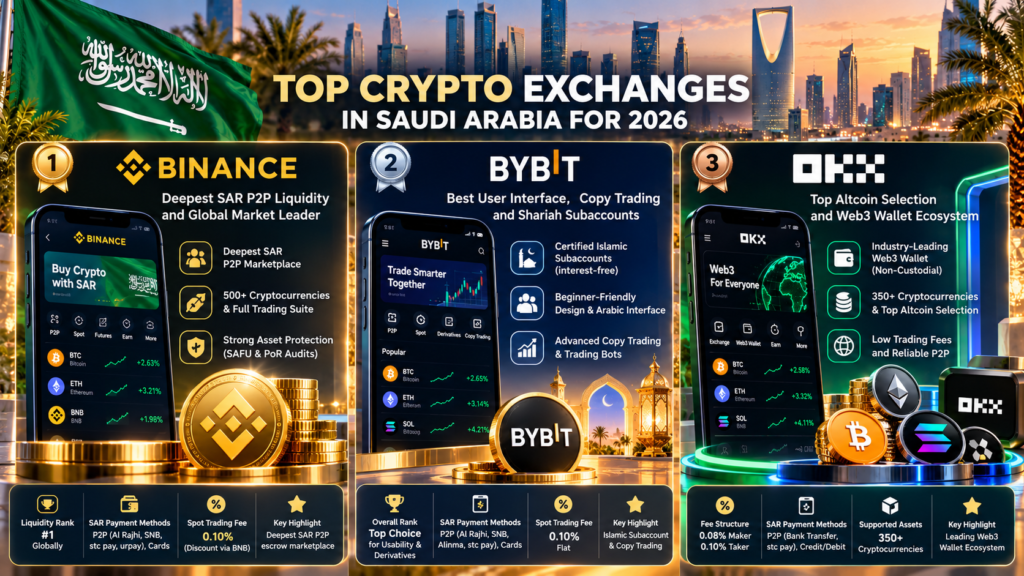
#1. Binance: Deepest SAR P2P Liquidity and Global Market Leader
Binance continues to stand out as a primary choice for traders searching for the best crypto exchange in saudi arabia 2026. It provides the deepest liquidity globally and maintains the most active SAR P2P marketplace.
+-----------------------------------------------------------------------+
| BINANCE KSA SNAPSHOT                                                  |
+-----------------------------------------------------------------------+
| Liquidity Rank      : #1 Globally                                     |
| SAR Payment Methods : P2P (Al Rajhi, SNB, stc pay, urpay), Cards      |
| Spot Trading Fee    : 0.10% (Discount available via BNB)              |
| Key Highlight       : Deepest SAR P2P escrow marketplace            |
+-----------------------------------------------------------------------+
Key Advantages for KSA Traders:
-
Deepest SAR P2P Marketplace: Binance hosts the highest volume of P2P merchants in Saudi Arabia. Traders can buy and sell USDT, BTC, and ETH using instantaneous local transfers via Al Rajhi Bank, Saudi National Bank (SNB), stc pay, and urpay.
-
Comprehensive Product Suite: Offers access to over 500 cryptocurrencies, advanced spot and futures trading, automated DCA bots, and Binance Earn yield options.
-
Strong Asset Protection: Backed by the Secure Asset Fund for Users (SAFU) and regular monthly Proof-of-Reserves (PoR) audits.
Potential Drawbacks:
-
The extensive ecosystem can feel overwhelming for complete beginners.
Read our detailed analysis in the Binance Review 2026.
#2. Bybit: Best User Interface, Copy Trading, and Shariah Subaccounts
Bybit ranks as a top overall platform for traders looking for the best crypto exchange in saudi arabia 2026 due to its beginner-friendly design, low fees, and specialized localized features.
+-----------------------------------------------------------------------+
| BYBIT KSA SNAPSHOT                                                    |
+-----------------------------------------------------------------------+
| Overall Rank        : Top Choice for Usability & Derivatives          |
| SAR Payment Methods : P2P (Al Rajhi, SNB, Alinma, stc pay), Cards     |
| Spot Trading Fee    : Flat 0.10%                                      |
| Key Highlight       : Certified Islamic Subaccount & Copy Trading     |
+-----------------------------------------------------------------------+
Key Advantages for KSA Traders:
-
Certified Islamic Subaccounts: Bybit offers interest-free Islamic trading subaccounts that remove swap fees on spot trading and grid bots, with asset lists certified by Shariah advisory bodies like CryptoHalal and ZICO Shariah.
-
Seamless Registration: Saudi citizens and expatriate residents can seamlessly sign up and pass identity verification using their Saudi National ID or Iqama.
-
Advanced Trading Tools: Features top-tier copy trading engines, trading bots, a native Arabic mobile interface, and zero-fee SAR P2P trading supported by major Saudi banks and stc pay.
Potential Drawbacks:
-
Offshore operational structure for Saudi users (UAE license does not passport to KSA).
Read our full hands-on review in the Bybit Review 2026.
#3. OKX: Top Altcoin Selection and Web3 Wallet Ecosystem
OKX remains a strong candidate for intermediate and advanced traders in Saudi Arabia who prioritize altcoin access, Web3 integration, and low fee structures.
+-----------------------------------------------------------------------+
| OKX KSA SNAPSHOT                                                      |
+-----------------------------------------------------------------------+
| Fee Structure       : 0.08% Maker / 0.10% Taker                       |
| SAR Payment Methods : P2P (Bank Transfer, stc pay), Credit/Debit      |
| Supported Assets    : 350+ Cryptocurrencies                           |
| Key Highlight       : Industry-Leading Web3 Non-Custodial Wallet      |
+-----------------------------------------------------------------------+
Key Advantages for KSA Traders:
-
Leading Web3 Wallet: OKX seamlessly integrates a non-custodial Web3 wallet into its mobile app, giving Saudi traders secure access to decentralized exchanges (DEXs), NFT marketplaces, and DeFi yield farming.
-
Low Trading Fees: Competitive base spot fees starting at 0.08% maker and 0.10% taker.
-
Reliable P2P Infrastructure: P2P desk supports local SAR funding via local bank transfers and stc pay.
Potential Drawbacks:
-
Smaller P2P order book volume compared to Binance during off-peak hours.
Comparison Table: Top Exchanges for Saudi Arabia Traders (2026)
| Feature / Criteria | Binance | Bybit | OKX |
| Primary Strength | Deepest Liquidity & SAR P2P | Copy Trading & Islamic Accounts | Web3 Wallet & Low Base Fees |
| Supported Cryptos | 500+ | 2,600+ | 350+ |
| Spot Base Fee | 0.10% | 0.10% | 0.08% Maker / 0.10% Taker |
| SAR Funding Rails | P2P (Al Rajhi, SNB, urpay, stc pay), Cards | P2P (Al Rajhi, SNB, Alinma, stc pay), Cards | P2P (Bank Transfer, stc pay), Cards |
| KSA Verification | Iqama / National ID | Iqama / National ID | Iqama / National ID |
| Proof of Reserves | Verified Monthly | Verified Monthly (Hacken) | Verified Monthly |
Regulatory Landscape vs. UAE: Key Differences for Regional Traders
A crucial distinction for regional crypto traders across the Middle East is the clear difference in regulatory framework between Saudi Arabia and the United Arab Emirates (UAE).
+------------------------------------------------------------------------+
| REGULATORY COMPARISON: KSA VS. UAE IN 2026                             |
+------------------------------------------------------------------------+
| FEATURE          | SAUDI ARABIA (KSA)      | UNITED ARAB EMIRATES (UAE)|
+------------------+-------------------------+---------------------------+
| Primary Oversight| SAMA / CMA              | VARA (Dubai) / SCA / ADGM |
| Dedicated Licensing| No Dedicated VASP Frame | Active Specialized Licensing|
| Direct Fiat Rails| Restricted Bank Wires   | Licensed Local AED Wires  |
| Operational Status| Cautionary / Sandbox    | Fully Regulated Hub       |
+------------------+-------------------------+---------------------------+
Saudi Arabia (SAMA & CMA Stance)
-
Regulatory Status: Saudi Arabia maintains a cautious stance on consumer-facing cryptocurrency activities.
-
Regulatory Authorities: Oversight is split between the Saudi Central Bank (SAMA)—which governs payment systems, banking infrastructure, and stablecoin initiatives—and the Capital Market Authority (CMA), which retains jurisdiction over tokenized securities and securities-like digital assets.
-
Licensing Status: As of 2026, Saudi Arabia does not issue dedicated Virtual Asset Service Provider (VASP) licenses for standalone retail offshore commercial exchanges operating in the Kingdom.
-
Individual Legal Status: Holding and trading digital assets individually is not explicitly criminalized under local statute. However, local commercial banks are prohibited from directly processing wire transfers to foreign crypto exchange bank accounts without explicit regulatory approval.
United Arab Emirates (VARA & SCA Framework)
-
In contrast, the UAE operates a fully formal framework led by Dubai’s Virtual Assets Regulatory Authority (VARA) and the federal Securities and Commodities Authority (SCA).
-
While exchanges operating in Dubai hold VARA operational licenses, these licenses do not automatically passport into Saudi Arabia. Saudi residents interact with global international entities under offshore terms rather than local GCC-wide permits.
Cross-Border Resource: To understand how neighboring markets operate under full licensing, read our guide on the [Best Crypto Exchange in UAE 2026].
How to Deposit and Withdraw SAR Safely in Saudi Arabia
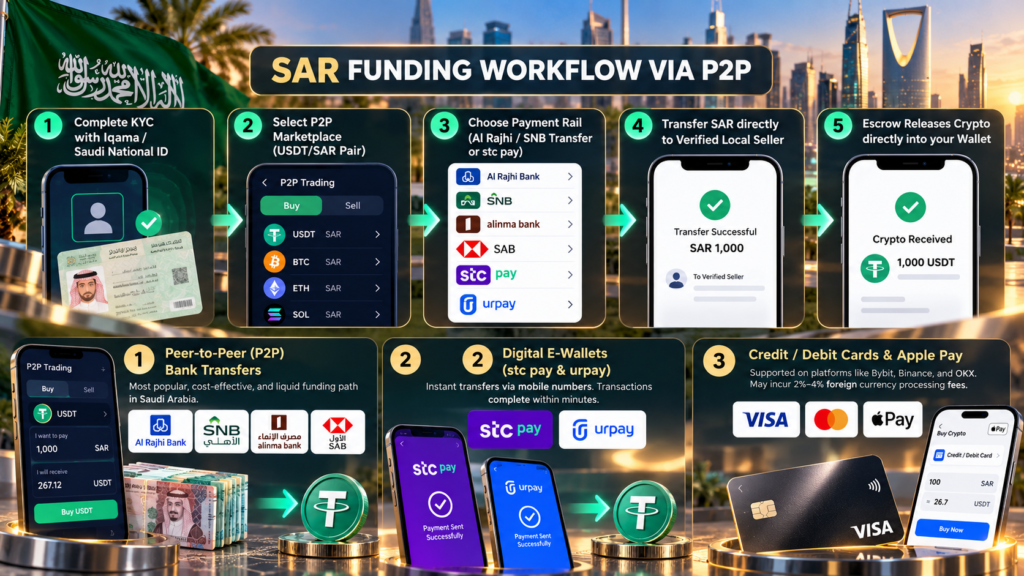
Because the Saudi Central Bank (SAMA) restricts local commercial financial institutions from processing direct SWIFT or wire transfers directly to offshore cryptocurrency exchanges, understanding secure, localized funding mechanisms is essential when choosing the best crypto exchange in saudi arabia 2026.
To onboard fiat capital safely, traders in Riyadh, Jeddah, Dammam, and across the Kingdom rely on peer-to-peer (P2P) networks, local fintech e-wallets, and regional bank transfers. Below is the complete operational guide to funding and withdrawing Saudi Riyals (SAR) securely while avoiding common payment pitfalls.
+-----------------------------------------------------------------------------------+
| SAR FUNDING WORKFLOW VIA PLATFORM ESCROW                                          |
+-----------------------------------------------------------------------------------+
| [Step 1] Complete KYC Level 1/2 using Iqama or Saudi National ID                   |
| [Step 2] Navigate to P2P Trading Desk & Select the USDT/SAR or BTC/SAR Pair       |
| [Step 3] Choose a Verified Merchant with >95% Completion Rate & High Order Volume |
| [Step 4] Execute Local SAR Transfer (Al Rajhi / SNB / stc pay / urpay)            |
| [Step 5] Confirm Payment in App -> Platform Escrow Releases Crypto to Wallet     |
+-----------------------------------------------------------------------------------+
1. Peer-to-Peer (P2P) Bank Transfers: The Primary On/Off-Ramp
Peer-to-Peer (P2P) trading remains the most liquid, cost-effective, and widely used method for funding and withdrawing SAR on major exchanges like Binance, Bybit, and OKX.
Supported Local Saudi Banks:
-
Al Rajhi Bank: The most popular choice on P2P marketplaces due to widespread adoption and instant internal account transfers.
-
Saudi National Bank (SNB): Excellent liquidity with fast mobile-banking processing times.
-
Alinma Bank & Saudi Awwal Bank (SAB): Fully integrated across P2P merchant networks with zero cross-bank transfer fees via local instant payment rails (Sarie).
Detailed Step-by-Step Deposit Process:
-
Initiate Order: Log into your exchange account, navigate to the P2P section, filter by currency SAR, and select Buy USDT.
-
Filter Merchants: Always select a Verified Merchant (indicated by a yellow checkmark or badge) who has completed at least 100+ orders with a completion rate above 97%.
-
Lock Escrow: Enter the desired SAR amount. Once you initiate the trade, the seller’s crypto is locked in the exchange’s secure escrow contract.
-
Transfer Funds: Open your local Saudi mobile banking app (e.g., Al Rajhi or SNB app) and transfer the exact SAR amount to the bank account details displayed on the exchange screen.
-
Confirm & Receive: Mark “Transferred, Notify Seller” on the exchange interface. Once the seller confirms receipt of funds in their bank account, the escrow system releases USDT directly into your funding wallet within minutes.
Detailed Step-by-Step Withdrawal Process (Crypto to SAR Cash-Out):
-
Navigate to the P2P section and select Sell USDT.
-
Select your preferred local bank account where you wish to receive the SAR.
-
Wait for the buyer to transfer SAR directly into your Saudi bank account.
-
Crucial Security Rule: Always open your bank app independently and confirm that the full SAR amount has cleared into your balance before clicking the “Release Crypto” button on the exchange.
2. Local Fintech E-Wallets (stc pay, urpay, & Tiqmo)
Saudi Arabia’s booming fintech ecosystem has made digital e-wallets one of the fastest and most convenient ways to trade crypto peer-to-peer without relying on traditional online banking sessions.
-
stc pay: The leading digital wallet in KSA. P2P merchants on Binance and Bybit extensively support stc pay transfers via mobile phone numbers. Transactions are processed instantly 24/7 without delays during banking holidays.
-
urpay & Tiqmo: Rapidly growing digital wallets that offer seamless instant mobile-to-mobile transfers, making them ideal for small to mid-sized deposit and withdrawal orders.
Pro Tip for E-Wallet Traders: Ensure that the mobile number registered with your stc pay or urpay account strictly matches the legal name verified on your exchange identity verification (KYC) to prevent order disputes.
3. Direct Visa / Mastercard Credit & Debit Cards
Direct debit and credit card purchases offer immediate crypto access, but come with specific structural limitations in Saudi Arabia:
-
Supported Platforms: Binance, Bybit, and OKX allow instant purchases using Visa and Mastercard.
-
Merchant Category Code (MCC) Blocks: Some traditional Saudi issuing banks automatically decline credit card payments mapped to cryptocurrency merchant codes (MCC 6051) under risk policies.
-
Foreign Exchange & Processing Fees: Successful card transactions typically incur a foreign exchange transaction fee ranging between 2% and 4%, making card purchases significantly more expensive than fee-free P2P bank transfers.
Essential Safety & Compliance Guidelines for Saudi Traders
To ensure your funds remain completely safe while navigating SAR P2P trading, strictly follow these compliance rules:
+-----------------------------------------------------------------------------------+
| GOLDEN RULES FOR SAFE SAR P2P TRANSACTIONS                                         |
+-----------------------------------------------------------------------------------+
| 1. ALWAYS match the bank account name with your exchange KYC name exactly         |
| 2. NEVER write crypto-related terms ("Crypto", "BTC", "Binance") in payment notes |
| 3. NEVER release crypto funds before verifying actual cleared funds in your bank   |
| 4. ONLY communicate with buyers/sellers inside the official exchange chat window  |
+-----------------------------------------------------------------------------------+
-
Name Matching (Strict Policy): Never use a third-party bank account (e.g., a friend or relative’s account) to transfer or receive SAR. The name on your Saudi bank account must match your exchange KYC name exactly, or merchants will decline the order and lock your funds in dispute.
-
Bank Reference Notes Caution: When initiating a bank transfer or stc pay transfer, leave the payment reference/notes section completely blank, or simply write “Personal transfer” or the order ID. Never write terms like “Crypto”, “USDT”, “Binance”, or “Bitcoin” in bank remarks, as local automated monitoring systems may flag or temporarily hold the transfer.
-
Keep Communications On-Platform: Keep all chat interactions strictly within the encrypted messaging system provided by the exchange’s P2P desk. Never move communication to WhatsApp, Telegram, or external phone calls.
Regional Market Context: Saudi Arabia vs. North Africa
For traders operating across North Africa and the broader Middle East, crypto accessibility varies significantly depending on local capital controls and banking policies.
-
Saudi Arabia: Utilizes high-tech digital banking infrastructure (stc pay, instant SAR bank transfers) via secure exchange escrow networks.
-
Egypt: Operates under strict central bank capital controls where local currency funding relies heavily on localized mobile wallet rails.
Regional Analysis: For detailed breakdowns on North African crypto trading environments, read our guide on the [Best Crypto Exchange in Egypt 2026].
Frequently Asked Questions (FAQ) for Saudi Arabian Traders
1. Is cryptocurrency trading legal in Saudi Arabia in 2026?
Individual ownership, buying, and trading of cryptocurrencies are not explicitly criminalized under statutory law in Saudi Arabia. Residents in Riyadh, Jeddah, Dammam, and across the Kingdom can legally register on global crypto exchanges and manage digital assets.
However, official regulatory bodies—including the Saudi Central Bank (SAMA) and the Capital Market Authority (CMA)—maintain a cautious, highly conservative stance toward virtual assets:
-
No Onshore Retail Licenses: As of 2026, SAMA and CMA do not issue commercial operating licenses for retail foreign cryptocurrency exchanges to establish local headquarters or physical branches within KSA.
-
Banking Restrictions: Saudi commercial banks are restricted from directly facilitating institutional fiat wire transfers to offshore crypto exchange accounts.
-
Investor Protection: Because offshore platforms operate outside local SAMA jurisdiction, retail investors rely on the exchange’s global security policies, insurance funds, and Proof-of-Reserves (PoR) rather than domestic regulatory protection.
2. Can I complete KYC verification on Binance or Bybit using my Saudi Iqama or National ID?
Yes. Major global exchanges targeting the Middle Eastern market, including Binance, Bybit, and OKX, fully support fast identity verification (KYC) for all legal residents of Saudi Arabia.
-
Supported Identity Documents: You can complete Level 1 and Level 2 KYC using either a Saudi National ID card (Huwiyah) for Saudi citizens or a valid Iqama (Resident Permit) for expatriates.
-
Verification Speed: In most cases, identity checks powered by AI verification systems process within 10 to 30 minutes. You will need to upload a clear photograph of your ID and pass a quick biometric facial scan via mobile device.
-
Proof of Address: Higher withdrawal tiers or fiat bank integrations may require a proof-of-address document, such as a local utility bill or a National Address short code document generated via the Absher or Tawakkalna apps.
3. What is the safest and cheapest method to deposit SAR into a crypto exchange?
Because direct bank wires to foreign crypto platforms are restricted by local banking networks, Peer-to-Peer (P2P) trading is the safest, most liquid, and cost-effective mechanism to deposit and withdraw Saudi Riyals (SAR).
+-------------------------------------------------------------------------+
| TOP APPROVED SAR P2P PAYMENT RAILS IN KSA                               |
+-------------------------------------------------------------------------+
| Local Banks       : Al Rajhi Bank, Saudi National Bank (SNB), Alinma    |
| Digital E-Wallets : stc pay, urpay, Tiqmo                              |
| Direct Cards      : Visa / Mastercard (Subject to foreign fx markup)    |
+-------------------------------------------------------------------------+
-
P2P Bank Transfers: Platforms like Binance and Bybit feature dedicated SAR P2P marketplaces where you buy Tether (USDT) or Bitcoin (BTC) directly from verified local merchants. You transfer SAR locally from your banking app (Al Rajhi Bank, SNB, Alinma, or SAB) to the seller’s Saudi account, and the exchange’s escrow system releases the crypto instantly once payment is verified.
-
Fintech E-Wallets (stc pay & urpay): Mobile e-wallets like stc pay and urpay offer instantaneous, fee-free SAR transfers linked directly to mobile numbers, making them a preferred choice for fast funding.
-
Debit/Credit Cards: Purchasing crypto with Visa or Mastercard is available on most platforms. However, local Saudi issuing banks may block international crypto transaction codes, or charge a 2% to 4% foreign conversion fee.
4. Are crypto trading gains subject to income tax or Zakat in Saudi Arabia?
For individual retail investors residing in the Kingdom of Saudi Arabia, the tax structure on digital assets remains highly favorable:
-
Personal Income & Capital Gains Tax: Saudi Arabia does not levy personal income tax or capital gains tax on individual residents trading digital assets on their personal accounts.
-
Corporate & Commercial Taxation: Commercial entities, businesses, or institutional funds registered in KSA that trade or hold digital assets must report holdings under local corporate tax laws administered by the Zakat, Tax and Customs Authority (ZATCA).
-
Zakat Obligations: Muslim traders holding digital assets for investment or commercial inventory over a full lunar year (Hawl) should consult Islamic financial advisors or official ZATCA guidelines to calculate applicable Zakat (typically 2.5% of net tradeable asset value).
5. Can I use a crypto exchange licensed in Dubai (UAE VARA) while living in Saudi Arabia?
While top platforms like Bybit, OKX, and Binance maintain official operational licenses issued by Dubai’s Virtual Assets Regulatory Authority (VARA) or Abu Dhabi’s ADGM, these licenses do not passport into Saudi Arabia.
-
Jurisdictional Boundary: VARA and ADGM regulations apply strictly within the geographic borders of the United Arab Emirates.
-
Offshore Terms of Service: When a trader residing in Riyadh or Jeddah signs up on an international exchange, their account is onboarded under the platform’s international offshore entity (e.g., Seychelles, British Virgin Islands, or Cayman Islands) rather than its UAE-licensed subsidiary.
-
Platform Functionality: Despite operating under international terms, Saudi traders still enjoy full access to deep market liquidity, competitive trading fees, and robust security standards provided by these global entities.
6. How do Shariah-compliant Islamic crypto accounts work for Saudi traders?
Given the central importance of Islamic finance principles in Saudi Arabia, top exchanges have launched dedicated, certified Islamic Subaccounts to serve faith-aligned investors.
-
Removal of Riba (Interest): Islamic accounts eliminate all overnight margin interest fees, funding rates, and swap fees on spot and leverage positions, ensuring transactions adhere to non-usurious guidelines.
-
Certified Token Lists: Platforms like Bybit partner with renowned Shariah advisory boards (such as CryptoHalal and ZICO Shariah) to vet listed tokens, filtering out projects associated with gambling, adult content, high-interest lending protocols, or excessive ambiguity (Gharar).
-
Ethical Trading Tools: Automated tools such as spot grid trading bots and fixed DCA programs are modified within Islamic subaccounts to ensure strict compliance with Islamic jurisprudence.
Conclusion
-
Navigating the digital asset landscape in Saudi Arabia entering 2026 requires balancing fast localized payment rails, robust platform liquidity, and personal trading priorities. As the Kingdom continues its modern financial evolution under Vision 2030, retail and institutional traders in Riyadh, Jeddah, and across KSA have access to world-class platforms that support seamless Saudi Riyal (SAR) funding, advanced trading tools, and faith-aligned financial products.
To summarize your ideal platform choice based on your trading style:
-
Binance is the primary choice for liquidity and local fiat volume: It remains the undisputed industry leader for high-volume traders who require the deepest order books to minimize slippage, as well as the most active SAR P2P marketplace supporting direct transfers via Al Rajhi Bank, SNB, stc pay, and urpay.
-
Bybit is the top option for usability, copy trading, and Islamic finance: Bybit delivers an outstanding, beginner-friendly interface alongside industry-leading copy trading tools. Crucially for Saudi traders, Bybit offers certified Shariah-compliant Islamic subaccounts, ensuring swap-free, faith-aligned spot and bot trading.
Ultimately, identifying the best crypto exchange in saudi arabia 2026 comes down to your personal priorities—whether that is maximizing local SAR P2P liquidity, executing complex derivative strategies, or accessing Web3 ecosystems securely. Before committing funds, always ensure your account identity verification (KYC) is completed with your Saudi National ID or Iqama, implement strong security measures like two-factor authentication (2FA), and select the funding method that offers you the best speed and lowest transfer costs.
-
Disclaimer: Cryptocurrency trading involves significant financial risk due to high market volatility. Digital assets are not backed or insured by the Saudi Central Bank (SAMA) or any government agency in Saudi Arabia. Traders in the Kingdom should conduct thorough independent research (DYOR), never invest funds they cannot afford to lose, and remain aware of local regulations governing digital asset transactions. Content provided here is strictly for educational and informational purposes and does not constitute financial, legal, or investment advice.