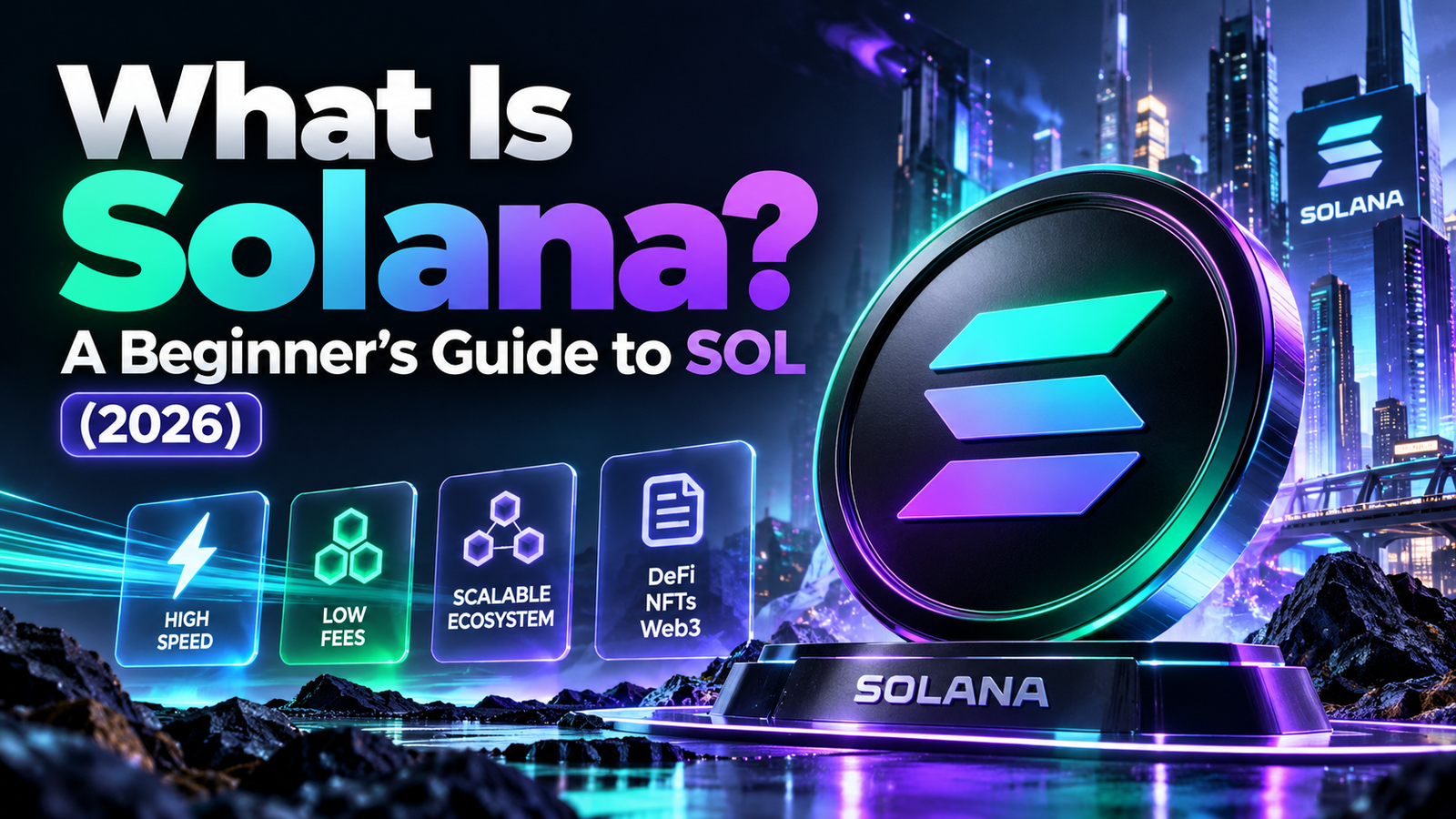
Discover what is Solana 2026 in this complete guide. Learn about SOL coin, Proof of History, ultra-low transaction fees, ecosystem dApps, and key risks.
The cryptocurrency landscape has evolved into an ecosystem where speed, transaction costs, and network efficiency dictate mainstream adoption. While early blockchain networks laid the foundation for decentralized finance (DeFi) and digital ownership, performance bottlenecks often hindered user experience. What is Solana 2026? In simple terms, Solana is a high-performance, open-source Layer 1 blockchain engineered to handle thousands of transactions per second at fractions of a cent.
If you are exploring the digital asset market in 2026, understanding what is Solana 2026 provides crucial insights into how modern decentralized infrastructure powers global finance, decentralized social networks, real-world assets (RWAs), and digital collectibles. This comprehensive beginner’s guide walks you through Solana’s history, technology, native token (SOL), ecosystem, inherent risks, and practical usage.
1. What Is Solana? Origin, Creators, and Core History
To fully grasp what is Solana 2026, it helps to understand its origins and the engineering problems its creators set out to solve.
The Origins and Founders
Solana was founded in 2017 by Anatoly Yakovenko, a former senior engineer at Qualcomm, alongside co-founders Greg Fitzgerald and Stephen Akridge. Yakovenko recognized a fundamental limitation in existing networks like Bitcoin and Ethereum: the lack of a standardized clock across decentralized nodes. In traditional systems, agreement on the precise time and sequence of events requires heavy communication overhead, slowing processing speeds down to single or double digits per second.
Yakovenko published the initial Solana whitepaper in November 2017, introducing a concept called Proof of History (PoH). By integrating a cryptographic clock into the blockchain architecture, nodes could independently verify the temporal sequence of events without waiting for full network agreement at every step.
+-----------------------------------------------------------------------+
|                       SOLANA ARCHITECTURE BRIEF                       |
+-----------------------------------------------------------------------+
|  Founder: Anatoly Yakovenko (ex-Qualcomm)                             |
|  Initial Whitepaper: November 2017                                    |
|  Mainnet Beta Launch: March 2020                                      |
|  Core Innovation: Proof of History (PoH) combined with Proof of Stake |
|  Primary Focus: High Throughput, Low Latency, Sub-Cent Fees           |
+-----------------------------------------------------------------------+
Key Milestones Leading to 2026
-
March 2020: The Solana mainnet beta was launched, bringing smart contract functionality to the network.
-
2021 – 2022: Solana experienced rapid adoption across DeFi and non-fungible tokens (NFTs), though rapid growth exposed initial network stability issues.
-
2023 – 2024: The ecosystem bounced back strongly, supported by active developer communities, memecoin trading volumes, mobile crypto integration (Solana Saga and Chapter 2 smartphones), and key client upgrades such as Firedancer.
-
2025 – 2026: Solana solidified its position as an enterprise-grade blockchain supporting major institutional products, including spot ETFs, tokenized real-world assets (such as tokenized US equities like Apple and Nvidia), and enterprise payment integrations.
Understanding [what is Blockchain 2026](link bài đã publish) provides broader context on how consensus mechanisms like Proof of History fit into the larger web3 architecture.
2. Core Features: High Speed, Low Fees, and Proof of History
When evaluating what is Solana 2026 against competing protocols, two distinct performance parameters stand out: unmatched execution speed and negligible fee structures.
+-----------------------------------------------------------------------+
|                    SOLANA VS TRADITIONAL SPEED                        |
+-----------------------------------------------------------------------+
|  Blockchain / Rail   | Transaction Finality | Average Cost            |
+----------------------+----------------------+-------------------------+
|  Ethereum Mainnet    | ~12 - 15 Seconds     | $0.50 - $5.00+          |
|  Solana (2026)       | ~400 - 600 Millisec  | $0.0001 - $0.001        |
|  Traditional Credit  | 1 - 3 Days (Settle)  | 1.5% - 3.5% Fee         |
+----------------------+----------------------+-------------------------+
Proof of History (PoH) Explained
Proof of History is not a replacement for Proof of Stake (PoS), but rather an optimization layer that works alongside PoS. In a standard blockchain, blocks require agreement on both data and time. PoH creates a continuous, verifiable cryptographic record of events over time.
It uses a Sequential Proof-of-Work Verifiable Delay Function (VDF) to insert hash outputs continuously into the state. Because every transaction carries a verifiable timestamp, validators can assemble transactions into blocks immediately without back-and-forth network coordination, dramatically reducing latency.
Sub-Cent Transaction Fees in 2026
In 2026, sending a transaction on Solana remains exceptionally affordable:
-
Base Fee: Fixed at 5,000 lamports (0.000005 SOL) per signature, which translates to roughly $0.00025 to $0.0004 under typical market conditions.
-
Priority Fees: Optional dynamic tips added during periods of localized network congestion to ensure rapid execution.
-
Average Cost: Routine transfers and basic token swaps generally cost under $0.001.
This micro-fee architecture enables use cases that are economically impossible on higher-cost networks, including micro-payments, on-chain gaming, real-time orderbook trading, and high-frequency decentralized physical infrastructure networks (DePIN).
3. What Is SOL Coin and What Is It Used For?
Every major Layer 1 network relies on an operational native cryptocurrency. In analyzing what is Solana 2026, the SOL token acts as the lifeblood of the entire network.
Core Utilities of SOL
-
Transaction Fees (Gas): Every smart contract invocation, token transfer, or state update on Solana requires a fee paid in SOL. Half of all base transaction fees are permanently burned, creating a deflationary counter-pressure to token emissions.
-
Staking and Network Security: Solana operates on a Proof-of-Stake consensus model. SOL holders can stake their tokens directly or delegate them to network validators. In exchange for locking up capital to secure the network, stakers earn staking rewards (yield) generated through dynamic token inflation and priority fee distributions.
-
Governance: SOL holders participate in protocol upgrade discussions, ecosystem grants, and DAO proposals that shape network parameters.
-
Collateral and Liquidity: Within Solana’s financial ecosystem, SOL serves as the primary liquidity pair and collateral asset for lending, borrowing, and margin trading.
Market Position (October 2026 Fact-Check)
-
Market Capitalization & Rank: As of October 2026, SOL consistently ranks among the top cryptocurrencies globally (typically holding the 4th to 7th spot by market capitalization, valued at approximately $60B to $70B depending on market movements).
-
Institutional Access: The market expanded significantly in 2026 following the approval and rollout of spot and futures Solana ETFs across major financial hubs, including the US and Hong Kong.
To see how SOL compares to other leading digital assets and where to acquire it, read our guide on the [Best Crypto Exchanges 2026].
4. Solana vs Ethereum: A Direct Comparison
A central topic in any discussion about what is Solana 2026 is how it compares to Ethereum, the pioneer of smart contract platforms. While both networks share the goal of hosting decentralized applications (dApps), their design philosophies differ fundamentally.
+-----------------------------------------------------------------------------------+
|                        SOLANA VS ETHEREUM COMPARISON (2026)                       |
+-----------------------------------------------------------------------------------+
| Feature               | Solana (SOL)                  | Ethereum (ETH)            |
+-----------------------+-------------------------------+---------------------------+
| Architecture          | Monolithic (Single-Layer)     | Modular (L1 + L2 Rollups) |
| Transaction Speed     | 2,000 - 10,000+ TPS           | 15 - 30 TPS on Mainnet    |
| Average Fee           | < $0.001                      | $0.50 - $5.00+            |
| Consensus             | PoH + Proof of Stake          | Proof of Stake            |
| Smart Contracts       | Rust, C, C++                  | Solidity, Vyper           |
| Hardware Requirements | High (Dedicated Server Nodes) | Low / Consumer Grade      |
+-----------------------+-------------------------------+---------------------------+
Monolithic vs. Modular Philosophy
-
Solana’s Monolithic Approach: Solana prioritizes execution inside a unified global state layer. Every dApp, token, and user operates on the same chain simultaneously. This design preserves composability—allowing smart contracts to interact directly in a single block transaction without relying on bridges or sidechains.
-
Ethereum’s Modular Approach: Ethereum relies heavily on Layer 2 scaling solutions (Rollups, Optimistic & ZK-Rollups) to process transactions off-chain, using the Ethereum mainnet primarily for settlement and data availability.
While Ethereum emphasizes low hardware requirements for validators to maximize decentralization, Solana prioritizes maximum throughput and hardware utilization, utilizing multi-threading and parallel transaction processing engines (Sealevel).
For an in-depth look at Ethereum’s architecture, check out our companion guide: [What Is Ethereum 2026].
5. The Solana Ecosystem: DeFi, NFTs, Memecoins, and DePIN
Understanding what is Solana 2026 extends far beyond its underlying protocol specifications; it requires examining the multi-faceted decentralized applications (dApps) operating across its execution layer. Thanks to sub-second block times and minimal transaction costs, Solana has cultivated an ecosystem optimized for high-frequency interaction, real-world utility, and mass consumer onboarding.
                  +-----------------------------------+
                  |      SOLANA ECOSYSTEM (2026)      |
                  +-----------------------------------+
                                    |
     +-----------------+------------+------------+-----------------+
     |                 |                         |                 |
+----+----+     +------+------+            +-----+-----+     +-----+-----+
|  DeFi   |     | NFTs & Art  |            | Memecoins |     |   DePIN   |
+---------+     +-------------+            +-----------+     +-----------+
| Raydium |     | Magic Eden  |            | BONK      |     | Helium    |
| Orca    |     | Tensor      |            | WIF       |     | Hivemapper|
| Kamino  |     | Compressed  |            | Launchpad |     | Render    |
| Jito    |     | NFTs (cNFT) |            | Platforms |     | Teleport  |
+---------+     +-------------+            +-----------+     +-----------+
Decentralized Finance (DeFi)
Solana’s architecture allows financial primitives to function at speeds comparable to traditional centralized exchanges, bypassing the high latency that historically limited Layer 1 DeFi protocols.
-
On-Chain Order Books (CLOBs): Traditional Automated Market Makers (AMMs) were built to accommodate slow block times. Solana’s throughput enables full Central Limit Order Books where market makers submit, update, and cancel bid-ask limit orders directly on-chain in milliseconds.
-
Liquid Staking Ecosystem: Protocols like Jito (JitoSOL) and Marinade Finance allow users to stake native SOL to earn network validation yields while maintaining full liquidity. Users receive liquid staking tokens (LSTs) that can be re-hypothecated across collateralized debt positions, lending pools, and automated yield vaults.
-
Lending, Borrowing, and Yield Aggregation: Platforms such as Kamino Finance, Marginfi, and Drift Protocol power algorithmic money markets, structured yield vaults, and high-leverage perpetual futures trading. These protocols handle automated liquidations with precision, reducing systematic cascading risk during volatile market swings.
NFTs and Compressed NFTs (cNFTs)
Solana reshaped the digital asset industry by fundamentally altering the cost structure of non-fungible tokens.
-
State Compression Technology: Built by Metaplex and Solana Labs, state compression uses Concurrent Merkle Trees to store metadata off-chain while anchoring ownership verification on-chain. This standard drops minting costs by over 1,000x compared to uncompressed NFTs. For example, minting 1 million compressed NFTs (cNFTs) costs a creator under $10 in network fees, whereas traditional minting models would require tens of thousands of dollars.
-
Enterprise & Consumer Use Cases: cNFT technology enabled enterprise-scale loyalty programs, in-game item distribution (e.g., Star Atlas), micro-artist rewards (such as DRiP), and digital event ticketing.
-
Secondary Market Infrastructure: High-throughput marketplaces such as Tensor and Magic Eden provide real-time order placement, bulk sweeps, and detailed portfolio analytics tailored for both retail collectors and algorithmic NFT traders.
Memecoins and Community Tokens
Solana became the primary destination for retail community tokens and viral memecoins, driving historic levels of daily active addresses and decentralized exchange (DEX) liquidity.
-
Automated Launchpad Platforms: Platforms like Pump.fun simplified token deployment down to a few clicks, allowing users to issue liquidity-locked tokens instantly. By removing complex smart contract deployments, these platforms generated thousands of new token launches daily.
-
Liquidity Engines: High-liquidity community assets like BONK, Dogwifhat (WIF), and political or pop-culture tokens served as gateway assets for onboarding millions of new self-custody wallets.
-
Economic Drivers & Risks: While memecoins act as liquidity engines and viral marketing campaigns for the broader network, they carry extreme price volatility, speculative risks, and potential drawdowns. Nevertheless, the sheer volume of memecoin trading has continuously battle-tested Solana’s DEX infrastructure (such as Raydium and Jupiter) under high load.
DePIN (Decentralized Physical Infrastructure Networks)
Solana established itself as the leading consensus layer for DePIN protocols—projects that combine real-world physical hardware networks with tokenized crypto economic incentives.
-
Helium Network: Migrated its entire infrastructure to Solana to manage global decentralized 5G and IoT wireless coverage. Millions of real-time micro-transactions and device-level data rewards settle on Solana continuously.
-
Hivemapper: Uses physical dashcams mounted on consumer vehicles to build a decentralized, street-level map of the world. Drivers earn native HONEY tokens in real time as fresh map telemetry is verified on-chain.
-
Render Network & io.net: Decentralized compute and GPU networks that connect excess GPU hardware capacity with artificial intelligence (AI) training pipelines and 3D graphics rendering workflows.
By bridging physical hardware with sub-cent micro-payments, Solana’s ecosystem proves that high-performance blockchain architecture can power real-world utility far beyond pure financial speculation.
6. Key Risks: Outages, Hardware Requirements, and Competition

A balanced and comprehensive examination of what is Solana 2026 requires an objective look at the trade-offs, technical compromises, and operational risks inherent in its engineering architecture. While Solana offers unparalleled speed and low costs, its high-throughput monolithic design introduces distinct challenges that users, investors, and developers must carefully evaluate.
+-----------------------------------------------------------------------------------+
|                        SOLANA RISK MATRIX & TRADE-OFFS                            |
+-----------------------------------------------------------------------------------+
| Risk Category            | Root Cause                      | Current Status (2026) |
+--------------------------+---------------------------------+----------------------+
| Network Outages          | Transaction floods & state bugs | Improved via QUIC,   |
|                          |                                 | dynamic priority fees|
|                          |                                 | & Firedancer client  |
+--------------------------+---------------------------------+----------------------+
| Validator Centralization | High hardware costs & dedicated | Balanced via dynamic |
|                          | bandwidth requirements          | stake delegation &   |
|                          |                                 | validator grants     |
+--------------------------+---------------------------------+----------------------+
| Ecosystem Competition    | L2 Rollups & Move-based chains  | Countered by raw     |
|                          | (Aptos, Sui, Monad)             | speed & composability|
+--------------------------+---------------------------------+----------------------+
Historical Network Stability & Outages
To push the absolute boundaries of blockchain transaction speed, Solana was designed to maximize network bandwidth and hardware utilization. However, this aggressive optimization model historically exposed the protocol to network congestion and full block-production halts during periods of extreme market volatility or automated bot activity.
-
Early Vulnerabilities (2021–2023): In its initial operational years, Solana experienced several high-profile network outages where transaction execution halted entirely for hours at a time. The root causes often stemmed from unthrottled bot traffic spamming popular DEX liquidity pools or NFT mints, memory allocation bugs in validator clients, and consensus communication breakdowns that required manual validator coordination across Discord to consensus-restart the cluster.
-
Structural Improvements: To permanently resolve these stability bottlenecks, core engineers implemented major protocol upgrades:
-
QUIC Protocol Integration: Replaced raw UDP-based networking protocols with QUIC to allow validators to throttle and manage incoming transaction flows based on IP addresses and bandwidth limits.
-
Stake-Weighted Quality of Service (QoS): Prioritizes transaction traffic based on the amount of SOL staked by the validator routing the message, preventing unauthorized spam bots from overwhelming the engine.
-
Firedancer Independent Client: Developed by Jump Crypto, Firedancer is a completely independent validator client implementation written in C. Deploying a second client architecture significantly mitigates single-software-failure risks, ensuring that a bug in the primary Solana Labs client code does not crash the entire network.
-
-
The 2026 Status: While uptime metrics have improved substantially and full consensus halts are now extremely rare, node operators must remain continuously vigilant against minor edge-case software bugs, peer-to-peer routing hiccups, and latency spikes during sudden global market rallies.
High Hardware Requirements & Validator Centralization
Unlike blockchains designed to run on consumer-grade hardware or lightweight home setups (such as Raspberry Pi units running Ethereum validation software), Solana’s monolithic architecture demands enterprise-grade infrastructure.
-
Heavy Resource Demands: Operating a competitive Solana validator in 2026 requires specialized multi-core server CPUs (e.g., AMD EPYC or Intel Xeon processors), a minimum of 256GB–512GB of high-speed RAM, enterprise NVMe SSD storage, and an unmetered 1Gbps to 10Gbps high-bandwidth internet connection.
-
Financial Barriers to Entry: In addition to high initial hardware purchases and monthly datacenter co-location costs, validators face ongoing operational overhead, including voting transaction fees paid directly on-chain every few seconds.
-
The Centralization Debate: Critics point out that these resource requirements raise the barrier to entry, potentially limiting node distribution to professional data centers and well-capitalized staking firms. While Solana’s active validator set numbers in the thousands, ensuring long-term geographic and infrastructure diversity remains an ongoing governance objective for the community.
Intense Layer 1 and Layer 2 Competition
The blockchain scalability landscape is fiercely competitive, with multiple design approaches competing for market share, total value locked (TVL), and developer adoption.
-
Ethereum Layer 2 Ecosystem: Ethereum’s modular expansion strategy uses Layer 2 rollups (such as Arbitrum, Optimism, and Base) to offload execution while securing data on Layer 1. These L2s offer low transaction fees and fast execution while retaining access to Ethereum’s deep liquidity pool.
-
Parallel Move-Based Blockchains: Next-generation Layer 1 networks such as Aptos and Sui—developed by former Meta engineers using the Move programming language—as well as EVM-compatible parallel chains like Monad, explicitly target Solana’s core value proposition by offering high-throughput, parallel transaction execution models.
-
Developer Retention: To retain its lead in 2026, Solana must continuously support its developer ecosystem, upgrade core software libraries, expand educational resources, and maintain capital efficiency to ensure that emerging Web3 projects continue choosing SOL as their primary foundation.
7. How and Where to Buy SOL safely
If you choose to participate in the Solana ecosystem, acquiring SOL is straightforward.
Recommended Steps to Buy SOL
-
Select a Tier-1 Exchange: Choose a reputable platform with deep liquidity and strong security standards.
-
Create and Verify Your Account: Complete identity verification (KYC) compliance steps.
-
Fund Your Wallet: Deposit fiat currency (USD, EUR, etc.) or transfer existing crypto assets.
-
Execute the Trade: Place a market or limit order for SOL.
-
Transfer to a Self-Custody Wallet: For added security, move your assets from the exchange to a non-custodial Solana wallet (e.g., Phantom or Solflare) secured by a hardware device.
For a detailed review of top-rated exchanges, security protocols, and fee schedules, check out our guide on the [Best Crypto Exchanges 2026](link bài đã publish).
💡 Official Resources:
Protocol Website: Solana.com
Live Market Metrics: CoinMarketCap SOL Page
Frequently Asked Questions (FAQ)
What makes Solana faster than Bitcoin and Ethereum?
Solana achieves its industry-leading execution speed and ultra-low latency through a unique architectural design that combines Proof of History (PoH) with a high-performance Proof of Stake (PoS) consensus mechanism.
In traditional blockchains like Bitcoin or Ethereum Mainnet, network participants must constantly communicate across nodes to agree upon time, block ordering, and transaction sequencing, which creates a massive communication bottleneck. Solana eliminates this friction by integrating Proof of History—a cryptographic Verifiable Delay Function (VDF)—which embeds a standardized, verifiable timestamp directly into the ledger. Because every node can independently verify the chronological order of transactions without waiting for global back-and-forth consensus at every single step, validators can stream transactions continuously.
Additionally, Solana utilizes Sealevel, a parallel smart contracts runtime that allows the engine to process tens of thousands of non-overlapping smart contract transactions simultaneously, compared to the single-threaded sequential execution models of older networks.
What is the average transaction fee on Solana in 2026?
In 2026, the average base transaction fee on the Solana network remains remarkably low, typically staying well under $0.001 (often hovering around $0.00025 to $0.0004 per basic transfer or signature).
Solana’s core architecture sets a fixed base transaction fee of 5,000 lamports (0.000005 SOL) per signature, half of which is permanently burned to create dynamic supply pressure. To manage high-demand applications and temporary network sprees, Solana utilizes localized priority fee markets. Unlike traditional networks where a single NFT mint or memecoin frenzy spikes global gas costs for every user on the entire blockchain, Solana’s localized fee structure ensures that heavy congestion on one specific decentralized application (dApp) or account does not inflate costs for unrelated transfers or DeFi activities elsewhere on the network.
Can Solana smart contracts be written in Solidity?
While Solana’s native programming languages are Rust, C, and C++—chosen for their high performance, memory safety, and low-level hardware access—developers can still write and deploy Solidity smart contracts on the Solana network using cross-chain compatibility solutions.
Projects such as Neon EVM (Ethereum Virtual Machine) act as an execution environment built directly on top of Solana. Neon EVM allows developers to deploy existing Solidity smart contracts, standard ERC-20 tokens, and Ethereum dApps to Solana without rewriting their entire codebase from scratch. This bridge lets developers leverage Ethereum’s familiar developer tooling (like Hardhat, Foundry, and Remix) while benefiting from Solana’s ultra-fast settlement times and fractional-cent transaction fees.
Are spot Solana ETFs available in 2026?
Yes, spot and futures Solana ETFs are actively listed and traded across major financial jurisdictions globally in 2026, including key markets in the United States, Europe, and Asia (such as Hong Kong).
Following the regulatory precedents set by Bitcoin and Ethereum exchange-traded funds, traditional financial institutions launched spot SOL ETFs to give both retail and institutional investors direct, regulated exposure to Solana’s spot price without requiring manual management of private keys, crypto wallets, or decentralized exchange onboarding. These financial products have drawn significant institutional capital, allowing traditional 401(k) accounts, pension funds, and wealth management firms to integrate SOL into diversified digital asset portfolios.
Conclusion
Understanding what is Solana 2026 provides a clear view into how high-performance, monolithic blockchain architecture can deliver sub-second transaction finality alongside sub-cent execution fees without sacrificing global composability. By addressing the severe throughput bottlenecks that historically constrained mainstream Web3 adoption, Solana has positioned itself not merely as a high-speed alternative to legacy networks, but as an indispensable settlement layer for next-generation digital infrastructure.
Throughout 2026, Solana’s evolution reflects a mature ecosystem operating across multiple fronts:
-
Institutional Integration: From the rollout and growth of spot Solana ETFs across major financial centers to the tokenization of enterprise real-world assets (RWAs) and corporate treasury products.
-
Capital-Efficient DeFi & Micro-Payments: Facilitating real-time, on-chain central limit order books (CLOBs), liquid staking platforms, and high-frequency, low-cost international remittances.
-
Physical & Consumer Scale Applications: Serving as the backbone for high-throughput Decentralized Physical Infrastructure Networks (DePIN) such as Helium, Hivemapper, and Render, while powering scalable NFT loyalty networks and consumer web3 applications through compressed NFTs (cNFTs).
While inherent trade-offs—such as high validator hardware requirements, historical network stability challenges during extreme traffic spikes, and intense Layer-1/Layer-2 competition—remain important considerations for developers and node operators, Solana’s commitment to continuous client diversity (notably through Firedancer) and protocol optimizations underscores its resilience. As decentralized applications demand greater speed, scalability, and cost efficiency, Solana remains at the forefront of the modern digital economy, driving the future of open financial systems and decentralized computing.
Disclaimer: The information, opinions, and analysis contained in this article are provided strictly for educational, educational research, and informational purposes only and should not be construed under any circumstances as financial, investment, legal, tax, or trading advice. Cryptocurrencies, decentralized tokens (including SOL), and digital assets are speculative, subject to extreme market volatility, technical risks, and complex regulatory changes across global jurisdictions. Past performance is not indicative of future market results or long-term growth. Neither the authors, publisher, nor platform advocate for purchasing, holding, or selling any cryptographic asset mentioned within this content.
Before making any financial or crypto-related decisions, readers are strongly advised to perform thorough independent research (Do Your Own Research – DYOR), evaluate their personal risk tolerance, assess potential tax implications, and consult with a licensed, certified financial advisor, legal professional, or tax consultant.