Master the market with this ultimate crypto glossary for beginners 2026. Discover 50 essential terms simplified with real-world examples to help you trade smart.
Crypto Glossary for Beginners 2026: 50 Essential Terms Explained Simply
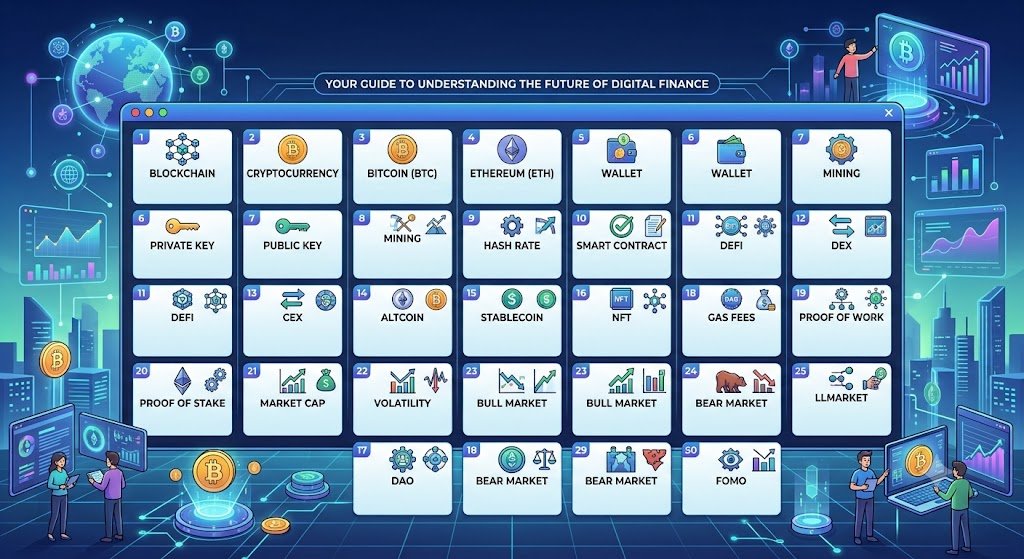
Navigating the cryptocurrency market often feels like learning an entirely new language. From complex decentralized finance protocols to fast-paced trading slang, the jargon can quickly overwhelm anyone taking their first steps into digital assets.
Having a reliable crypto glossary for beginners 2026 is essential for understanding market trends, reading whitepapers, and executing safe transactions. This comprehensive reference guide breaks down 50 core crypto terms across five structured categories, giving you the foundation needed to explore Web3 safely.
1. Basics: Fundamental Concepts Every New Investor Must Know
Understanding the core infrastructure of blockchain technology prevents costly mistakes and sets the stage for a secure crypto journey.
-
ATH (All-Time High): The highest historical price level ever achieved by a specific cryptocurrency asset.
-
Example: Bitcoin reached an ATH of nearly $74,000 in early 2024.
-
-
ATL (All-Time Low): The lowest price point recorded for a token since its initial market listing.
-
Example: An investor buying a coin at its ATL hopes to capture maximum long-term upside potential.
-
-
Blockchain: A decentralized, digital ledger that securely records transactions across a distributed network of computers.
-
Example: Bitcoin operates on its own public blockchain where every transaction is permanently verified.
-
-
FOMO (Fear Of Missing Out): An emotional impulse that drives traders to buy assets rapidly due to rising prices.
-
Example: Buying a token after it surges 50% in a single day is often driven by pure FOMO.
-
-
FUD (Fear, Uncertainty, and Doubt): The deliberate spreading of negative, false, or misleading information to create market panic.
-
Example: Unverified news reports about regulatory bans frequently generate FUD among retail investors.
-
-
HODL (Hold On for Dear Life): A long-term investment strategy that involves keeping crypto assets regardless of short-term volatility.
-
Example: Instead of day trading daily swings, many investors choose to HODL Bitcoin for years.
-
-
Private Key: A confidential alphanumeric password used to authorize transactions and access digital wallet funds.
-
Example: Sharing your private key with anyone gives them full, permanent control of your assets.
-
-
Public Key: An open cryptographic address that allows you to receive cryptocurrency funds from other users.
-
Example: You freely share your public key or wallet address with friends so they can transfer tokens to you.
-
-
Seed Phrase: A series of 12 to 24 random words used to restore access to your private key and wallet.
-
Example: Storing your seed phrase offline on paper protects your portfolio if your hardware wallet breaks.
-
-
Wallet: A software application or physical device used to store private keys and interact with blockchain networks.
-
Example: MetaMask is a popular software wallet, while Trezor is a highly secure hardware wallet.
-
2. Trading: Essential Vocabulary for Market Analysis and Order Execution
To buy, sell, or trade digital tokens effectively, you must master standard exchange terminology and order execution types.
-
Bull / Bear: A bull market describes rising asset prices; a bear market refers to prolonged price declines.
-
Example: Bullish sentiment often drives widespread adoption, whereas bear markets test investor patience.
-
-
Futures: Derivative financial contracts that obligate traders to buy or sell an asset at a predetermined price on a future date.
-
Example: Traders use futures to speculate on Bitcoin price movements without actually holding the underlying asset.
-
-
Leverage: Borrowed capital used to amplify the potential profit or loss of a trading position.
-
Example: Using 10x leverage increases both potential gains and potential downside risks tenfold.
-
-
Liquidation: The automatic closing of a leveraged position by an exchange when losses hit a safety threshold.
-
Example: A sharp drop in price can trigger immediate liquidation if your leverage ratio is set too high.
-
-
Long / Short: Going long means betting on price increases; going short means profiting from falling token prices.
-
Example: A trader opens a long position on Ethereum when technical indicators show a strong uptrend.
-
-
Maker / Taker: Market makers add liquidity by placing limit orders; market takers remove liquidity by filling existing orders instantly.
-
Example: Exchanges typically charge lower fees to market makers because they help build market depth.
-
-
Order Book: An active electronic list of buy and sell orders for a specific asset organized by price level.
-
Example: Reviewing the order book helps traders identify key support and resistance zones.
-
-
Slippage: The difference between the expected price of a trade and the actual execution price.
-
Example: High market volatility often causes higher slippage on decentralized exchange orders.
-
-
Spot: The market where financial instruments are bought and sold for immediate settlement and direct asset ownership.
-
Example: Buying Ethereum on the spot market means you instantly own the physical tokens.
-
-
Volume: The total nominal value or amount of a cryptocurrency traded over a specified period, usually 24 hours.
-
Example: High trading volume indicates strong market liquidity and active investor interest.
-
3. DeFi: Decentralized Finance Terms Every Beginner Must Learn
Decentralized finance eliminates traditional intermediaries, replacing them with automated financial tools and smart contracts.
-
AMM (Automated Market Maker): An autonomous protocol that uses mathematical formulas to price assets directly within liquidity pools.
-
Example: Uniswap uses an AMM model rather than a traditional centralized order book.
-
-
APY / APR: APY calculates annual interest including compounding effects; APR reflects the simple interest rate without compounding.
-
Example: Staking a token at a 10% APY yields higher overall returns over a year than a 10% APR.
-
-
DEX (Decentralized Exchange): A peer-to-peer trading platform operating via smart contracts without central authority control.
-
Example: Traders use a DEX like Uniswap or PancakeSwap directly from their self-custody wallets.
-
-
Gas Fee: The processing fee paid to blockchain network validators to execute transactions or smart contracts.
-
Example: Sending tokens during peak Ethereum network activity results in significantly higher gas fees.
-
-
Impermanent Loss: A temporary loss of capital experienced by liquidity providers due to price changes in pooled assets.
-
Example: Providing liquidity during extreme market swings can result in lower value than simply holding the tokens.
-
-
Liquidity Pool: A crowd-funded reserve of tokens locked inside a smart contract to facilitate decentralized trading.
-
Example: Depositing equal values of ETH and USDT into a liquidity pool earns you a percentage of trading fees.
-
-
Smart Contract: A self-executing digital agreement with conditions directly coded into the blockchain network software.
-
Example: A smart contract automatically releases escrowed funds once a payment is confirmed.
-
-
Staking: The act of locking up crypto tokens to support network operations and security in exchange for rewards.
-
Example: Staking Ethereum allows token holders to earn passive yield directly from network transaction fees.
-
-
TVL (Total Value Locked): The total dollar amount of crypto assets currently deposited across a DeFi protocol.
-
Example: A rising TVL indicates growing user trust and capital inflow into a DeFi project.
-
-
Yield Farming: The practice of moving crypto assets across different DeFi platforms to maximize investment yield.
-
Example: Yield farmers deposit tokens into protocols that offer the highest combination of interest and token rewards.
-
4. Exchange & Security: Safeguard Your Assets and Evaluate Projects
Understanding security protocols and fundamental market data safeguards your portfolio against common market risks.
-
2FA (Two-Factor Authentication): An essential security layer requiring two separate verification methods to confirm account access.
-
Example: Using an authenticator app for 2FA prevents hackers from logging in with just your password.
-
-
AML (Anti-Money Laundering): A framework of laws and regulations designed to prevent financial crimes within digital platforms.
-
Example: Regulated exchanges enforce strict AML protocols to track suspicious transaction flows.
-
-
Circulating Supply: The total number of crypto tokens currently available to the public and moving in active circulation.
-
Example: Bitcoin has a maximum cap of 21 million, but its circulating supply grows gradually through mining rewards.
-
-
Cold / Hot Wallet: A cold wallet stays completely offline for maximum security; a hot wallet remains connected to the internet.
-
Example: Investors store long-term holdings in cold storage while keeping daily trading funds in a hot wallet.
-
-
KYC (Know Your Customer): A mandatory identity verification process enforced by centralized exchanges during user registration.
-
Example: Uploading a government-issued passport or ID is a standard requirement to pass KYC checks.
-
-
Market Cap (Market Capitalization): The overall dollar value of a cryptocurrency, calculated by multiplying price by circulating supply.
-
Example: A token priced at $2 with 100 million coins in circulation has a market cap of $200 million.
-
-
Proof of Reserves: An independent auditing method used by centralized exchanges to prove they hold full customer deposits.
-
Example: Proof of Reserves confirms that an exchange isn’t misusing user funds behind the scenes.
-
-
Tokenomics: The economic model and structural incentive mechanisms governing a cryptocurrency project’s design and token distribution.
-
Example: Analyzing tokenomics reveals whether a project suffers from rapid token dilution.
-
-
Vesting: A scheduled lock-up period restricting early investors and team members from selling their allocation all at once.
-
Example: A two-year vesting schedule prevents project founders from immediately dumping tokens on the open market.
-
-
Whitepaper: An official technical document published by a crypto project to explain its technology, goals, and roadmap.
-
Example: Reading Bitcoin’s original 2008 whitepaper offers clear insight into peer-to-peer electronic cash systems.
-
5. Web3 Slang: Decode the Internet Culture of Crypto Communities
Social media communities use specialized terminology to discuss trends, market sentiment, and community behavior.
-
Degen: Short for degenerate; describes a trader who takes high-risk, speculative positions with minimal research.
-
Example: Buying a brand-new meme token minutes after release is classic degen behavior.
-
-
Diamond Hands: A phrase describing an investor who holds their assets firmly despite intense market downturns and panic.
-
Example: Investors with diamond hands refused to sell their holdings during deep historical market crashes.
-
-
Moon: A dramatic upward price movement in a short period.
-
Example: Community members often celebrate when a newly launched project starts to moon.
-
-
NGMI (Not Going To Make It): A term used to describe poor investment choices, bad security practices, or closed-minded attitudes.
-
Example: Ignoring basic security tools like two-factor authentication is a quick path to being NGMI.
-
-
Paper Hands: A term for an investor who panics and sells their crypto holdings at the first sign of price drops.
-
Example: Paper hands often lock in heavy losses by selling right before market recoveries.
-
-
Pump and Dump: An illegal market manipulation tactic where prices are artificially inflated before insiders dump their holdings.
-
Example: Social media influencers hyping low-cap coins often participate in pump and dump schemes.
-
-
Rekt: Slang derived from “wrecked,” describing a trader who suffers massive financial losses from a bad trade.
-
Example: Getting liquidated on a 50x leverage position leaves a trader completely rekt.
-
-
Rug Pull: A malicious scam where project developers abandon a token and drain all investor funds from the liquidity pool.
-
Example: Unvetted projects with unlocked liquidity carry a high risk of an unexpected rug pull.
-
-
Shill: Unsolicited or aggressive promotion of a specific cryptocurrency token for personal financial gain.
-
Example: Be cautious when an anonymous user relentlessly tries to shill a project without clear fundamentals.
-
-
WAGMI (We’re All Going To Make It): An uplifting phrase used across crypto social communities to encourage collective optimism.
-
Example: During prolonged market accumulation phases, community members post WAGMI to keep morale high.
-
How to Use This Crypto Reference Guide Effectively
Bookmarking a comprehensive educational resource is an important first step, but real progress comes from actively integrating this knowledge into your daily Web3 routine. Whether you are actively managing a portfolio, evaluating emerging protocols, or following market news, translating theoretical definitions into practical habits is what separates successful market participants from those who fall victim to preventable mistakes.
Below is an actionable, step-by-step framework to help you utilize this guide to its fullest potential and navigate the digital asset landscape with precision.
1. Integrate Terminology Into Active Market Analysis
When reading whitepapers, tokenomics breakdowns, or technical analyses, treat this reference guide as a real-time translation tool:
-
Cross-Reference On-Chain Metrics: When reviewing metrics like Market Cap, Circulating Supply, or Total Value Locked (TVL), avoid looking at numbers in isolation. Compare a protocol’s TVL against its market capitalization to evaluate whether an asset may be overvalued or undervalued relative to its actual ecosystem utility.
-
Decipher Order Book Dynamics: While examining exchange interfaces, apply trading terms directly. Distinguish between Maker and Taker orders to optimize your fee structure, and adjust your Slippage tolerance settings based on available order book depth before confirming decentralized trades.
2. Establish Rigorous Security Protocols
Theoretical knowledge of security jargon must immediately translate into physical self-custody practices. Protecting your capital is always more critical than chasing short-term yields:
-
Safeguard Your Access Keys: Never store your Private Key or 12/24-word Seed Phrase in digital formats such as cloud storage, email drafts, or smartphone screenshots. Always write seed phrases down on physical, durable media and keep them stored securely offline.
-
Audit Contract Approvals Regularly: Before connecting your Wallet to new decentralized applications (dApps), check for smart contract permission risks. Always verify whether a platform requires unlimited token spending allowances, and revoke unused contract approvals periodically to mitigate Rug Pull risks.
-
Implement Multi-Layer Verification: Activate hardware-based Two-Factor Authentication (2FA)—such as security keys or authenticator applications—on all centralized exchange accounts, avoiding vulnerable SMS-based verification methods whenever possible.
3. Conduct Independent Fundamental Research (DYOR)
Never rely solely on social media commentary or community hype. Use foundational vocabulary to perform structured due diligence before allocating capital to any project:
-
Analyze Tokenomics and Vesting Schedules: Read project Whitepapers to evaluate supply dynamics. Pay close attention to team allocation percentages, linear versus cliff Vesting schedules, and annual inflation rates to ensure early investors cannot dump large supply unlocks onto public market participants.
-
Evaluate Governance and Audits: Ensure that smart contracts governing liquidity pools or staking mechanisms have undergone independent security audits by reputable blockchain security firms.
4. Build a Structured Learning Path Across Related Ecosystems
Mastering terminology is part of a broader educational journey. To develop a well-rounded understanding of the Web3 ecosystem, build upon these core concepts by systematically exploring detailed contextual resources:
-
Foundational Frameworks: Gain a complete structural overview of blockchain technology and monetary innovation through our comprehensive guide on What Is Cryptocurrency 2026.
-
Market Drivers & Digital Gold: Discover how consensus mechanisms, halving cycles, and institutional adoption shape the primary store of value in digital finance via What Is Bitcoin 2026.
-
Decentralized Infrastructure: Transition from passive holding to active Web3 participation by mastering automated market makers, yield strategies, and lending markets with What Is DeFi 2026.
-
Proactive Risk Management: Protect your digital identity and wallet balances against phishing, malicious smart contracts, and social engineering by reviewing our essential checklist on How to Avoid Crypto Scams.
5. Leverage Trusted External Educational Resources
To build long-term success in digital assets, bookmarking this comprehensive resource is just the first step. Here is how to apply this knowledge effectively:
-
Verify Official Documentation: Before buying any coin, read its project documentation. You can dive deeper into fundamental concepts in our guide on What Is Cryptocurrency 2026.
-
Focus on Security: Always prioritize offline security. Learn more about safeguarding your portfolio by reviewing our checklist on How to Avoid Crypto Scams.
-
Master Market Basics: Ensure you understand major market movers by reviewing What Is Bitcoin 2026 alongside specialized ecosystems covered in What Is DeFi 2026.
To continue exploring industry terms, you can cross-reference definitions with external educational databases like Binance Academy or CoinGecko’s official glossary.
Conclusion
Mastering cryptocurrency terminology is much more than an academic exercise—it is your first line of defense and your most valuable asset when navigating the decentralized economy. By familiarizing yourself with these 50 essential terms across blockchain fundamentals, trading mechanics, decentralized finance, security compliance, and community culture, you effectively bridge the gap between being a passive observer and becoming a confident, informed investor.
As digital assets continue to integrate into global finance, market vocabulary will inevitably expand. However, the core principles outlined in this guide remain the foundation of financial literacy in Web3. Bookmark this resource, revisit it as you encounter new protocols, and use it as a steady reference point to make clear, data-driven decisions throughout your crypto journey.
Disclaimer: This guide is for informational and educational purposes only and does not constitute financial, investment, or legal advice. Cryptocurrency trading involves substantial market risk, including the loss of invested capital. Always conduct thorough research (DYOR) and consult a certified financial advisor before executing trades.