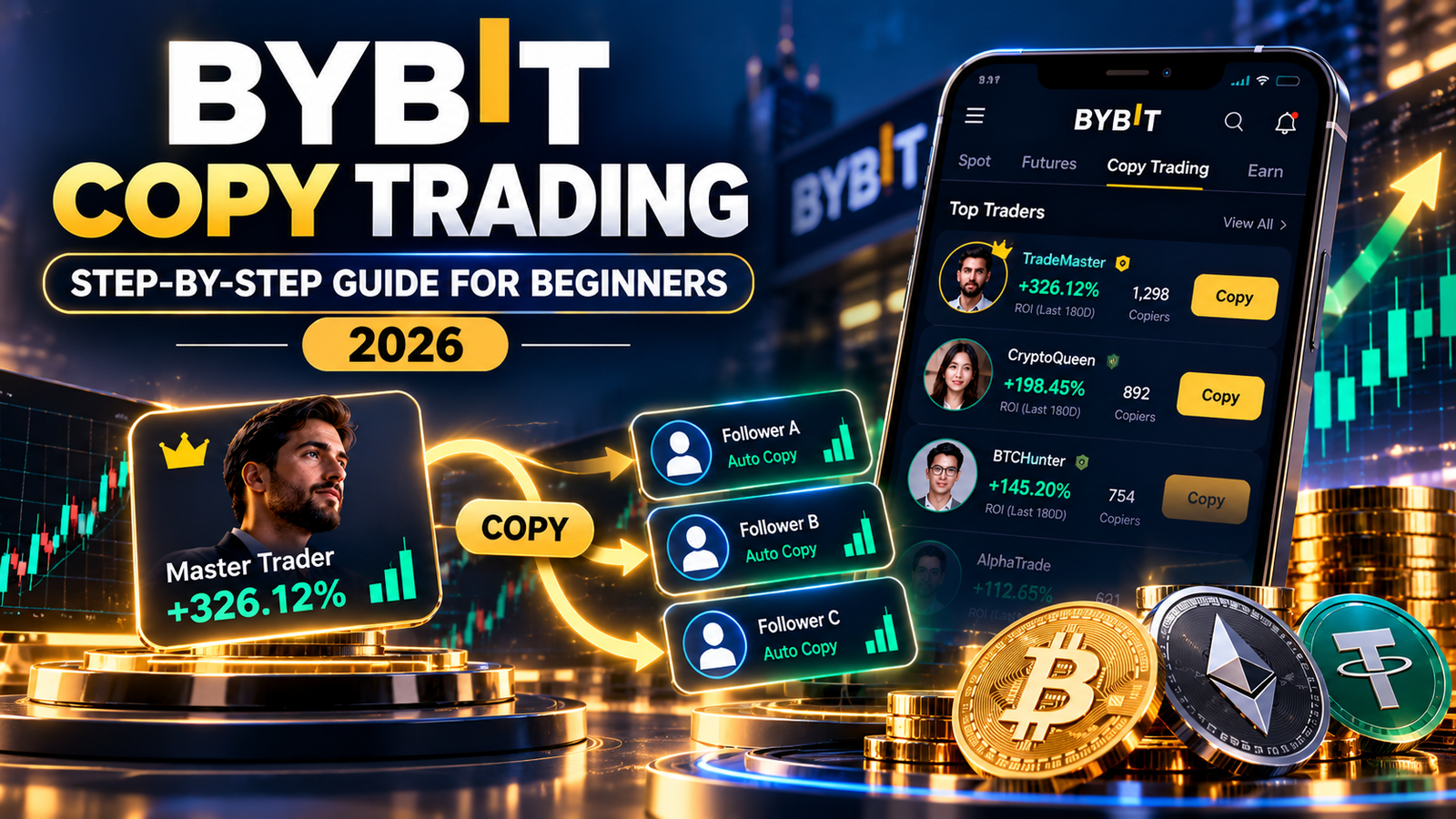
Crypto copy trading has evolved into one of the most popular features for modern investors looking to gain exposure to the cryptocurrency market without spending hours analyzing charts. If you are searching for a comprehensive bybit copy trading guide, this walkthrough will explain everything you need to know from setup to advanced risk management.
While copy trading offers convenience, it is not a guaranteed path to passive income. Every market trade carries financial risk. In this article, you will discover how Bybit copy trading works under the hood, how to analyze Master Traders, step-by-step setup instructions, fee structures, and critical risk controls to safeguard your capital.
If you have already read our introductory guide on [How to Use Bybit 2026], this article goes much deeper into technical metrics, account mechanics, order routing, and capital preservation tactics specific to copy trading.
1. What Is Bybit Copy Trading and How Does It Work?
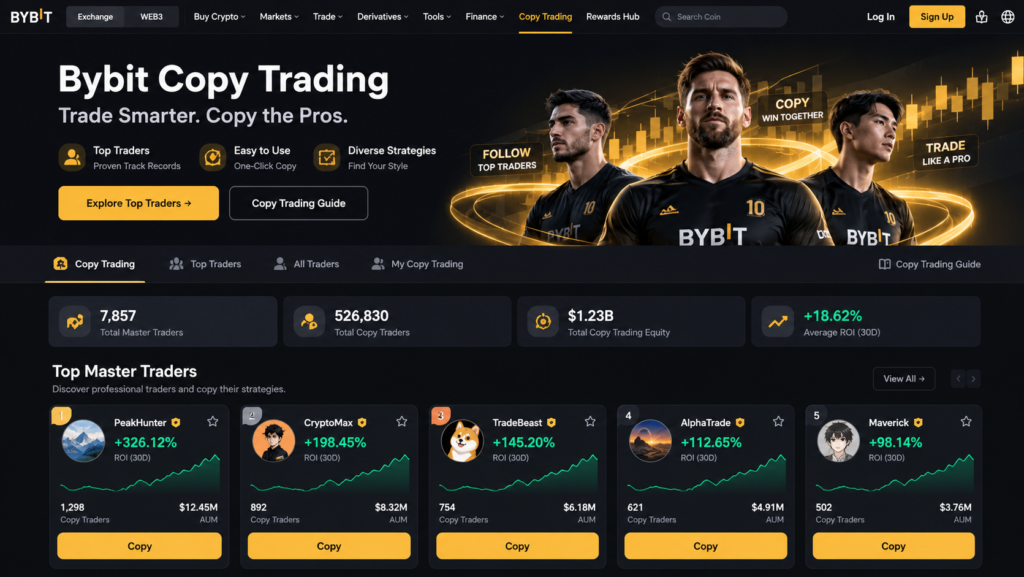
Bybit copy trading is an automated feature that connects followers (individual traders or investors) with Master Traders (experienced, verified traders). When a Master Trader opens or closes a position on Bybit, the system automatically replicates those identical trades in your personal trading account in real time based on your designated funds.
+-------------------+      Executes Trade      +-------------------+
|   Master Trader   |  --------------------->  |   Bybit Engine    |
+-------------------+                          +-------------------+
                                                         |
                                                         | Auto-Replicates
                                                         v
                                               +-------------------+
                                               | Follower Account  |
                                               +-------------------+
The Engine Behind Copy Trading
Bybit uses an automated order-matching engine to handle trade execution. When you allocate funds to copy a trader, you choose between two execution modes:
-
Smart Copy Mode: Automatically calculates your position size relative to the Master Trader’s total account balance. It balances leverage and risk settings to match the strategy proportionally.
-
Advanced Copy Mode: Gives you direct control over your fixed margin per trade, leverage limits, slippage settings, and individual stop-loss levels.
Bybit supports copy trading across Futures (Derivatives), Spot, and Automated Trading Bots (Grid Bots). Beginners typically focus on Futures or Spot copy trading depending on their risk tolerance.
2. Key Metrics to Analyze Before Choosing a Master Trader
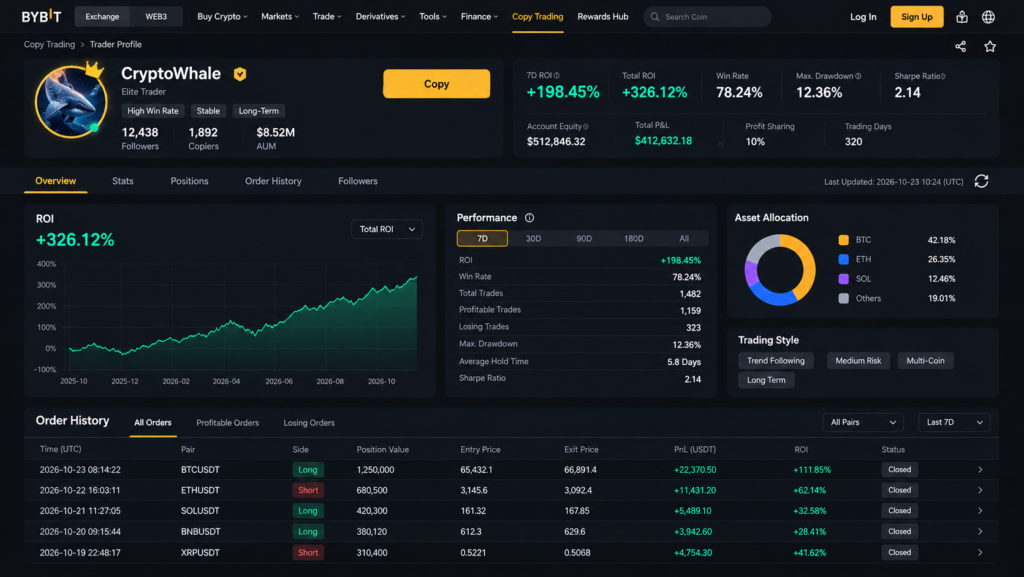
Selecting the right Master Trader is the most important decision you will make in your copy trading journey. Avoid picking traders based solely on flashy short-term gains. Every complete bybit copy trading guide emphasizes evaluating long-term performance data across these essential performance indicators:
| Metric | What It Measures | Ideal Target / Benchmark |
| ROI (Return on Investment) | Percentage return generated over a set timeframe | Stable gains over 30d/90d (e.g., 15–40%) |
| Win Rate | Percentage of trades closed in profit | 60% – 85% with consistent risk-reward |
| Max Drawdown (MDD) | Peak-to-trough decline in account equity | Under 20–25% |
| Days Active | Operational duration as a Master Trader | Minimum 60–90+ consecutive days |
| AUM (Assets Under Management) | Total funds allocated by all followers | Higher AUM reflects broader market confidence |
Detailed Breakdown of Key Metrics
-
ROI (Return on Investment): Look at 30-day or 90-day ROI rather than 7-day spikes. High 7-day ROI often signals high-leverage gambles rather than scalable trading strategies.
-
Win Rate vs. Risk-Reward Ratio: A high win rate (e.g., 90%) can be deceiving if a trader holds losing trades indefinitely without using stop losses. Always cross-check win rate with average loss sizes.
-
Max Drawdown (MDD): Max Drawdown reveals maximum historical capital loss during a losing streak. If a trader’s MDD is 60%, your account would experience that same 60% drop during a market downturn.
-
Days Active: Consistency is key in crypto markets. Traders with over 90 active days demonstrate resilience across different market conditions.
-
AUM & Follower Count: High AUM indicates that experienced traders trust the Master Trader with larger capital allocations.
For more details on Bybit’s security features and account tiers, explore our complete Bybit Review 2026.
3. Step-by-Step Setup: How to Start Copy Trading on Bybit
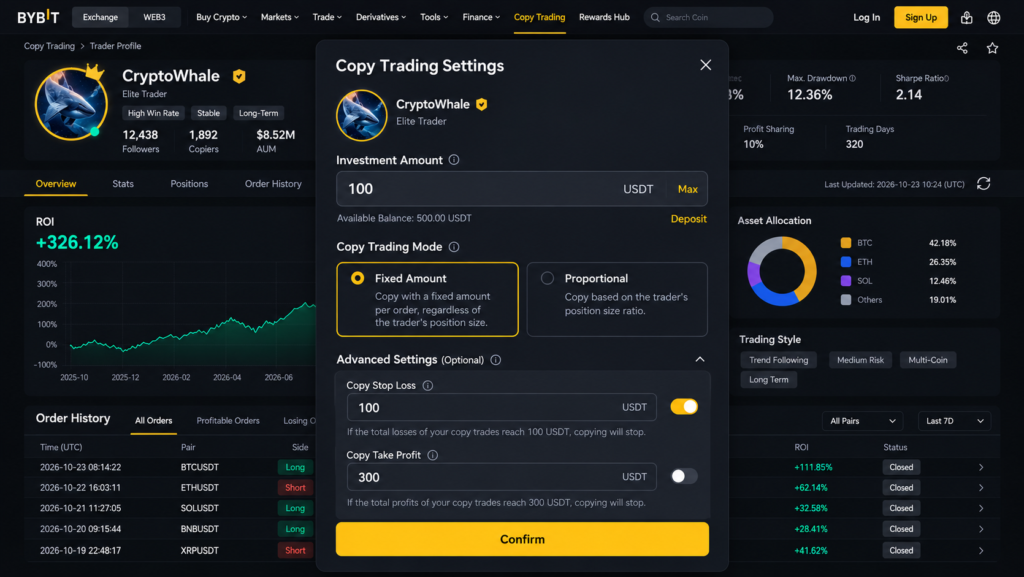
Setting up your account takes only a few minutes once you have funded your Bybit wallet. Follow this step-by-step bybit copy trading guide workflow to launch your first portfolio:
Step 1: Fund Wallet ---> Step 2: Choose Trader ---> Step 3: Select Mode ---> Step 4: Set Risk Limits ---> Step 5: Confirm
Step 1: Fund Your Account
Navigate to Assets > Transfer and move funds (such as USDT) from your Fund Account or Unified Trading Account (UTA) into your Copy Trading Account. The minimum capital required to start copy trading on Bybit varies by trader, but most allow initial investments starting at $50 to $100 USDT.
Step 2: Select a Master Trader
Navigate to Trade > Copy Trading in the main navigation menu. Use the filter tools to sort traders by 30-Day ROI, Stability Index, or Lowest Max Drawdown. Click on a trader’s profile to inspect their open trades, past history, and active leverage.
Step 3: Choose Your Copy Mode
Click Copy on your selected trader’s profile. Choose between:
-
Smart Copy Mode: Recommended for beginners who prefer automated position sizing based on the trader’s balance.
-
Advanced Copy Mode: Recommended for traders who want manual control over fixed margin sizes and custom leverage limits.
Step 4: Configure Risk Settings
-
Copy Investment: Enter your total investment amount (e.g., $500 USDT).
-
Copy Stop Loss (CSL): Set an absolute equity loss threshold (e.g., stop copying if losses reach 20%).
-
Max Position Margin: Limit maximum capital allocated to a single trade position.
Step 5: Review and Confirm
Check your settings, confirm the agreement, and click Copy Now. Your account will instantly mirror new trades executed by the Master Trader.
4. Essential Risk Management Strategies and Copy Trading Fees
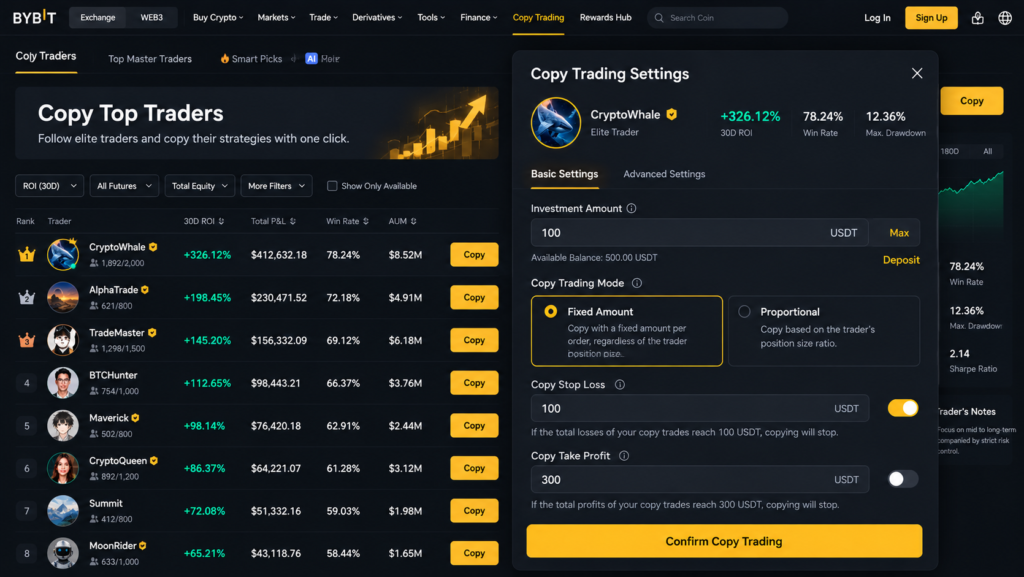
Copy trading automated execution does not eliminate risk. Capital protection depends on your active risk management setup.
Essential Risk Management Rules
-
Set an Account-Level Copy Stop Loss (CSL): Always set a CSL (e.g., 15% to 20%). If a Master Trader experiences an unexpected drawdown, your account will automatically disconnect to lock in remaining funds.
-
Diversify Across Multiple Traders: Never allocate 100% of your copy balance to a single trader. Split your capital across 2 to 4 Master Traders with complementary styles (e.g., one conservative spot trader and one low-leverage futures swing trader).
-
Limit Per-Trade Capital Allocation: Use Advanced Mode to restrict maximum margin per trade to 5% or 10% of your dedicated portfolio.
Understanding Bybit Copy Trading Fees
Understanding fee structures ensures transparent earnings tracking:
-
Trading Fees: Standard taker/maker trading fees apply to every copied order, handled directly through Bybit’s standard order engine.
-
Profit Sharing Percentage: Master Traders receive a profit share of net profits generated for followers. As of late 2026, profit sharing ranges from 10% to 15% depending on the Master Trader’s rank level (Cadet, Hero, Prodigy, Legend).
-
High-Water Mark Principle: Profit sharing fees are calculated using a high-water mark system. Profit share is deducted only when net profits reach new absolute highs over a settlement period, preventing double deductions on recovered losses.
5. Common Pitfalls to Avoid and FAQ
Even experienced investors fall into traps when using copy trading platforms. Review these common pitfalls to protect your crypto investment capital:
Critical Pitfalls to Avoid
-
Chasing 7-Day High ROI Traders: Traders showing +500% ROI in 7 days often use high leverage (50x–100x) or high-risk martingale tactics. These accounts often face total liquidation during sudden volatility.
-
Ignoring Floating Losses (Unrealized PnL): A trader may display a 99% win rate by refusing to close losing trades. Always check their Open Positions tab to monitor unrealized losses.
-
Over-Leveraging Copy Capital: Ensure your leverage matches your risk tolerance. Setting high leverage on copied trades accelerates liquidation risks during market corrections.
-
Treating Copy Trading as Risk-Free Passive Income: Copy trading requires ongoing supervision. Regularly review trader performance, rebalance your funds, and update your stop-loss parameters.
Frequently Asked Questions (FAQ)
Is Bybit copy trading profitable for beginners?
Copy trading on Bybit can certainly generate consistent profits for beginners, but profitability depends almost entirely on trader selection and active risk management rather than passive luck. Beginners who succeed treat copy trading as portfolio management rather than a hands-off money machine.
-
Risk Mitigation First: Profitable copy traders focus heavily on selecting disciplined Master Traders with steady equity curves, low Maximum Drawdown (MDD under 20%), and verified trading histories spanning at least 60 to 90 days.
-
Capital Protection Rules: Utilizing automated tools like Bybit’s Copy Stop Loss (CSL) ensures that a sudden drawdown by a Master Trader won’t liquidate your account balance.
-
The Reality of Crypto Markets: Past performance is never a guarantee of future returns. Cryptocurrency markets remain highly volatile, and copy trading carries inherent financial risks.
If you are just getting started with account management and platform security before committing funds, explore our comprehensive guide on How to Use Bybit 2026 to ensure your account security and funds are set up correctly.
What is the minimum capital needed to copy trade on Bybit?
The minimum capital required to start copy trading on Bybit varies depending on the specific Master Trader’s settings and your chosen copy mode, but beginners can typically launch their portfolio with as little as $50 to $100 USDT.
-
Smart Copy Mode: Generally allows smaller initial balances (often starting around $50 USDT) because Bybit automatically calculates proportional order sizing based on the Master Trader’s active balance.
-
Advanced Copy Mode: May require higher initial capital ($100 to $200+ USDT) because you manually specify a fixed margin per trade (e.g., $10 USDT per position). If your allocated capital is too low relative to your fixed order size, your account may fail to execute incoming orders due to insufficient margin.
-
Recommended Buffer: Starting with $150 to $300 USDT provides a healthier cushion. This balance allows the trading engine to execute multiple concurrent orders smoothly without running into minimum order threshold errors.
To understand how Bybit structures its spot and derivatives trading accounts, read our in-depth Bybit Review 2026 for an overview of platform mechanics.
Can I manually close a copied trade on Bybit?
Yes, absolutely. You retain 100% control over your account equity at all times and can manually close any active copied trade directly from your user dashboard without waiting for the Master Trader to exit the position.
How Manual Exits Work:
-
Instant Execution: If a Master Trader is holding a position through high market volatility and you wish to secure your current profits or cap your unrealized losses, navigate to your User Center > Copy Trading Dashboard.
-
Individual Control: Select the specific position under the Open Positions tab and click Close.
-
Uncopying Options: You can also choose to stop copying a Master Trader altogether at any point. When you terminate a copy relationship, Bybit will prompt you to choose whether to close all active copied positions immediately at market price or keep them open until the trader closes them manually.
Having direct control over trade exits is a vital risk-management feature, allowing you to protect profits during unexpected macroeconomic shifts or geopolitical events.
How does Bybit copy trading compare to other exchanges?
Bybit stands out as an industry leader for copy trading due to its deep market liquidity, sub-millisecond execution engine, minimal slippage, and granular risk management controls.
| Platform Feature | Bybit Copy Trading | Competitor Standard |
| Execution Engine | High-speed matching engine minimizes slippage | Higher slippage during extreme volatility |
| Risk Customization | Advanced Copy Mode with fixed margins and custom leverage | Basic percentage-based allocation only |
| Trader Screening | Strict Master Trader tiers (Cadet to Legend) | Less stringent verification criteria |
| Bot Integration | Copy Spot, Futures, and Automated Grid Trading Bots | Often limited to Futures derivatives only |
For a head-to-head comparison evaluating copy trading features, trading fees, leverage caps, and asset selection against competing platforms, check out our comparative analysis on BingX vs Bybit 2026.
Where can I find official Bybit copy trading documentation?
For full system specifications, official platform terms, Master Trader tier qualifications (Cadet, Hero, Prodigy, Legend), and recent UI updates, you should always consult official exchange documentation.
-
Access Bybit’s verified guides via the official Bybit
-
Always cross-reference platform rules to stay informed on updated profit-sharing tier mechanics and settlement schedules.
Conclusion
Bybit copy trading offers an efficient way to automate your crypto portfolio by leveraging experienced market traders. By selecting Master Traders based on long-term metrics, enforcing strict Copy Stop Loss limits, and avoiding common pitfalls like chasing short-term ROI, you can build a balanced copy trading portfolio.
Use this bybit copy trading guide as your reference framework to adjust settings, monitor drawdowns, and protect your capital effectively.
Disclaimer: Trading cryptocurrencies, derivatives, and copy trading involves substantial risk of loss and is not suitable for every investor. The content provided in this article is for educational and informational purposes only and should not be construed as financial or investment advice. Always perform independent research and never invest money you cannot afford to lose.