Curious about what is defi 2026? Discover decentralized finance explained simply, covering smart contracts, risks, and how it compares to traditional banking.
What Is DeFi 2026? Decentralized Finance Explained Simply
Imagine a world where you can borrow money, lend your savings, trade assets, or earn interest 24/7 without ever stepping into a bank, filling out paper forms, or asking a manager for permission. That is the core promise of DeFi (short for Decentralized Finance).
If you have been following cryptocurrency or fintech trends, you have likely heard this buzzword thrown around. But what does it actually mean for an average person? Understanding what is defi 2026 requires stripping away the complex technical jargon and looking at how modern financial technology is redesigning money for the internet age.
1. What Is DeFi? Decentralized Finance Explained Simply
To understand what is defi 2026, let’s start with a simple real-world comparison: Traditional Banking (TradFi) vs. Decentralized Finance (DeFi).
Traditional Banking (TradFi)                 Decentralized Finance (DeFi)
┌───────────────────────────┐                ┌───────────────────────────┐
│       Central Bank        │                │    Blockchain Network     │
└─────────────┬─────────────┘                └─────────────┬─────────────┘
              │                                            │
              ▼                                            ▼
┌───────────────────────────┐                ┌───────────────────────────┐
│     Middlemen / Banks     │                │  Smart Contracts (Code)   │
└─────────────┬─────────────┘                └─────────────┬─────────────┘
              │                                            │
              ▼                                            ▼
┌───────────────────────────┐                ┌───────────────────────────┐
│        End User           │                │      Peer-to-Peer         │
└───────────────────────────┘                └───────────────────────────┘
Traditional Finance (TradFi)
When you send money or apply for a loan today, you rely on middlemen—banks, payment processors, brokerages, and insurance companies.
-
They control your accounts.
-
They operate only during business hours.
-
They charge fees for handling your transactions.
-
They can deny service based on your location, credit history, or identity.
Decentralized Finance (DeFi)
DeFi replaces these traditional gatekeepers with self-executing computer code running on public blockchains like Ethereum. When asking what is defi 2026, the simplest answer is: an open, global financial system built on software code instead of central institutions.
Why Was DeFi Created?
DeFi emerged from a fundamental need for financial inclusion, transparency, and user autonomy:
-
Accessibility: Anyone with an internet connection and a digital wallet can participate. There are no credit checks or geographic barriers.
-
Transparency: All transactions and protocol code are visible on public blockchains for anyone to audit.
-
Control (Self-Custody): You retain full ownership of your assets. No bank can freeze your account or limit your withdrawal amounts.
-
24/7 Efficiency: Operations run continuously without weekend delays or manual human intervention.
2. How DeFi Works: Smart Contracts, Liquidity Pools, and DEXs
To truly grasp what is defi 2026 under the hood, you don’t need a degree in computer science or advanced financial engineering. At its core, the entire decentralized financial architecture rests on three foundational building blocks: self-executing code (Smart Contracts), crowd-funded asset reserves (Liquidity Pools), and peer-to-peer trading hubs (Decentralized Exchanges or DEXs).
Understanding how these three mechanisms fit together unlocks the real magic of how money moves on a public blockchain without human intervention.
┌─────────────────────────────────────────────────────────┐
│                    SMART CONTRACTS                      │
│      The self-executing code & programmatic logic       │
└───────────────────────────┬─────────────────────────────┘
                            │
              ┌─────────────┴─────────────┐
              ▼                           ▼
┌───────────────────────────┐   ┌───────────────────────────┐
│      LIQUIDITY POOLS      │   │   DECENTRALIZED EXCHANGES │
│ Shared reserves of tokens │   │ Peer-to-peer trading hubs │
│ provided by users (LPs)   │   │ powered by smart contracts│
└───────────────────────────┘   └───────────────────────────┘
a. Smart Contracts: Digital Automated Escrows
A smart contract is simply a digital program stored on a blockchain (like Ethereum, Solana, or Arbitrum) that automatically executes actions when specific, predetermined conditions are met.
In traditional business, when two parties enter a contract—say, securing a loan or executing a wire transfer—they rely on third-party intermediaries (lawyers, banks, escrow agents) to ensure both sides hold up their end of the bargain. Smart contracts replace those expensive and slow middlemen with immutable code.
The Vending Machine Analogy
Imagine buying a soda from a physical vending machine. You don’t need a clerk, a bank teller, or a contract lawyer present. You insert $2 (the condition), press the button for your drink (the selection), and the machine automatically drops the soda while returning your change (the execution).
The rules are hardcoded into the mechanical logic of the machine. If you don’t put in enough money, you don’t get the drink. If you put in the exact amount, the transaction completes instantly. A smart contract is simply a software version of that vending machine running on a tamper-proof global ledger.
Why Smart Contracts Are Revolutionary
-
Deterministic Execution: The outcome is guaranteed by math and code. “If Person A sends Token X, then Person B receives Token Y.” No human can alter or stop the transaction mid-way.
-
Cost Efficiency: By removing human processing, operational overhead drops significantly, enabling near-instant settlement.
-
Transparency: Because smart contract code is open-source and stored on a public blockchain, anyone can audit the code to ensure it behaves exactly as promised.
b. Liquidity Pools: The Engine of Automated Trading
In traditional finance (like the New York Stock Exchange or NASDAQ), markets rely on an Order Book model. Buyers submit bid prices (“I want to buy 1 ETH at $2,500”) and sellers submit ask prices (“I want to sell 1 ETH at $2,505”). A central matching engine pairs buyers with sellers. If there are no buyers or sellers available at a given moment, trading grinds to a halt.
Because blockchains can suffer from latency and high transaction fees when updating individual order books rapidly, DeFi invented a radical alternative: Liquidity Pools powered by Automated Market Makers (AMMs).
How a Liquidity Pool Functions
Instead of matching individual buyers with individual sellers, a liquidity pool is a digital reservoir containing two or more tokens locked inside a smart contract.
 Traditional Order Book                DeFi Liquidity Pool (AMM)
┌───────────────────────┐            ┌───────────────────────────┐
│ Buyer <---> Seller    │            │ Trader <---> Smart Pool   │
│ (Needs exact match)   │            │ (Trades against reserves) │
└───────────────────────┘            └───────────────────────────┘
-
Liquidity Providers (LPs): Everyday users deposit pairs of equal-value assets into the pool (for example, $500 worth of Ethereum and $500 worth of USDC stablecoins).
-
Instant Trading: When a trader wants to swap ETH for USDC, they don’t wait for a seller to appear. They deposit their ETH directly into the pool, and the smart contract automatically calculates the exchange rate and releases the equivalent amount of USDC from the pool to the trader.
-
Earning Passive Income: In exchange for locking up their capital and making continuous trading possible, Liquidity Providers earn a proportional share of every transaction fee generated by traders using that specific pool.
c. Decentralized Exchanges (DEXs): Trading Without Gatekeepers
A Decentralized Exchange (DEX) is a Web3 application that brings smart contracts and liquidity pools together into a user-friendly interface. Platforms like Uniswap, dYdX, and PancakeSwap allow traders to buy, sell, or swap cryptocurrencies directly from their personal crypto wallets.
Key Differences Between CEXs and DEXs
| Feature | Centralized Exchange (CEX) | Decentralized Exchange (DEX) |
| Custody of Funds | The exchange holds your private keys and funds. | You retain 100% control of your crypto via your wallet. |
| Identity Verification | Mandatory Know Your Customer (KYC) identity checks. | Permissionless—requires only an active crypto wallet. |
| Order Mechanism | Centralized Order Book. | Automated Market Maker (AMM) & Liquidity Pools. |
| Availability | Can suffer downtime or restrict withdrawals. | Runs non-stop 24/7 on public blockchain infrastructure. |
When you use a DEX, you never give up ownership of your assets. You simply connect your Web3 wallet (like MetaMask or Rabby), select the token pair you wish to swap, review the transaction parameters, and sign the approval. Within seconds, the smart contract interacts with the relevant liquidity pool, executes the swap on-chain, and delivers the new tokens directly into your wallet—no permission, registration, or broker required.
3. Core Categories of DeFi Applications
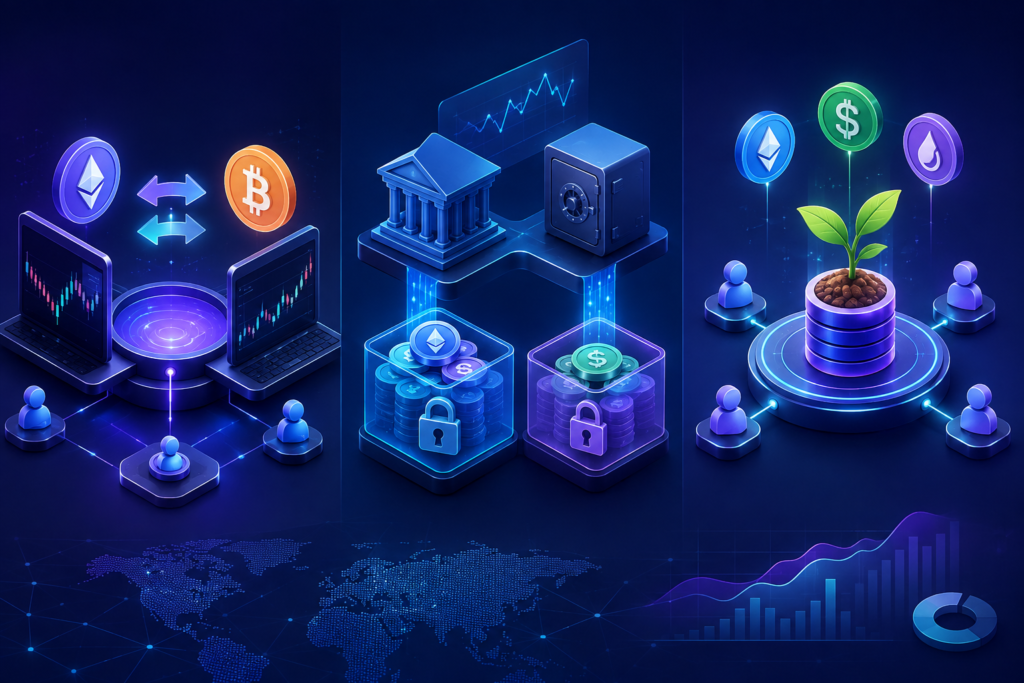
As the decentralized ecosystem reaches maturity, answering what is defi 2026 requires looking at the wide array of financial services now operating entirely on-chain. What began as simple token swapping has evolved into a complete, modular financial stack capable of mirroring—and improving upon—almost every feature of traditional finance.
| DeFi Category | Traditional Equivalent | Key Characteristics | Popular Protocols |
| Decentralized Exchanges (DEXs) | Stock Exchanges / Forex Brokers | Non-custodial, peer-to-peer trading via automated liquidity pools without identity checks. | Uniswap, dYdX, PancakeSwap |
| Lending & Borrowing | Commercial Banks / Loan Agencies | Algorithmic, permissionless lending where borrowers lock digital assets as collateral. | Aave, Compound, MakerDAO |
| Yield Farming & Staking | High-Yield CDs / Investment Accounts | Earning compound yields or consensus rewards by supplying liquidity or locking native tokens. | Lido, Yearn Finance, Convex |
a. Decentralized Exchanges (DEXs): Trading Without Intermediaries
Decentralized Exchanges are the fundamental trading hubs of Web3. In traditional markets, if you want to swap currencies or trade shares, you must open an account with a broker, submit identity verification documents (KYC), and rely on their internal order books.
DEXs like Uniswap, dYdX, and PancakeSwap eliminate every single one of those barriers.
-
Spot Trading via Automated Market Makers (AMMs): Platforms like Uniswap utilize smart contract liquidity pools to allow users to exchange assets (such as swapping ETH for stablecoins) instantly from their Web3 wallets without waiting for an order match.
-
Decentralized Derivatives: Advanced DEXs like dYdX bring perpetual futures and leverage trading on-chain. Traders can execute complex trading strategies with deep liquidity, all while maintaining total custody of their private keys.
-
Permissionless Token Listings: Unlike centralized exchanges that require lengthy, expensive approval processes to list new digital assets, DEXs allow any developer or project to pair their token with liquidity and make it instantly tradeable worldwide.
b. Lending and Borrowing Platforms: Algorithmic Credit Systems
Traditional bank loans are notoriously slow and restrictive. Banks assess your credit score, demand income verification, and take days or weeks to approve funds. In DeFi, protocol-based credit platforms like Aave and Compound make credit accessible to anyone instantly through algorithmic loan pools.
                  ┌───────────────────────────────┐
                  │    AAVE / COMPOUND PROTOCOL   │
                  └───────────────┬───────────────┘
                                  │
          ┌───────────────────────┴───────────────────────┐
          ▼                                               ▼
┌───────────────────┐                           ┌───────────────────┐
│     LENDERS       │                           │    BORROWERS      │
│ Deposit assets    │                           │ Lock collateral   │
│ Earn dynamic APY  │                           │ Borrow instantly  │
└───────────────────┘                           └───────────────────┘
How On-Chain Lending Works
-
For Lenders: Users deposit idle crypto assets into shared smart contract pools. In return, they automatically earn fluctuating interest rates based on real-time market supply and demand.
-
For Borrowers (Over-Collateralization): Because there are no credit scores or background checks in DeFi, loans are over-collateralized. To borrow $100 worth of stablecoins (like USDC), a user might need to lock up $150 worth of Ethereum as collateral inside the smart contract.
-
Liquidation Protection: If the market value of the borrower’s collateral falls below a specific threshold relative to their debt, the smart contract automatically liquidates a portion of the collateral to repay lenders, ensuring the platform always stays solvent.
c. Yield Farming and Staking: Programmatic Wealth Building
In a world where traditional savings accounts often pay minimal real interest, Yield Farming and Staking provide alternative mechanisms for earning yield on digital holdings.
Proof-of-Stake (PoS) Staking
Proof-of-Stake blockchains (such as Ethereum and Solana) rely on token holders locking up their native coins to validate transactions and keep the network secure. In exchange for committing their assets, validators receive network rewards (newly minted tokens and transaction fees).
Liquid staking protocols like Lido have made this even more accessible by letting users stake any amount of crypto while receiving a liquid derivative token (like stETH) that can still be used across other DeFi protocols.
Yield Farming & Yield Aggregators
Yield farming involves strategically moving crypto assets across different DeFi protocols to capture the highest possible returns (consisting of trading fees, interest rates, and protocol incentive tokens).
Because manually balancing assets across dozens of platforms is time-consuming and gas-intensive, Yield Aggregators like Yearn Finance automate the process:
-
You deposit your assets into a Yearn “Vault.”
-
The Vault runs automated smart contract strategies behind the scenes.
-
Your funds are continuously rebalanced to target the optimal risk-adjusted yields across the ecosystem.
4. Key Risks in DeFi and How DeFi Compares to CeFi
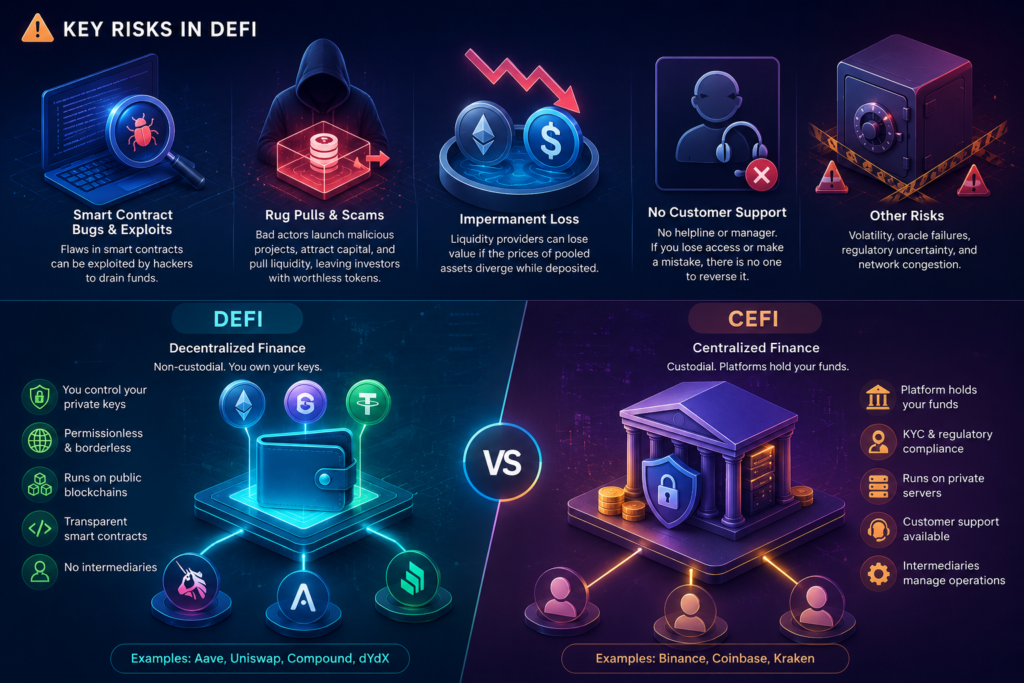
While exploring what is defi 2026, it is critical to address risks alongside benefits. Higher potential returns come with distinct technological and operational vulnerabilities.
Major Risks in DeFi
-
Smart Contract Bugs & Exploits: Code is written by humans. If a developer leaves a flaw in a smart contract, hackers can exploit it to drain funds.
-
Rug Pulls & Scams: Because anyone can launch a token or protocol, bad actors can create malicious projects, attract capital, and pull liquidity out, leaving investors with worthless tokens.
-
Impermanent Loss: Liquidity providers in automated market makers can lose value relative to simply holding tokens if the prices of pooled assets diverge drastically while deposited.
-
No Customer Support: If you send funds to the wrong address or forget your private seed phrase, there is no helpline or manager to reverse the transaction.
DeFi vs. CeFi (Centralized Finance)
Understanding what is defi 2026 also requires contrasting it with Centralized Crypto Finance (CeFi):
-
CeFi (e.g., Binance, Coinbase): Act as intermediaries. They store your private keys, manage compliance, offer customer support, and process transactions internally on private databases.
-
DeFi (e.g., Aave, Uniswap): Operates non-custodially. You retain control of your private keys via wallets, interacting directly with public blockchain smart contracts.
5. Should Beginners Participate in DeFi in 2026?
When asking what is defi 2026 as a beginner, the primary consideration should be your risk tolerance and technical readiness.
Start Small and Educate Yourself
DeFi offers self-sovereignty, financial access, and innovative yield opportunities. However, the learning curve is real. Beginners should:
-
Master base concepts like wallets and security before transferring significant capital.
-
Practice transactions with small test amounts.
-
Never invest more capital than they can afford to lose.
If you are new to the ecosystem, build a foundation by learning about foundational technology first:
-
Read our guide on What Is Blockchain 2026 to understand the settlement layers powering DeFi.
-
Review What Is Cryptocurrency 2026 to grasp how digital tokens function as medium-of-exchange and gas assets.
-
Study How to Store Crypto Safely to ensure your non-custodial wallets and seed phrases remain secure against phishing attacks.
Conclusion
Understanding what is defi 2026 reveals a fundamental shift in how global financial systems can operate—moving from permissioned, human-run institutions to open, code-driven networks. By replacing central intermediaries with self-executing smart contracts, DeFi offers unprecedented financial inclusion, transparency, and user autonomy. However, this level of freedom demands strict personal responsibility. As the ecosystem continues to evolve, staying educated on technical security and risk management will be essential for anyone looking to navigate the future of decentralized finance safely.
Disclaimer: This article is provided strictly for educational and informational purposes only and does not constitute financial, investment, tax, or legal advice. Cryptocurrency assets and decentralized finance (DeFi) protocols involve significant risk, price volatility, and technical exposure to smart contract vulnerabilities. Readers should conduct their own independent research, perform due diligence, and consult with a qualified financial advisor before making any financial decisions or interacting with smart contracts.