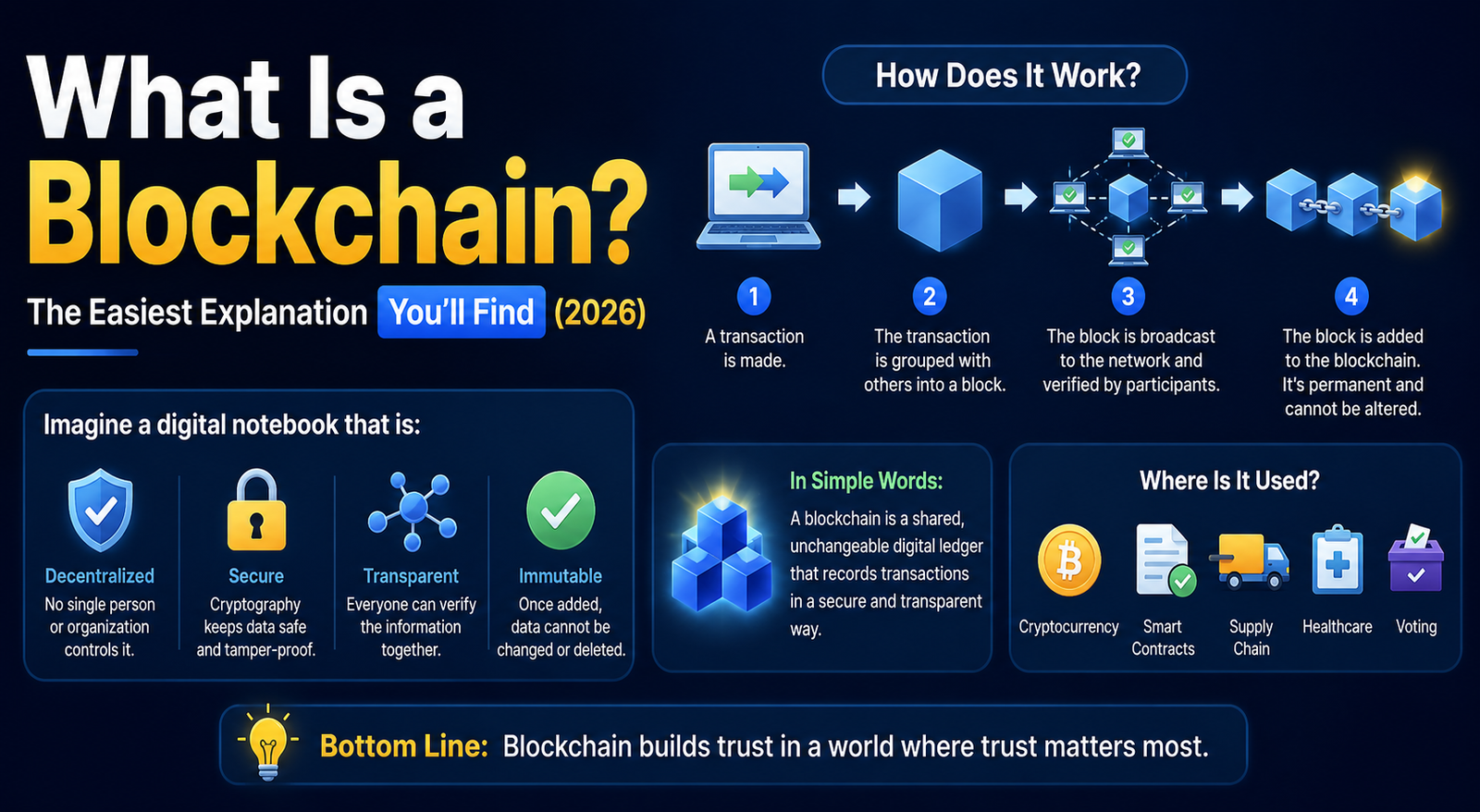
Curious about how crypto works behind the scenes and what is blockchain 2026? Here is the easiest, jargon-free explanation using real-world examples to help you finally understand this revolutionary technology.
If you have spent even five minutes reading about finance, technology, or the future of the internet lately, you have definitely stumbled across the word “blockchain.” Usually, it is wrapped in dense technical jargon, surrounded by complex math, or lumped together with wild stories about Bitcoin and cryptocurrencies.
But stripped down to its core, blockchain is actually a beautifully simple concept. You do not need a computer science degree to understand it.
In this guide, we are going to break down exactly what is blockchain 2026 using simple, everyday examples. No confusing tech-speak allowed. By the time you finish reading, you will understand it better than 95% of the population.
1. Understanding Blockchain Through a Real-World Example
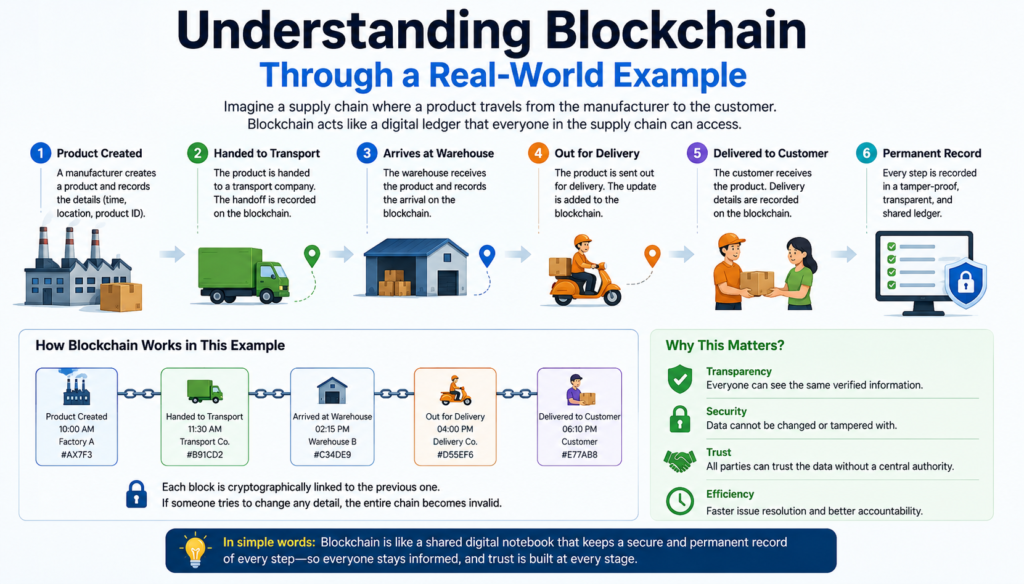
The Google Docs Analogy
If you have ever worked on a Google Doc with a team, you already understand the basic spirit of a blockchain.
In the past, if you wanted to share a document with three coworkers, you had to write it in Microsoft Word, attach the file to an email, and send it to them. Then, you had to wait for them to make changes, save it, and send it back to you. The problem? You had multiple versions of the same file floating around, and it was easy to get confused about which one was the most updated.
With a Google Doc, the file is shared with everyone simultaneously. When one person types a word, everyone else sees it happen in real-time. There is only one version of the truth, and everyone has access to it.
A blockchain works in a similar way. It is a shared, digital notebook that updates automatically across a massive network of computers around the world. Because everyone has an identical copy, no single person can cheat, lie, or alter history.
Building the Chain: How Pages (Blocks) Lock Together in the Record Book
Now that you have the basic picture in your head, let’s look at a few common terms you will hear when people talk about what is blockchain 2026.
Why Is It Called a “Distributed Ledger”?
In the accounting world, a “ledger” is just a fancy word for a record book where you write down income and expenses.
-
Centralized Ledger: Your traditional bank account is a centralized ledger. The bank owns the record book, they keep it on their private servers, and you have to trust them completely to manage your money accurately.
-
Distributed Ledger: “Distributed” means spread out. A blockchain is a distributed ledger because the record book isn’t stored in one single office or computer. It is copied and distributed across thousands of independent computers all over the planet.
Meet the Pieces: Blocks, Chains, and Nodes
How does this digital notebook actually look under the hood? It is built using three simple components:
+-----------+       +-----------+       +-----------+
|  Block 1  |======>|  Block 2  |======>|  Block 3  |
| (Page 1)  |       | (Page 2)  |       | (Page 3)  |
+-----------+       +-----------+       +-----------+
When a page (Block) is completely filled up with transaction data, it is permanently sealed and attached to the page before it. This continuous, unbreakable line of pages creates the blockchain.
2. The Trust Machine: Why Blockchain Cannot Be Hacked or Edited
One of the most common questions beginners ask when exploring what is blockchain 2026 is this: “If this digital notebook is completely public and anyone can download a copy, what stops a clever hacker from simply altering a record to give themselves a million dollars?”
It is a perfectly logical question. In the traditional digital world, if you can access a file, you can usually edit it. If you can hack into a database, you can change the numbers. However, this is exactly where the true genius of blockchain technology reveals itself.
A blockchain is fundamentally designed to be immutable. In plain English, immutable means that once a piece of data is written down and confirmed by the network, it is written in stone. It cannot be changed, it cannot be deleted, and it cannot be overwritten by anyone—not even the person who created it.
To understand why this system is so incredibly secure, we need to look at the three layers of defense that protect a modern blockchain network.
Layer 1: Cryptographic Hashes (The Digital Fingerprints)
Every single block on a blockchain is sealed with a unique identifier known as a cryptographic hash. To keep things simple, do not think of this as complex computer code. Instead, think of a hash as a unique digital fingerprint.
This fingerprint is generated by a highly sophisticated mathematical formula that takes all the data inside that specific block—every single transaction, timestamp, and amount—and condenses it into a fixed string of numbers and letters.
The magic of a hash lies in its extreme sensitivity. If you change even a single character, add a single comma, or move a single decimal point inside a block, the entire digital fingerprint changes instantly and completely. There is no such thing as a “small change” in a hash.
Furthermore, every new block created on the network does not just contain its own fingerprint; it also explicitly stores the fingerprint of the block that came directly before it. This creates an interconnected, tight mathematical chain link between all past history and the present moment.
Layer 2: The Domino Effect (Why Past History Is Locked)
Because every block links to the fingerprint of the previous block, changing the past becomes a logistical nightmare. Let’s look at exactly what happens if a malicious hacker attempts to go back in time to alter a transaction in Block 2 to steal some money.
[Block 1] <--- [Block 2 (HACKED!)] XXXXX [Block 3] ---> (Chain Broken!)
-
The Data Changes: The hacker alters a transaction in Block 2 to show they received a massive payment.
-
The Fingerprint Breaks: Because the data inside Block 2 changed, the hash (fingerprint) of Block 2 instantly changes to something completely new.
-
The Chain Breaks: Block 3 is sitting right next to it, holding a record of the old Block 2 fingerprint. Suddenly, Block 3 looks at its neighbor and realizes the math no longer matches. The link breaks completely, and Block 3 essentially signals to the entire network: “Hey, the chain has been compromised! Someone altered past records!”
To make this hack successful and fool the system, the hacker cannot just stop at Block 2. They would have to manually recalculate and alter the fingerprints for Block 3, Block 4, Block 5, and every single subsequent block that has been added to the chain since that moment.
Because blocks are added every few minutes, the hacker would be racing against a global network of supercomputers, making it mathematically impossible to keep up.
Layer 3: The Security of Numbers (The 51% Rule)
Even if a hacker somehow possessed a supercomputer fast enough to rewrite the fingerprints of an entire blockchain on their own device, they still face an insurmountable obstacle: The Consensus Mechanism.
As we discussed earlier when defining what is blockchain 2026, this ledger does not exist in one central location. It is running on thousands of independent computers (nodes) spread all over the planet.
Whenever a computer proposes a update or a change to the ledger, the entire network takes a vote. The honest nodes constantly compare their versions of the notebook with each other.
-
If 9,999 computers have Notebook A, and one hacker’s computer has Notebook B (the altered one), the network immediately sees the mismatch.
-
The system instantly flags the hacker’s notebook as fraudulent, rejects the changes, and boots them off the network.
To actually rewrite history on a major, established blockchain like Bitcoin or Ethereum, a hacker would need to launch what is called a 51% Attack. This means they would have to buy, set up, and control more than half of all the computers on the global network at the exact same time.
By mid-2026, the sheer size of these decentralized networks makes such an attack practically impossible. Doing this would require billions of dollars worth of specialized computer hardware and enough electricity to power a medium-sized country. Even if you had that money, it would be much more profitable to simply use those computers to secure the network honestly and earn rewards, rather than attempting a hack that would instantly destroy the value of the asset you are trying to steal.
3. Blockchain vs. Traditional Databases: Spotting the Core Differences
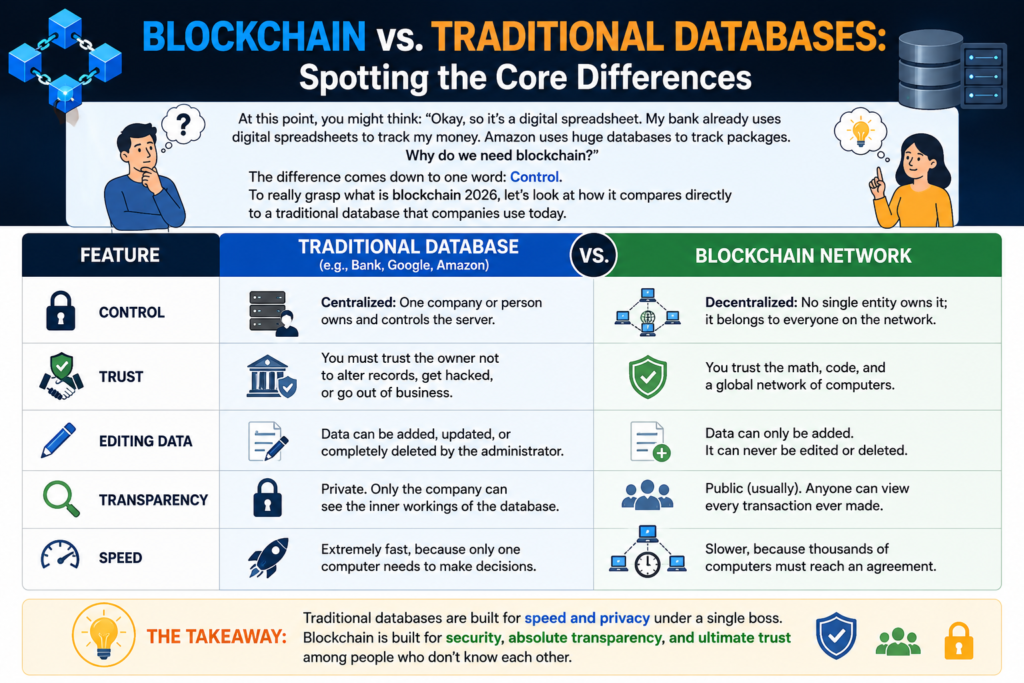
At this point, you might think: “Okay, so it’s a digital spreadsheet. My bank already uses digital spreadsheets to track my money. Amazon uses huge databases to track packages. Why do we need blockchain?”
The difference comes down to one word: Control.
To really grasp what is blockchain 2026, let’s look at how it compares directly to a traditional database that companies use today.
The Takeaway: Traditional databases are built for speed and privacy under a single boss. Blockchain is built for security, absolute transparency, and ultimate trust among people who don’t know each other.
4. Bitcoin vs. Blockchain: Clearing Up the Common Confusion
It is incredibly common for beginners to use the words “Bitcoin” and “Blockchain” interchangeably, as if they are the exact same thing. But they aren’t.
To keep it simple: Blockchain is the technology. Bitcoin is just the very first application of that technology.
Think of it like the relationship between the Internet and Email:
-
The Internet is the underlying infrastructure that allows computers to talk to each other.
-
Email is an application built on top of the internet to send messages.
-
You can use the internet for many other things besides email, like watching Netflix, browsing social media, or shopping online.
Similarly, Bitcoin could not exist without blockchain, but blockchain can do a whole lot more than just power Bitcoin.
If you want to dive deeper into how these two components work hand-in-hand, you can check out our detailed guides on What Is Cryptocurrency 2026 and What Is Bitcoin 2026.
5. Real-World Applications: What Can Blockchain Do Outside of Crypto?
While blockchain started as a tool for digital money, innovators quickly realized that an un-hackable, transparent, shared notebook is incredibly useful for almost every industry on Earth.
As we look at what is blockchain 2026, the technology has expanded far beyond financial markets. Here are a few ways it is shaking up the real world today:
1. Supply Chains (Knowing Exactly Where Your Food Comes From)
Imagine buying a package of organic beef at the grocery store. How do you actually know it is organic? How do you know it didn’t sit in a warm truck for three days? Companies now use blockchain to track items from the farm to the store shelf.
-
The farmer scans a barcode when the beef leaves the farm (recorded on the blockchain).
-
The shipping company records the temperature of the truck every hour (recorded on the blockchain).
-
The grocery store records the date it arrived (recorded on the blockchain). Because no one can alter the data, you can scan a QR code on the package and see an honest, unedited timeline of your food’s journey.
2. Healthcare (Safe and Secure Medical Records)
Medical records are notoriously messy. They are often trapped in separate, private databases owned by different hospitals you have visited throughout your life. If you change doctors, getting your history transferred can be a painful process. By placing medical histories on a secure, encrypted blockchain, you hold the master key to your own health data. Any doctor you visit can instantly view your accurate, updated medical history with your permission, eliminating mistakes and saving lives.
3. Voting (Ending the Election Trust Debate)
Voting systems around the world are constantly plagued by security concerns, recounts, and accusations of tampering. A blockchain-based voting system could allow citizens to cast their votes digitally from their phones or computers. Each vote would be securely recorded as a block on the ledger. Because the records cannot be modified or deleted, election fraud would become virtually impossible, and votes could be counted instantly with 100% transparency.
4. Real Estate (Buying a House Without the Mountain of Paperwork)
Buying a house is currently an absolute nightmare of paperwork, title searches, lawyers, and escrow agents. It takes weeks and costs thousands of dollars in fees just to verify that the person selling the house actually owns it. If property deeds are stored on a blockchain, ownership history is perfectly clear and undisputed. A buyer could transfer money and receive the digital deed to a house in a matter of minutes, cutting out costly middlemen entirely.
Do You Need to Fully Understand Blockchain to Invest in Crypto?
The short answer? No, but it gives you a massive advantage.
Think about it this way: Do you know the exact technical details of how the internet works? Do you understand TCP/IP protocols, data packets, or how fiber-optic cables transmit light waves across the ocean floor? Probably not. But you still use the internet every single day to run your business, watch videos, and manage your life.
The exact same logic applies to cryptocurrencies. You do not need to be able to write blockchain code to buy, sell, or use digital assets.
However, understanding the concept of what is blockchain 2026 is vital because it helps you separate the valuable projects from the hype. When you realize that blockchain is a revolutionary way to build trust without relying on banks, governments, or corporations, you begin to see why certain digital assets hold immense long-term value.
Frequently Asked Questions (FAQ)
Who invented blockchain?
The concept of blockchain was introduced in 2008 by an anonymous person (or group of people) using the pseudonym Satoshi Nakamoto. It was designed to serve as the public ledger for Bitcoin. To this day, nobody knows who Satoshi Nakamoto actually is. Learn more by checking out the foundational resources on Bitcoin.org.
How many blockchain networks are actively running in 2026?
There isn’t just one single “Blockchain.” Anyone can write code and launch their own network. In 2026, there are tens of thousands of active blockchain networks operating globally. Some are public and open to anyone (like Bitcoin and Ethereum), while others are private networks used internally by major corporations and banks.
How big is the Bitcoin blockchain in 2026?
Because every single transaction in Bitcoin’s history is recorded permanently, the file size of the ledger grows every minute. By 2026, the total size of the Bitcoin blockchain has grown to roughly 600 to 650 gigabytes. Anyone who wants to run a full node and verify transactions independently needs enough hard drive space to store this entire history.
Is blockchain bad for the environment?
It depends on the type of blockchain. Early blockchains like Bitcoin use a system called “Proof of Work,” which requires powerful computers to solve math problems, consuming a lot of electricity. However, modern networks—including Ethereum—have switched to an alternative system called “Proof of Stake,” which uses 99.9% less energy, making them incredibly eco-friendly. You can explore these modern use cases directly on Ethereum.org.
Can a blockchain be shut down?
A public, decentralized blockchain cannot be shut down by any single government, company, or individual because it lives on thousands of computers worldwide. As long as there are computers running the software and participating in the network somewhere in the world, the blockchain will keep running.
Conclusion: Blockchain in Two Sentences
If someone asks you at a dinner party to explain what is blockchain 2026, just tell them this: A blockchain is a shared, digital record book that keeps an identical copy of transactions across thousands of computers simultaneously. Because every entry is mathematically locked together, it is completely impossible for anyone to hack, cheat, or change past records.
It is a simple shift from trusting a centralized corporation to trusting a decentralized network of math, code, and community.
Now that you understand the powerful foundation of blockchain technology, are you ready to start your crypto journey? Take your first step securely by checking out our vetted list of the Best Crypto Exchanges 2026 to find the safest platform for your needs.
Disclaimer: The information provided in this article is for educational and informational purposes only. It does not constitute financial, investment, or legal advice. Cryptocurrency investments are highly volatile and carry risks. You should always do your own research (DYOR) and consult with a certified financial advisor before making any investment decisions. The links provided include affiliate or partner resources to help you get started safely.