Read our honest kucoin vs mexc 2026 comparison. Discover trading fees, security, coin selections, and speed of listing to pick the best exchange for altcoins.
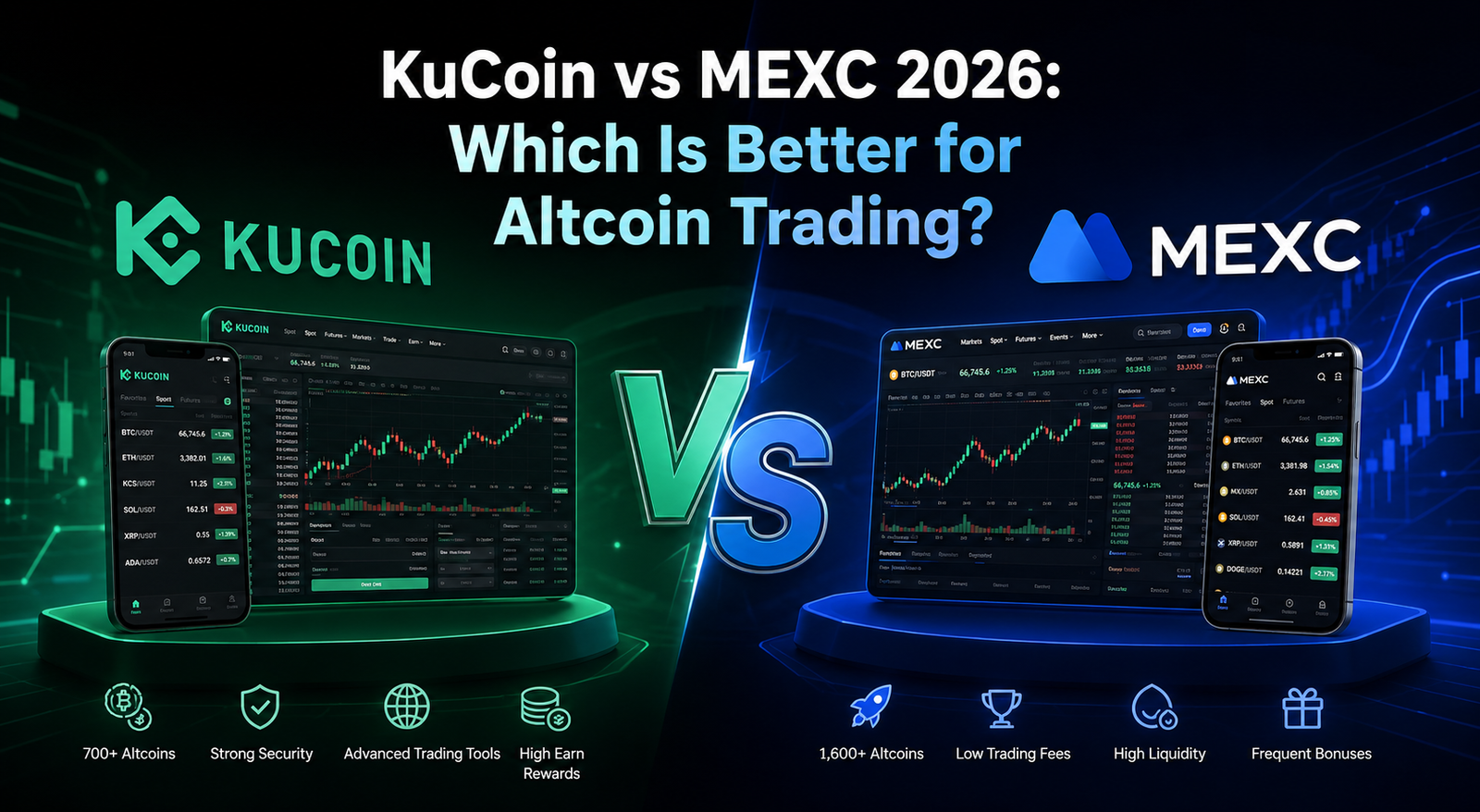
Selecting the right central exchange (CEX) is a critical decision for micro-cap researchers and high-frequency traders. When analyzing kucoin vs mexc 2026, traders face two dominant platforms known for early-stage tokens, massive altcoin ecosystems, and explosive trading features. In this comprehensive kucoin vs mexc 2026 guide, we compare both exchanges to help you choose the best venue for your altcoin strategies.
1. MEXC vs KuCoin: Overview and Market Positions in 2026
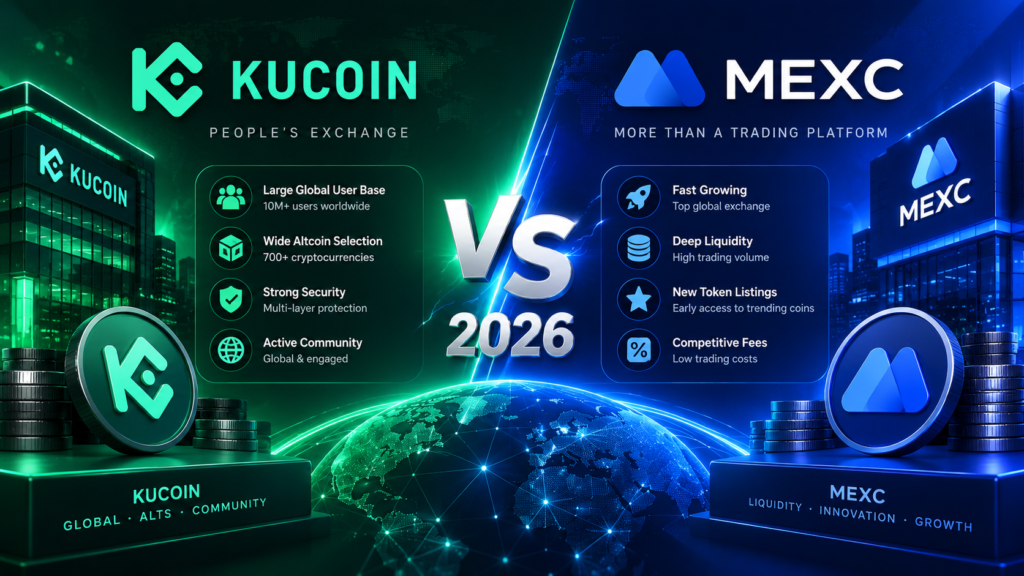
Both platforms have built global reputations around extensive asset listings. Choosing between kucoin vs mexc 2026 comes down to whether you prioritize raw token availability or a balance of liquidity, compliance, and secondary trading services.
MEXC: The High-Volume Launchpad for Early-Stage Assets
Founded in 2018, MEXC has solidified its standing as the primary venue for ultra-low-cap gems, meme coins, and rapid-fire token listings. Serving over 40 million global users across 170+ markets, the platform relies heavily on an aggressive fee structure—notably maintaining 0% maker fee models across spot and futures markets—to attract active day traders, high-frequency scalpers, and retail specifiers.
Beyond spot trading, MEXC acts as a comprehensive incubation hub through its Kickstarter and Launchpad portals. These programs allow users to commit native MX tokens to gain early access to newly minted decentralized finance (DeFi), AI, and Web3 infrastructure projects before they hit mainstream centralized venues. With a focus on high-risk, high-reward trading mechanics, MEXC caters directly to market participants looking to maximize early-stage exposure.
KuCoin: The Established Multi-Service Platform
Known globally as the “People’s Exchange,” KuCoin offers a more mature, refined ecosystem engineered for mid-to-large-cap liquidity, algorithmic automation, and structured asset management. Operating with a stricter listing curation framework than MEXC, KuCoin prioritizes deep order book liquidity, institutional counterparty integration, and compliance frameworks—including dedicated European regulatory pathways under MiCA authorization.
KuCoin sets itself apart through built-in trading infrastructure:
-
Native Automated Bots: Integrated Spot Grid, Futures Grid, Smart Rebalance, and Dollar-Cost Averaging (DCA) bots that execute strategies without requiring external API key management.
-
KuCoin Earn: A robust yield aggregator providing flexible/fixed staking, structured dual-investment products, and institutional-grade lending protocols.
-
Deep Spot & Derivatives Liquidity: A balanced environment designed to minimize slippage on large-order executions across major altcoins and baseline trading pairs.
When evaluating kucoin vs mexc 2026, traders generally lean toward MEXC for fast, low-cost access to emerging micro-caps, while turning to KuCoin for portfolio management, structured passive yields, and programmatic trading tools.
For additional background on individual exchange mechanics, explore our in-depth KuCoin Review 2026 and MEXC Review 2026.
2. Trading Fees & Cost Structures: MEXC Zero Maker Fee vs. KuCoin
When evaluating kucoin vs mexc 2026, fee schedules significantly impact overall profitability—especially for high-frequency day traders, scalpers, and algorithmic execution bots. Minimizing friction costs across spot and derivatives markets is often the single most decisive factor when selecting a primary trading venue.
MEXC Fee Model: Industry-Leading Zero-Fee Framework
MEXC continues to dominate cost-focused comparisons in kucoin vs mexc 2026 discussions due to its hyper-aggressive fee reductions.
-
Spot Trading: 0% Maker fee and 0.05% Taker fee as baseline entry rates. Furthermore, MEXC routinely executes platform-wide promotional campaigns that slash spot Taker fees down to 0% across major pairs.
-
Futures Trading: 0% Maker fee and 0.02% Taker fee for standard Web and Mobile application orders. (Note: API futures executions carry a separate 0.01% Maker / 0.05% Taker structure).
-
Native Token Discount: Holding MX tokens unlocks substantial fee tier reductions. Staking or maintaining a balance of 500+ MX tokens grants up to a 50% discount on applicable Taker fees.
KuCoin Fee Model: Tiered Volume Discounts & Utility Rebates
KuCoin utilizes a traditional, tiered Maker-Taker matrix that rewards institutional volume, high account balances, and native token utilization.
-
Spot Trading: Base Level 0 (LV0) accounts start at 0.10% Maker and 0.10% Taker for standard Class A trading pairs. Lower-liquidity Class B and Class C micro-cap altcoin listings carry scaled base rates reaching up to 0.16% or 0.24%.
-
Futures Trading: Standard baseline derivatives contracts charge 0.02% Maker and 0.06% Taker.
-
Native Token Discount: Activating the “Pay Fees with KCS” option provides an automatic 20% discount on spot trading fees, reducing baseline costs down to an effective 0.08% Maker / 0.08% Taker rate.
Direct Fee Comparison: Impact on Active Traders
In any direct kucoin vs mexc 2026 cost breakdown, MEXC provides significantly lower baseline execution expenses for retail market participants. For example, executing a $10,000 spot Limit (Maker) order on KuCoin incurs a $10 fee (or $8 with KCS discount), whereas the same order on MEXC incurs $0. Over hundreds of monthly trades, this cost divergence makes MEXC the superior choice for fee-sensitive traders, while KuCoin relies on its VIP tier progression to match institutional rates.
3. Asset Availability & New Listing Speed
A major driver in the kucoin vs mexc 2026 decision is access to early-stage projects, high-growth ecosystems, and diverse trading pairs. For altcoin traders, asset selection determines whether an exchange functions as a discovery engine for micro-cap gems or a reliable hub for liquid mid-cap tokens.
Coin Selection: Ecosystem Depth vs. Quality Curation
-
MEXC Catalog: MEXC hosts over 3,000 listed cryptocurrencies and thousands of active trading pairs. Its catalog covers speculative meme coins, nascent Web3 gaming protocols, experimental Layer-1/Layer-2 tokens, and decentralized finance (DeFi) assets.
-
KuCoin Catalog: KuCoin supports a curated catalog of 700 to 800+ cryptocurrencies. Rather than listing every available token, KuCoin acts as a secondary filter, focusing on projects with verified trading volume, active developer activity, and sustainable tokenomics.
Listing Velocity: Rapid Execution vs. Vetted Quality
-
MEXC Listing Speed: MEXC lists newly launched tokens rapidly, often within hours of contract deployment or initial Decentralized Exchange (DEX) liquidity pool creation. By acting as a primary CEX venue, MEXC allows retail traders to acquire early-stage tokens before they reach broader market awareness.
-
KuCoin Listing Speed: KuCoin maintains a structured vetting procedure through its Spotlight launchpad and formal review board. While it lists assets significantly faster than conservative venues like Coinbase, KuCoin prioritizes initial spot liquidity depth, anti-sybil checks, and project track record prior to market opening.
Market Fit for Altcoin Traders
In any direct kucoin vs mexc 2026 evaluation, your strategy dictates platform choice:
-
Early-Stage Speculators: Traders seeking sub-50-million-dollar market cap opportunities and meme coin launches favor MEXC for its raw speed and unmatched token selection.
-
Balanced Altcoin Investors: Traders who prioritize higher liquidity, lower slippage, and integration with automated DCA or grid trading tools rely on KuCoin’s refined asset selection.
For broader market options and comparative breakdowns, consult our comprehensive guide on the Best Crypto Exchanges 2026.
4. Security Frameworks, Proof of Reserves & Funds Protection
Security and transparency remain crucial when evaluating kucoin vs mexc 2026. Both exchanges utilize modern custodial security architectures.
Security Architecture Comparison

MEXC:
├── Merkle Tree Proof of Reserves (PoR) [Audited by Hacken]
├── Asset Reserve Ratios > 100% (BTC, ETH, USDT, USDC)
└── $100M Guardian Protection Fund + Futures Insurance Fund

KuCoin:
├── Merkle Tree Proof of Reserves (PoR)
├── Multi-Asset Cold Storage & Multi-Sig Custody
└── Multi-Layer Operational Security & Risk Management
-
MEXC Safeguards: MEXC publishes monthly Merkle Tree Proof of Reserves (PoR) independently audited by Hacken, consistently maintaining reserve ratios above 100% across core digital assets (BTC, ETH, USDT, USDC). It backs operations with a $100 Million Guardian Fund alongside a dedicated Futures Insurance Fund.
-
KuCoin Safeguards: KuCoin conducts periodic Proof of Reserves updates utilizing Merkle Tree verification, backed by cold wallet storage, hardware security modules (HSM), and rigorous access controls.
5. UI/UX, Mobile Trading & User Friendliness
Platform navigation influences order execution speed and efficiency, especially for beginners evaluating kucoin vs mexc 2026.
-
Beginner Experience: KuCoin delivers a polished interface with structured navigation, clear asset categorization, and embedded educational guides. MEXC offers a functional interface optimized for quick order placement across its vast list of tokens.
-
Automated Trading: KuCoin features native, customizable Grid and DCA bots directly within its mobile application. MEXC supports standard strategy trading and third-party integrations via API.
-
Mobile App Usability: Both exchanges provide iOS and Android applications with live TradingView charting, real-time order books, and price alert systems.
6. Withdrawal Fees, Chains & Options
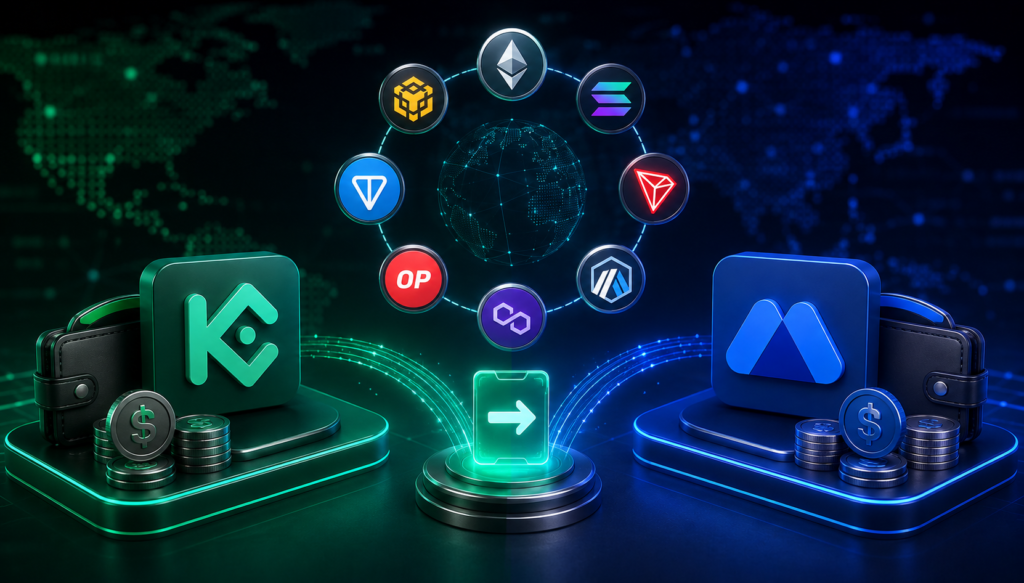
Deposit and withdrawal efficiency is a key operational metric when evaluating kucoin vs mexc 2026. For high-frequency traders and DeFi liquidity providers, moving assets seamlessly between centralized accounts and self-custodial wallets without incurring steep fees or execution delays directly impacts net portfolio performance.
Blockchain Network Variety & Cross-Chain Integration
Both venues support extensive cross-chain architecture, allowing users to deposit and withdraw assets via multiple layer-1 and layer-2 networks.
-
Supported Chains: Standard multi-chain deployments include Ethereum (ERC-20), BNB Chain (BEP-20), Solana, TRON (TRC-20), Arbitrum One, Optimism, Polygon, and TON (The Open Network).
-
Niche Network Support: Because MEXC lists micro-cap assets rapid-fire upon token creation, it frequently integrates niche or newly launched mainnets earlier than competitor venues. KuCoin, while maintaining deep support for major EVM-compatible ecosystems, typically adds dedicated network support alongside established token listings.
Withdrawal Cost Dynamics: Dynamic Network Pricing vs. Promotions
While deposit processing is completely free across both platforms, withdrawal costs follow a dynamic, per-network fee model tailored to real-time gas costs and on-chain congestion.
-
MEXC Withdrawal Structure: MEXC applies flat per-coin and network-specific fees that fluctuate with baseline block-space demand. To maintain its competitive edge for retail users, MEXC frequently launches promotional campaigns that subsidize or completely waive withdrawal fees across selected Layer-2 networks (such as Arbitrum, Optimism, or Polygon) and low-cost Layer-1 chains (such as Solana, TON, or Sui).
-
KuCoin Withdrawal Structure: KuCoin tracks transparent, real-time network fees with automated scaling adjustments based on mempool congestion. While KuCoin rarely offers zero-fee withdrawal promotions, its withdrawal infrastructure provides features like account-to-account internal transfers (100% free) and withdrawal whitelisting for enhanced custody management.
Practical Transfer Strategy for Altcoin Traders
When transferring funds between venues in the kucoin vs mexc 2026 environment:
-
Optimize Network Choice: Avoid high-congestion mainnets like Ethereum for stablecoin transfers; instead, utilize lower-cost routes like TRON (TRC-20), Solana, or Arbitrum, where fees remain near $1 or lower.
-
Verify Real-Time Rates: Always check the live withdrawal fee interface on the execution screen prior to confirming transfers, as gas spikes directly alter processing charges across both exchanges.
7. Head-to-Head Comparison: 8 Key Criteria
The following table breaks down the essential features of kucoin vs mexc 2026:
| Criteria | MEXC (2026) | KuCoin (2026) |
| 1. Primary Advantage | Ultra-low fees & vast asset selection | High spot depth, trading bots & KuCoin Earn |
| 2. Listed Tokens | 3,000+ | 700+ to 800+ |
| 3. Spot Maker Fee | 0% | 0.10% (Class A standard) |
| 4. Spot Taker Fee | 0.05% (or lower on campaigns) | 0.10% (Class A standard) |
| 5. Futures Fees | 0% Maker / 0.02% Taker | 0.02% Maker / 0.06% Taker |
| 6. Native Token | MX (up to 50% discount) | KCS (20% fee discount) |
| 7. Proof of Reserves | Monthly PoR (Audited by Hacken) | Regular Merkle Tree PoR |
| 8. Listing Speed | Fast (Hours after launch) | Moderate (Focuses on vetted projects) |
Evaluating these parameters helps pinpoint which venue matches your trading volume and strategy in the kucoin vs mexc 2026 ecosystem.
Final Verdict: Which Exchange Should You Choose in 2026?
Selecting the winner of kucoin vs mexc 2026 depends on your specific trading style and goals:
Choose MEXC if you:
-
Want the lowest trading fees (0% spot maker / 0.05% taker).
-
Trade low-cap altcoins, new meme coins, and early-stage tokens right after launch.
-
Prioritize high-frequency futures trading with low maker fees.
Choose KuCoin if you:
-
Prefer established altcoins with deeper order book liquidity.
-
Want access to built-in trading bots and structured yield products (KuCoin Earn).
-
Prefer a polished user interface tailored for long-term portfolio management.
Many active traders maintain accounts on both platforms—using MEXC to catch new altcoin launches and KuCoin for executing higher-volume trades.
For live market metrics and volume statistics, check out the official market pages on CoinGecko KuCoin Page and CoinGecko MEXC Page.
Disclaimer
Financial Disclaimer: Cryptocurrency trading involves substantial risk of loss and is not suitable for every investor. The valuation of digital assets can fluctuate rapidly. This content is strictly for educational and informational purposes and does not constitute financial, investment, or legal advice. Always conduct independent research (DYOR) and evaluate your personal financial position before trading on centralized exchanges.