Curious about what is crypto staking 2026? Discover how staking works, its risks, APY expectations, and how beginners can start earning passive income today.
If you have spent any time exploring the cryptocurrency market, you have likely come across the term “staking.” Promised as a way to generate passive income on your digital assets without actively trading, it has become one of the most popular strategies for long-term investors. But what is crypto staking 2026, how does it work behind the scenes, and is it truly as risk-free as some make it sound?
In this comprehensive guide, we will break down the concept into plain English, explain the underlying technology, weigh the genuine benefits against critical risks, and provide a clear roadmap for beginners looking to get started safely.
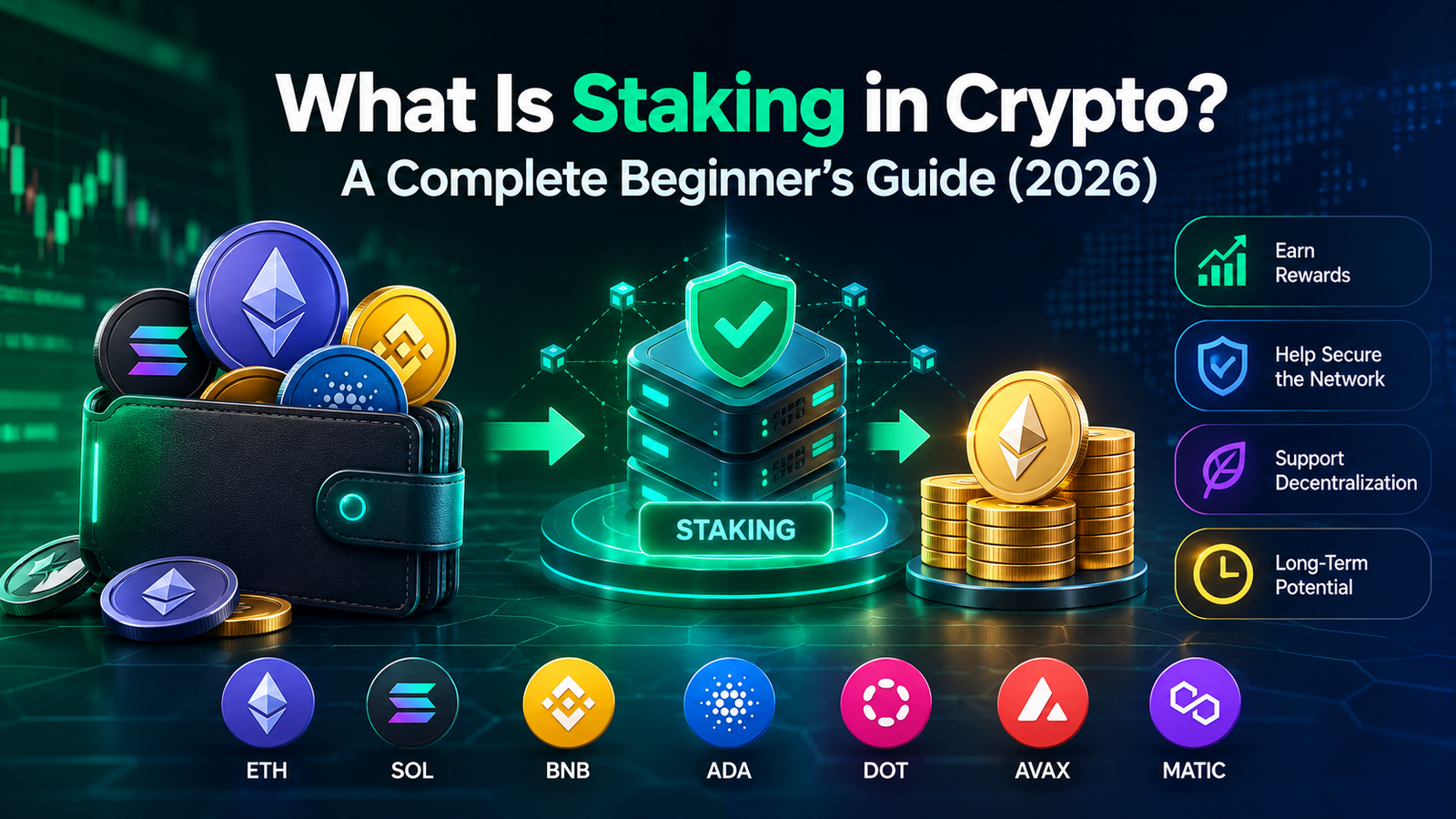
What Is Staking in Crypto? A Complete Beginner’s Guide (2026)

At its core, understanding what is crypto staking 2026 begins with a simple concept: locking up your digital assets to support a blockchain network in exchange for financial rewards.
To grasp how this works without getting bogged down in complex computer science, compare crypto staking to a traditional High-Yield Savings Account at a bank:
-
Savings Account: You deposit fiat currency (like USD or EUR) into a bank. The bank uses your money to issue loans or fund financial operations. In return for letting them hold your capital, the bank pays you a percentage of interest annually.
-
Crypto Staking: You lock your cryptocurrency tokens into a blockchain network or smart contract. The network uses your staked assets to validate transactions and maintain security. In return for helping secure the system, the blockchain generates new tokens and distributes them to you as rewards.
However, unlike a bank account where a centralized third party manages your funds, on-chain crypto staking operates autonomously through decentralized protocols. When people ask what is crypto staking 2026 in everyday language, the simplest answer is: it is a way to earn “yield” or interest on your digital asset holdings simply by keeping them locked in place.
How Proof of Stake (PoS) Works Under the Hood
To fully answer what is crypto staking 2026, we must look at the consensus mechanism that makes it possible: Proof of Stake (PoS).
Blockchains are decentralized digital ledgers. Because there is no central authority like Visa or PayPal to verify that transactions are legitimate, the network relies on participant nodes to review transactions, group them into blocks, and add them permanently to the chain.
Proof of Work vs. Proof of Stake
In older networks like Bitcoin, this agreement is achieved via Proof of Work (PoW). Miners run powerful, energy-intensive computer rigs to solve complex mathematical puzzles. The first miner to solve the puzzle earns the right to validate the block and receive a reward. While secure, PoW consumes massive amounts of electricity and scales slowly.
Proof of Stake (PoS) was developed as a greener, more scalable alternative:
-
Validators Replace Miners: Instead of buying expensive mining computers, participants lock up (stake) the network’s native token (e.g., ETH on Ethereum, SOL on Solana) to become network validators.
-
Block Selection: The consensus mechanism randomly selects a validator to propose and verify the next block of transactions. The probability of being chosen is directly proportional to the amount of crypto the validator has staked.
-
Earning Rewards: Once a validator verifies transactions accurately and adds the block to the ledger, the network mints new tokens and collects transaction fees, distributing them back to the validator as a reward.
For networks such as Ethereum—as detailed in our guide on [What Is Ethereum 2026]—transitioning to PoS reduced network energy usage by over 99% while opening up earning potential to everyday token holders.
The Main Benefits: Why Investors Stake Crypto
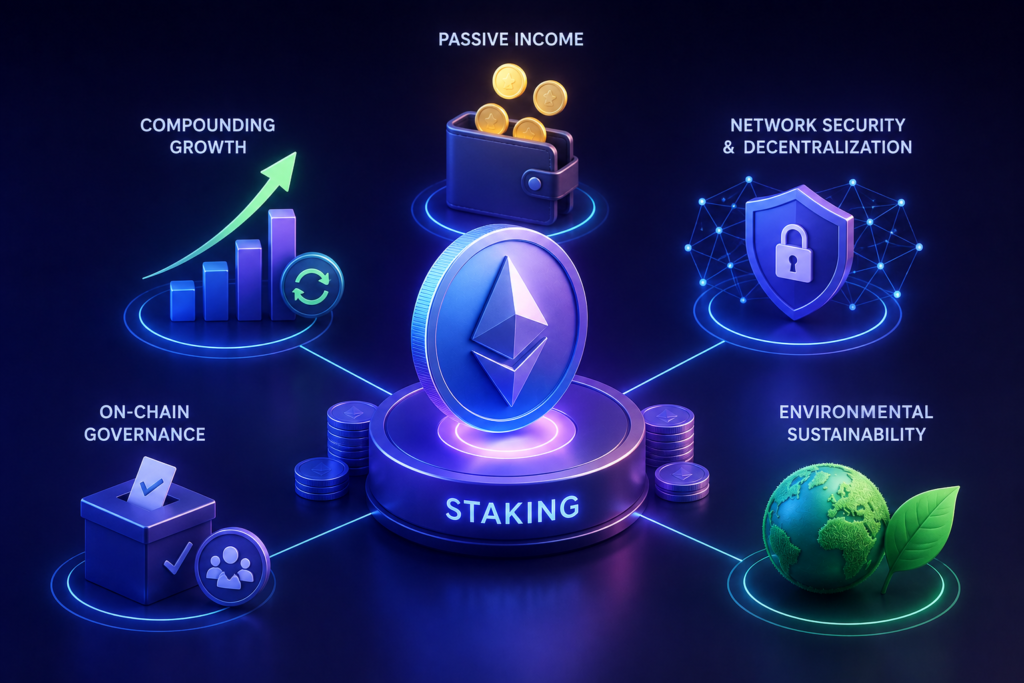
The rapid expansion and institutional maturity of the digital asset landscape highlight why understanding what is crypto staking 2026 has become a fundamental pillar for modern crypto investors. Rather than leaving digital tokens sitting idle in self-custodial cold wallets or exchange accounts, staking transforms passive holdings into active, yield-bearing financial productive assets. For long-term investors committed to the future of Web3 infrastructure, participating in network consensus offers several compelling, multi-faceted benefits that go beyond simple interest generation.
Benefits of Staking
-
Passive Income Generation: Earn continuous, programmatic token yields on your existing digital asset holdings without needing to actively trade.
-
Compounding Growth: Accelerate your portfolio balance over time through automated or manual reward reinvestment strategies.
-
Network Security & Decentralization: Directly strengthen node consensus mechanisms, help distribute validation power, and shield blockchains against malicious attacks.
-
On-Chain Governance Voting: Influence future protocol upgrades, community treasury allocations, and key ecosystem parameter changes by exercising your voting rights.
-
Environmental Sustainability: Participate in an eco-friendly yield model that requires minimal electricity overhead compared to traditional hardware mining.
1. Earning Reliable Passive Yield
The most immediate appeal of staking is the ability to generate a steady, predictable stream of passive income. When you lock or delegate your native tokens on a Proof of Stake (PoS) blockchain, the protocol rewards you with freshly minted tokens alongside a share of collected network transaction fees. Because these rewards are distributed programmatically directly from the protocol layer based on transparent consensus rules, investors can accurately project token accumulation over time. This continuous distribution provides a consistent cash flow in crypto terms, helping offset broader market stagnation or sideways price action.
2. Powerful Portfolio Compounding Effects
Beyond baseline returns, modern staking ecosystems make it seamless to compound your earnings for exponential portfolio growth. By regularly reinvesting—or utilizing liquid protocols that automatically auto-compound—your accrued rewards back into your staked balance, your earning base expands exponentially over time. Over extended investment horizons, this compounding engine dramatically accelerates the total unit count of your digital asset holdings, maximizing your upside potential when bull cycles drive up underlying token values.
3. Strengthening Ecosystem Security and Governance Rights
When deeply evaluating what is crypto staking 2026, it is important to recognize the vital non-financial contribution stakers make to decentralized architecture. By committing your tokens to validator nodes, you directly increase the economic cost required for malicious actors to launch a 51% attack or compromise the ledger. Distributed stake across thousands of globally operating nodes preserves decentralization and trustless reliability. Furthermore, in many modern Layer-1 and Layer-2 protocols, staked token ownership grants direct voting power on-chain, allowing you to voice opinions, vote on technical upgrades, approve grant disbursements, and shape the long-term strategic evolution of the networks you hold.
4. Eco-Friendly Operational Sustainability
Unlike legacy Proof of Work (PoW) networks that demand vast data centers and monumental electrical power to solve computational puzzles, Proof of Stake operates with high energy efficiency. By securing networks through economic collateral rather than raw electricity, staking reduces the carbon footprint of blockchain verification by over 99.9%. This environmental sustainability makes staking an aligned choice for modern ESG-conscious institutions and retail investors alike.
The Dark Side: Essential Risks You Must Know
While the prospect of earning continuous passive yield is undeniable, an authentic beginner’s guide must provide a realistic, transparent assessment of the associated vulnerabilities. Truly mastering what is crypto staking 2026 requires balancing financial optimism with a clear-eyed evaluation of market exposure, technical friction, and custodial risks.
1. Market Volatility and Fiat Value Depreciation
The most prevalent hazard for newcomers is failing to separate token quantity from fiat purchasing power. Staking yields are denominated and paid out in the network’s native cryptocurrency, not in stable fiat currencies like US dollars or Euros.
Real-World Scenario: Suppose you purchase and stake 100 units of a token at $10 each (a $1,000 investment) offering a generous 12% Annual Percentage Yield (APY). After one full year, your nominal token balance grows to 112 tokens. However, if market volatility causes the asset’s price to drop by 40% to $6 per token, your total portfolio value shrinks to $672 ($112 \times \$6$). Despite earning 12 extra tokens, you incur an overall capital loss of $328 in fiat terms. Yield cannot offset severe underlying price drawdowns.
2. Lockup Periods and Unbonding Friction
Proof of Stake networks maintain financial stability by requiring staked capital to remain committed to the network. Consequently, most protocols enforce an unbonding or lockup period when you decide to withdraw your assets—a process that typically ranges from 7 to 28 days depending on the specific blockchain. During this unbonding window:
-
Your assets cease earning staking rewards.
-
Your tokens remain completely illiquid and locked in smart contracts.
-
You cannot transfer, swap, or sell your holdings to mitigate capital losses during sudden market crashes or black swan events.
3. Slashing Penalties and Validator Failures
To preserve consensus integrity without centralized oversight, Proof of Stake networks rely on severe, automated economic penalties known as slashing. If a validator node behaves improperly—whether by attempting to double-sign transaction blocks, validating conflicting ledger entries, or suffering extended operational downtime—the underlying protocol automatically confiscates and permanently burns a percentage of the capital staked on that node. If you delegate your tokens to an improperly managed or malicious validator, your principal capital can be permanently destroyed through no fault of your own.
4. Smart Contract Bugs and Platform Exposure
Participating in staking often requires interacting with external software infrastructure, introducing layers of operational risk:
-
Smart Contract Vulnerabilities: When utilizing liquid staking protocols or non-custodial decentralized applications (dApps), your funds are held in automated smart contracts. If a hacker uncovers a hidden logic flaw or reentrancy bug in the protocol’s code, they can exploit the contract and drain the underlying liquidity pools.
-
Centralized Exchange Insolvency: Opting for easy, one-click exchange staking transfers your private key ownership to a third-party custodial business. If the exchange suffers a security breach, mismanages user funds, or faces bankruptcy, your staked holdings can be frozen or lost entirely in legal proceedings.
The 3 Main Types of Crypto Staking
Depending on your technical expertise, asset size, and risk tolerance, there are three main methods to stake digital assets.
+-----------------------------------------------------------------------------------+
|                            TYPES OF STAKING COMPARED                              |
+-------------------+---------------------------+-------------------+---------------+
| Staking Type      | Primary Examples          | Ease of Use       | Custody Control|
+-------------------+---------------------------+-------------------+---------------+
| On-Chain Direct   | Native ETH, SOL, ADA      | Advanced / Med    | Full Self     |
+-------------------+---------------------------+-------------------+---------------+
| Exchange Staking  | Bybit Earn, Binance Earn  | Very Easy         | Custodial     |
+-------------------+---------------------------+-------------------+---------------+
| Liquid Staking    | Lido (stETH), Rocket Pool | Moderate          | Smart Contract|
+-------------------+---------------------------+-------------------+---------------+
1. On-Chain Native Staking (Solo or Delegated)
-
Solo Staking: Running your own validator hardware node directly connected to the blockchain network. On networks like Ethereum, this requires technical expertise, constant internet connectivity, and a minimum of 32 ETH.
-
Delegated Staking: Chains like Solana (SOL) and Cardano (ADA) use Delegated Proof of Stake (DPoS). You can delegate the voting power of your tokens to an existing community validator directly from your non-custodial wallet without losing custody of your private keys.
2. Exchange-Based Staking (Custodial)
Centralized crypto exchanges offer simple, one-click staking features for beginners:
-
How it works: You deposit crypto on an exchange platform, select their earn product, and click “Stake.” The platform handles validator hardware, smart contracts, and distribution behind the scenes.
-
Pros: Extremely beginner-friendly with low minimum entry amounts.
-
Cons: You forfeit direct control of your private keys to a central company.
3. Liquid Staking
Traditional staking locks your crypto, making it unusable until unstaked. Liquid Staking Protocols solve this capital inefficiency:
-
How it works: When you deposit your crypto (e.g., ETH) into a liquid staking protocol like Lido or Rocket Pool, the protocol stakes the ETH for you and issues a “liquid receipt token” (such as stETH or rETH) in return at a 1:1 ratio.
-
Why it matters: These receipt tokens accrue staking yields automatically while remaining liquid. You can hold, trade, or use them as collateral across various decentralized finance platforms.
Where and How to Start Staking for Beginners?
For newcomers taking their first steps, choosing a safe, reliable entry point is critical. Here is a practical, step-by-step path:
Step 1: Choose Your Preferred Platform Type
-
For Absolute Beginners: Centralized options like Bybit Earn provide straightforward dashboards and automated reward payouts. To evaluate features and safety measures, read our comprehensive Bybit Review 2026.
-
For Intermediate Users: Non-custodial crypto wallets paired with liquid staking protocols or delegated pools offer greater autonomy and control.
Step 2: Acquire Staking-Compatible Assets
Select supported Proof-of-Stake assets. Top options include Ethereum (ETH), Solana (SOL), Cardano (ADA), or Polkadot (DOT). Avoid purchasing micro-cap altcoins purely because they advertise temporary high yields.
Step 3: Secure Your Private Keys
If you opt for on-chain or liquid staking via self-custodial wallets, practicing proper security hygiene is vital. Review our step-by-step guide on [How to Store Crypto Safely](link bài đã publish) to safeguard your seed phrases and hardware devices against online threats.
Step 4: Initiate Staking and Track Yields
Navigate to your chosen platform’s earn portal, select your asset, review lockup periods and slash protection policies, and confirm the transaction. Monitor your yield payouts regularly to ensure your selected validator maintains high uptime.
Frequently Asked Questions (FAQ)
Can you lose crypto by staking? Yes, it is entirely possible to suffer financial losses or lose your principal tokens when participating in crypto staking. The primary avenue of loss is market depreciation: because staking yields are paid out in the native digital asset rather than stable fiat currency, a sharp drop in the token’s market price can easily eclipse any percentage interest you earn. For instance, if you achieve an 8% annual yield on a token whose market value plummets by 50% over the same timeframe, your total portfolio value in real dollar terms decreases significantly. Beyond market risk, there are concrete technical risks:
-
Validator Slashing: If you delegate your tokens to an unreliable or dishonest validator node that violates consensus rules (e.g., signing double blocks or experiencing extended server downtime), the underlying protocol may execute a penalty called “slashing.” This permanently burns a percentage of the staked capital, including funds from innocent delegators.
-
Smart Contract Vulnerabilities: Utilizing liquid staking protocols or decentralized applications (dApps) introduces software exposure. If the underlying smart contract contains exploitable bugs or logic flaws, malicious actors could drain the liquidity pool, resulting in a total loss of your deposited funds.
-
Platform Insolvency: Staking through centralized exchanges (CEXs) exposes you to counterparty custody risk. If the exchange faces liquidity crises, operational mismanagement, or regulatory freezes, your staked assets could become trapped or lost entirely in bankruptcy proceedings.
Is staking legal globally? The legal and regulatory status of crypto staking varies dramatically depending on your jurisdiction, as financial authorities worldwide continue to refine their frameworks surrounding digital assets:
-
Regulatory Classification: In several regions, regulatory bodies (such as the U.S. Securities and Exchange Commission) have scrutinized centralized “Staking-as-a-Service” programs offered by exchanges, arguing that yield-bearing accounts may constitute unregistered securities offerings. Consequently, some platforms have restricted or sunsetted staking products for retail users in specific countries, even while native, on-chain staking remains operationally accessible.
-
Taxation Requirements: From a tax perspective, most major revenue agencies (including the IRS in the United States, HMRC in the United Kingdom, and Australian Taxation Office) treat crypto staking rewards as taxable income. The income is typically assessed based on the fair market value of the earned tokens on the exact date and time they are received into your control. Furthermore, if you later sell, trade, or swap those earned rewards after their price has appreciated, you may also be subject to capital gains tax on the realized profits. Because reporting requirements change rapidly, it is crucial to consult a local tax professional or CPA specializing in digital assets.
What is the difference between staking and crypto lending? While both strategies enable investors to generate passive yield on their digital holdings, they rely on fundamentally different economic mechanisms, risk profiles, and infrastructure:
-
Crypto Staking: This is an infrastructure-level mechanism native to Proof of Stake (PoS) blockchains. When you stake, your tokens are locked into a protocol or delegated to a validator node to verify transactions, produce blocks, and secure the underlying decentralized ledger. The rewards you receive are freshly minted tokens generated directly by the protocol’s inflation model, supplemented by network transaction fees. You are not lending your capital to a borrower; rather, your capital acts as financial collateral to guarantee honest participation in consensus.
-
Crypto Lending: This is a credit market activity that can occur on centralized finance (CeFi) platforms or decentralized finance (DeFi) lending protocols (such as Aave or Compound). In lending, you deposit your crypto into a lending pool or hand it to an intermediary, which then loans those funds out to institutional borrowers, margin traders, or liquidity seekers. The yield you earn comes directly from the interest rates paid by these borrowers, rather than network-level protocol emissions. Consequently, lending carries distinct credit risks, such as borrower default, collateral liquidation failures, or pool illiquidity during market volatility.
Is staking worth it for small amounts of crypto? Staking can certainly be worthwhile for smaller capital allocations, but its feasibility largely depends on the specific blockchain architecture and the method of staking you choose:
-
High-Fee vs. Low-Fee Networks: On high-throughput, low-fee Layer-1 and Layer-2 networks (such as Solana, Cardano, Avalanche, or Ethereum L2s), transaction fees for delegating, claiming rewards, and unstaking cost fractions of a cent. On these chains, even small balances can comfortably accumulate compound interest over time without transaction fees eroding your profit margins.
-
Ethereum Base-Layer Constraints: Conversely, conducting direct on-chain smart contract interactions or liquid staking transactions on the mainnet Ethereum execution layer requires paying “gas fees” in ETH. During periods of high network congestion, executing the necessary smart contract approvals and deposits can cost dozens of dollars in gas. If you are only staking a small balance (e.g., $100 equivalent of ETH), the initial network gas fee alone could exceed your entire expected annual yield, rendering direct base-layer staking economically unviable.
-
Alternative Solutions for Small Balances: Small-scale investors looking to participate without high overhead generally turn to centralized exchanges (which pool funds and absorb gas costs internally) or liquid staking protocols deployed on lower-cost Layer-2 scaling solutions, allowing them to earn proportional yields without fee friction.
Conclusion
As the global blockchain ecosystem matures throughout 2026, gaining a comprehensive understanding of what is crypto staking 2026 has evolved from an optional technical curiosity into an essential skill for anyone building a resilient digital asset strategy. Staking effectively bridges the structural gap between high-risk active trading and passive long-term holding. It offers token holders a reliable, programmatic way to generate native yield while simultaneously reinforcing the consensus mechanisms, operational security, and decentralization of the underlying network infrastructure.
However, in the world of digital assets, financial yield never exists in a vacuum—it is always a direct reflection of underlying risk. Before committing your capital to any staking pool, liquid derivative, or exchange program, it is paramount to conduct thorough due diligence. Investors must carefully evaluate key variables, including token price volatility, unbonding lockup durations, protocol smart contract audits, validator reliability, and platform custody risks. By balancing yield expectations with strict risk management, you can ensure that your staking strategy fits seamlessly into your overall financial goals while protecting your assets for the long term.
Disclaimer: This article is strictly for educational and informational purposes only and does not constitute financial, investment, legal, or tax advice. Cryptocurrency markets are highly volatile and carry significant risk of capital loss. Always conduct your own independent research (DYOR) and consult with a qualified financial advisor before making investment decisions.