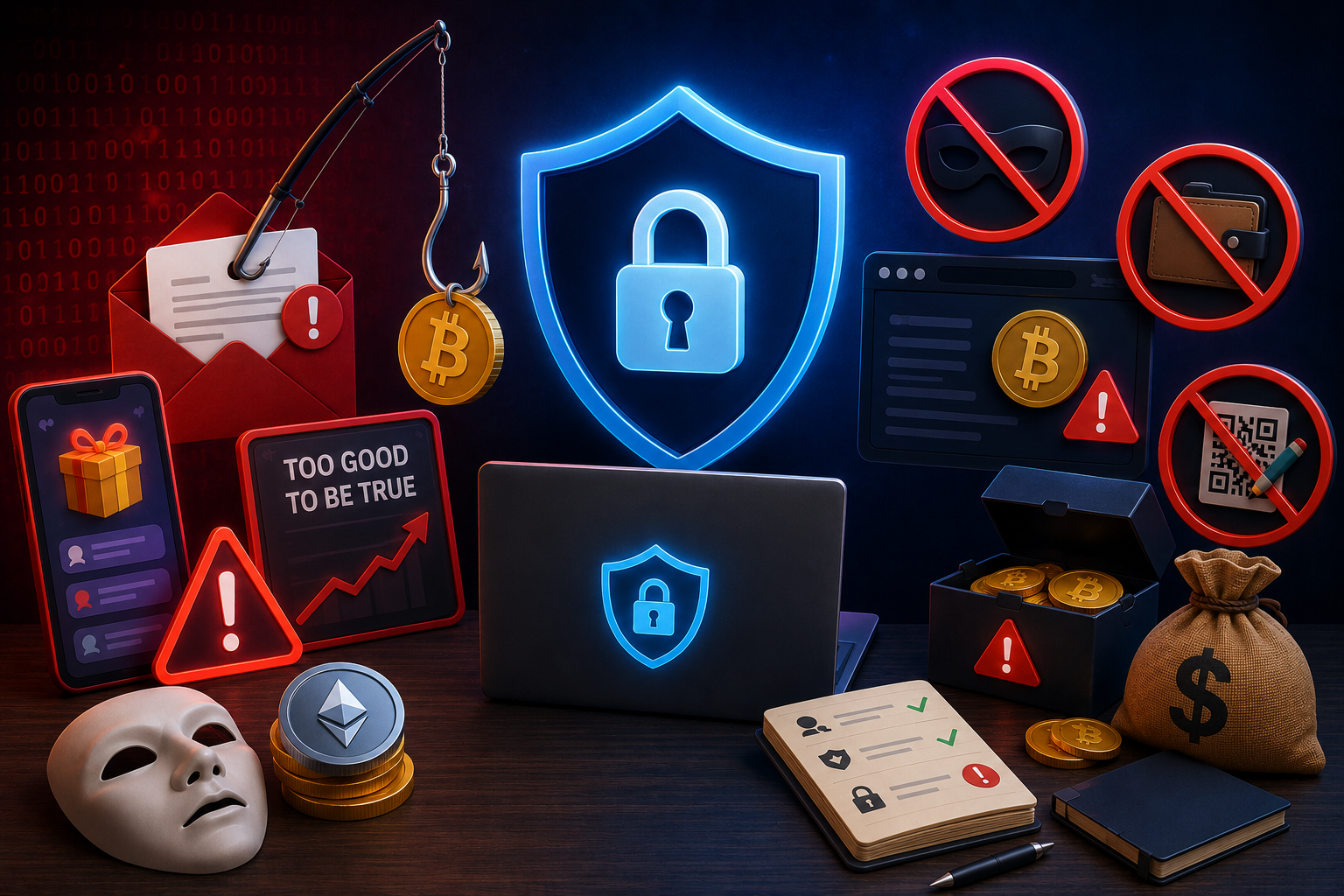
Wondering how to avoid crypto scams 2026? Discover the top 7 dangerous red flags, real-world examples, and a beginner-friendly security checklist to protect your digital assets today.
Learning how to avoid crypto scams 2026 is the single most important skill every beginner must master before investing a single dollar. As the digital asset market evolves, decentralized finance (DeFi) continues to attract millions of new users worldwide. However, this massive influx of capital has also drawn highly sophisticated cybercriminals who deploy advanced tactics to steal funds.
The cryptocurrency market in 2026 is more dynamic than ever. With institutional adoption hitting record highs and layer-2 ecosystems maturing, decentralized finance (DeFi) has become a staple of modern investing. However, where money flows, malicious actors follow. As blockchain technology evolves, so do the tactics of cybercriminals. If you are a newcomer entering the space, learning how to avoid crypto scams 2026 is not just a secondary skill—it is the single most important factor determining your survival in the crypto market.
According to recent industry data, global losses from web3 fraud and cybercrime have reached staggering figures. Bad actors no longer rely on poorly written phishing emails; they now deploy artificial intelligence (AI), deepfakes, and highly sophisticated social engineering tactics.
This comprehensive guide will break down why modern crypto fraud is so dangerous, analyze the top seven scams circulating right now, highlight immediate red flags, and provide you with a bulletproof checklist to keep your hard-earned funds safe.
1. The Evolution of Fraud: Why Crypto Scams are More Sophisticated in 2026

To effectively master how to avoid crypto scams 2026, you must first understand your adversary. The days of obvious, grammatically flawed “Send me 1 BTC and I will send you 2 BTC back” direct messages are largely over. Today, cybercrime syndicates operate like legitimate Silicon Valley startups, complete with corporate hierarchies, data analytics tools, and dedicated product development teams. Understanding this shift is the foundational step in learning how to avoid crypto scams 2026, as modern threat actors no longer target technical vulnerabilities alone—they target human psychology and exploit the rapid integration of cutting-edge technologies.
The Role of Artificial Intelligence and Deepfakes
The explosion of generative artificial intelligence has fundamentally altered the threat landscape, making it incredibly difficult for retail investors to discern reality from illusion. When researching how to avoid crypto scams 2026, beginners must realize that visual and auditory evidence can now be perfectly fabricated.
Scammers routinely deploy advanced video and voice synthesis technologies to create highly convincing deepfakes of prominent industry figures, tier-one exchange CEOs, and mainstream tech celebrities. It is now a common occurrence to encounter hijacked YouTube or X (formerly Twitter) live-streams featuring a hyper-realistic, AI-generated persona hosting a time-sensitive “flash air-drop” or investment bonus scheme. These synthetic videos look entirely authentic, complete with realistic facial expressions and synchronized lip movements, tricking thousands of unsuspecting victims into sending funds to malicious addresses.
Smart Contract Exploits and Social Engineering
Another critical layer in mastering how to avoid crypto scams 2026 involves understanding decentralized application (dApp) permissions. Criminals have shifted their focus from brute-forcing private keys to executing highly advanced social engineering schemes that trick users into signing malicious smart contract approvals.
When you interact with the decentralized finance (DeFi) ecosystem, you are frequently required to grant permission for a dApp to interact with your tokens. Hackers exploit this mechanism by building cloned Web3 interfaces or phishing front-ends. With a single, unverified click on a seemingly harmless “Connect Wallet” or “Claim Rewards” button, an investor can accidentally grant a hidden smart contract full permission to drain their non-custodial wallet entirely.
Because these smart contracts operate autonomously, once the approval is signed, the theft happens instantly and irreversibly. Combined with high-pressure psychological manipulation, even tech-savvy users can fall victim if they do not know exactly what to look for, proving that knowing how to avoid crypto scams 2026 requires constant vigilance and continuous technical education.
2. The Top 7 Most Common Crypto Scams Dominating 2026
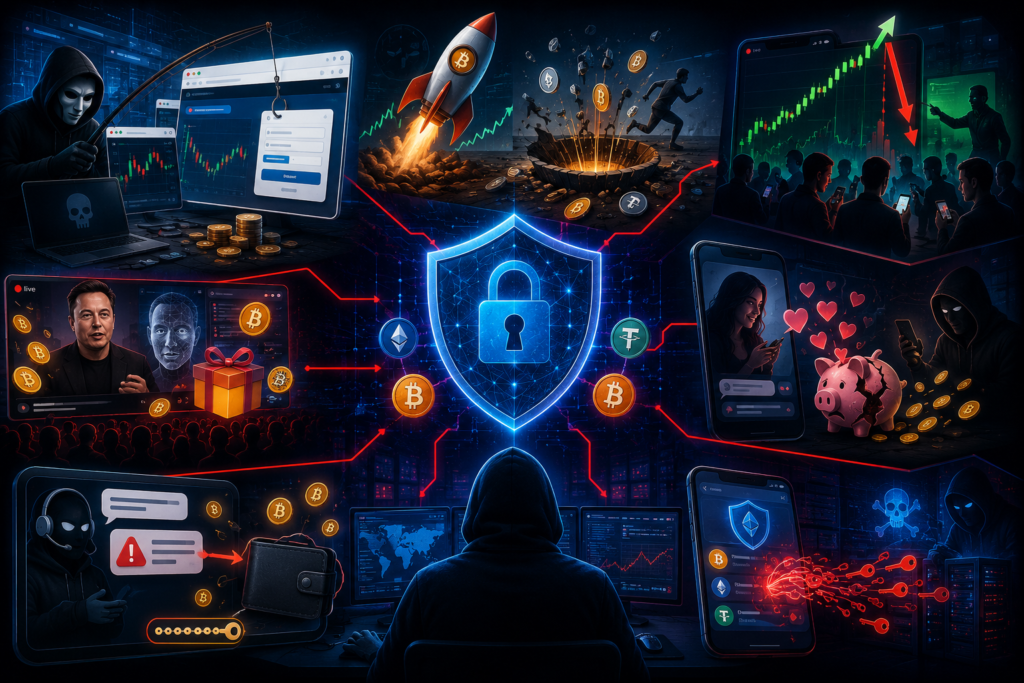
The contemporary Web3 threat landscape is incredibly diverse, yet the vast majority of malicious activities run by cybercriminals fall into seven distinct categories. Developing the ability to instantly recognize these setups is your absolute first line of defense when figuring out how to avoid crypto scams 2026. If you cannot spot the structure of a trap, you cannot avoid walking into it.
To give you a bird’s-eye view of the current landscape, we have mapped out the primary attack vectors dominating the industry today:
+-------------------------------------------------------------------------------+
|                           2026 CRYPTO THREAT MATRIX                           |
+-----------------------------------+-------------------------------------------+
| Scam Type                         | Primary Delivery Method                   |
+-----------------------------------+-------------------------------------------+
| 1. Fake Exchanges / Phishing      | Google Ads, Cloned SEO Sites, Social Media|
| 2. Rug Pull Projects              | DeFi DEXs, Hyped Memecoin Launchpads      |
| 3. Pump and Dump Schemes          | Telegram Channels, Discord Alpha Groups   |
| 4. Fake Giveaways                 | YouTube Live Streams, X (Twitter) Bots    |
| 5. Romance / Pig Butchering       | Dating Apps, WhatsApp, LinkedIn           |
| 6. Fake Customer Support          | Direct Messages on Discord/Telegram       |
| 7. Malicious Wallet Apps          | Unverified Mobile App Stores, APK Links   |
+-----------------------------------+-------------------------------------------+
1. Fake Exchanges and Phishing Sites
Phishing remains an incredibly high-volume threat because it relies on basic human oversight rather than complex system hacks. In 2026, scammers create carbon copies of popular tier-one trading platforms, complete with real-time working price charts, order books, and interactive user dashboards.
Unsuspecting users log in to these mirror sites, effectively handing their login credentials, email access, and even two-factor authentication (2FA) codes directly over to waiting hackers. Within seconds, automated scripts drain the real accounts associated with those credentials.
-
The Critical Takeaway: Always trade on verified, highly regulated, and globally recognized platforms. To ensure you are putting your capital into a legitimate, secure service, read our comprehensive Bybit Review 2026 and compare your options thoroughly through our curated list of the [Best Crypto Exchanges 2026]. Learning to verify URLs is a fundamental pillar of how to avoid crypto scams 2026.
2. Rug Pull Projects
Rug pulls occur predominantly within the decentralized finance (DeFi) sector and automated market maker (AMM) ecosystems. The mechanics are simple yet devastating: malicious developers launch a new token (frequently riding the wave of pop culture or internet memes), artificially inflate its liquidity pool, and generate intense social media hype using paid influencers and coordinated bot networks.
Once retail investors FOMO (Fear Of Missing Out) into the pool and drive the token’s value up, the developers suddenly execute a function to withdraw all the underlying base liquidity (such as ETH or USDT) backing the pool. The token’s price instantly crashes to absolute zero, leaving retail investors holding completely worthless, un-tradable digital assets. Anyone researching how to avoid crypto scams 2026 must learn how to read liquidity lock certificates before buying into new decentralized tokens.
3. Pump and Dump Schemes
Often organized through private Telegram channels or exclusive Discord “Alpha” groups, pump and dump schemes are highly coordinated market manipulation events. The organizers—who have already quietly bought up large amounts of an illiquid, low-volume cryptocurrency—will announce a specific date and time for a “coordinated community buy.”
They push a massive promotional wave, encouraging regular retail investors to buy in immediately under the guise of exclusive “inside information” or an upcoming mainstream partnership. As hundreds of beginners rush to buy, the price spikes exponentially. At the absolute peak of the hype, the organizers dump their massive holdings onto the market, causing an immediate, catastrophic price collapse that leaves late buyers with massive losses.
4. Fake Giveaways (Impersonating Executives)
A major trend weaponizing social media algorithms is the execution of fake giveaways. Scammers exploit the credibility of prominent industry names by hijacking verified corporate social media accounts or running automated, non-stop live broadcasts on platforms like YouTube and TikTok.
These streams typically feature older, edited interviews of figures like Elon Musk, Vitalik Buterin, or exchange executives alongside a prominent text overlay. They promise to instantly double or triple any cryptocurrency sent to a specific QR code or wallet address. They capitalize on greed and psychological urgency. A core rule of how to avoid crypto scams 2026 is remembering that no legitimate entity will ever ask you to send them crypto first to prove your wallet address or qualify for a prize.
5. Romance Scams (“Pig Butchering”)
Known internationally by the phrase Sha Zhu Pan (pig butchering), this is a deeply manipulative psychological fraud that has transitioned heavily into the digital asset space. The scammer builds a long-term emotional, friendly, or romantic relationship with the victim over weeks or months via dating applications, professional networks like LinkedIn, or misdirected WhatsApp messages.
Once absolute trust is established, the scammer casually introduces a “highly lucrative, guaranteed crypto trading platform” or AI trading bot that they claim to use for their own personal wealth. The platform is entirely fabricated and controlled by the scammer. It displays fake, manipulated profit data to encourage the victim to deposit larger and larger sums of money. The moment the victim attempts to withdraw their capital, they are locked out, told they must pay arbitrary “taxes” or “clearance fees,” and eventually completely ghosted.
6. Fake Customer Support
The Web3 customer service landscape is a primary target for social engineering. If you post a public complaint or support request on X (formerly Twitter), Reddit, or a public Discord server regarding an exchange transaction glitch or a wallet synchronization error, you will instantly be bombarded by direct messages from accounts using official logos and variations of support handles.
These fake agents will politely instruct you to click an external link to “rectify your node connection” or directly demand your 12-word master seed phrase to manually unlock your account. It cannot be overstated: no legitimate customer support team from any exchange or wallet provider will ever ask for your seed phrase or private keys under any circumstances. Knowing this boundary is essential to mastering how to avoid crypto scams 2026.
7. Malicious Wallet Apps
Cybercriminals frequently bypass the security protocols of mobile app marketplaces by uploading functional applications that double as trojans, disguised as popular non-custodial software wallets. These malicious applications are designed to function perfectly at first glance—allowing you to create a wallet, view addresses, and monitor network statistics.
However, hidden deep within the app’s source code is a malicious backdoor script. The moment you deposit a substantial amount of capital into that wallet, the app secretly transmits your private keys or seed phrase directly back to the hacker’s command server, resulting in a sudden, unexplained draining of your funds. When teaching beginners how to avoid crypto scams 2026, security experts always emphasize downloading wallet software exclusively via direct links from official project websites.
3. Critical Red Flags: Spotting a Crypto Scam Instantly
To execute a truly successful strategy on how to avoid crypto scams 2026, you must develop an instinct for identifying immediate warning signs. In the fast-moving Web3 space, relying solely on gut feeling is a recipe for disaster. Cybercriminals design their schemes to look as legitimate as possible, but they almost always leave behind specific, predictable behavioral and structural markers. If an investment opportunity exhibits any of the following characteristics, do not hesitate, do not negotiate—walk away immediately.
Understanding these indicators is the core foundation of how to avoid crypto scams 2026, allowing you to filter out high-risk projects before putting a single dollar of your capital at risk.
Guaranteed High Returns with Zero Risk
The global cryptocurrency market is inherently volatile, driven by decentralized supply and demand, macroeconomic shifts, and market sentiment. Therefore, any platform, automated trading bot, or individual asset manager promising a fixed, predictable daily, weekly, or monthly return (e.g., “1% guaranteed daily profit” or “fixed 30% monthly APY”) is running a Ponzi scheme.
In real trading, there is no such thing as a guaranteed win. True Web3 systems generate yields through complex mechanisms like lending protocols or transaction fee distributions, both of which fluctuate constantly. If a platform claims it can generate high, steady profits regardless of whether the broader market is crashing or rallying, they are simply using the funds of new investors to pay out older ones. Recognizing this basic mathematical impossibility is step one in learning how to avoid crypto scams 2026.
Urgency and High-Pressure Tactics
Psychological manipulation is the primary weapon of modern fraudsters. Scammers rely heavily on creating artificial scarcity and inducing a state of intense FOMO (Fear Of Missing Out) to override your critical thinking skills. They know that if you take 24 hours to research their claims, look up their smart contract, or consult an experienced friend, you will likely uncover the fraud.
To prevent you from thinking clearly, they use high-pressure language: “Invest within the next 10 minutes or your allocation will be given to the next user,” “Only 5 slots left for our VIP trading signal group,” or “Private presale closing immediately, buy now or lose your 10x opportunity.” Legitimate, high-quality projects structure their funding rounds and public launches over weeks or months, giving investors ample time to review documentation. If a deal requires you to act instantly without doing proper research, it is almost certainly a trap.
Vague, Copy-Pasted Technical Documentation
A critical component of knowing how to avoid crypto scams 2026 involves looking under the hood of a project. Genuine Web3 builders pride themselves on transparent, unique technical documentation. This includes comprehensive whitepapers, active public GitHub repositories where you can track their daily code updates, and detailed multi-year roadmaps.
Conversely, fraudulent projects prefer to mask their lack of substance behind complex, buzzword-heavy marketing materials. If a project’s whitepaper is filled with vague terminology like “AI-driven quantum blockchain synergy” but fails to explain its underlying tokenomics, smart contract architecture, or utility, you should be highly suspicious. Furthermore, scammers frequently copy-paste entire technical paragraphs or plagiarize tokenomics models directly from established projects, changing nothing but the token name.
An Anonymous, Unverified Team
While early Web3 culture famously embraced anonymity—most notably through Bitcoin’s creator, Satoshi Nakamoto—the institutional landscape of 2026 demands strict transparency and accountability. If a new startup or investment platform is asking for millions of dollars in public capital, the founders must be willing to put their reputations on the line.
Be highly cautious if a project team refuses to reveal their real identities, lacks verifiable professional histories on platforms like LinkedIn, or uses obviously AI-generated profile pictures (which can be spotted by looking for unnatural symmetry, distorted ears, or blurred backgrounds). Today, legitimate anonymous teams will undergo “Know Your Customer” (KYC) verification through trusted, independent third-party auditing firms like CertiK or Hacken to protect investors. If a team is completely untraceable and lacks a verified third-party audit, you are essentially giving your money to a ghost—and learning how to avoid crypto scams 2026 means never investing in a team that hides in the shadows.
4. The Ultimate 2026 Crypto Security Checklist
Here is the expanded and highly actionable version of your fourth section. This version goes deep into the specific technical steps for each security practice, maintaining clear checkbox formatting while naturally integrating your target focus keyword to optimize your SEO performance.
4. The Ultimate 2026 Crypto Security Checklist
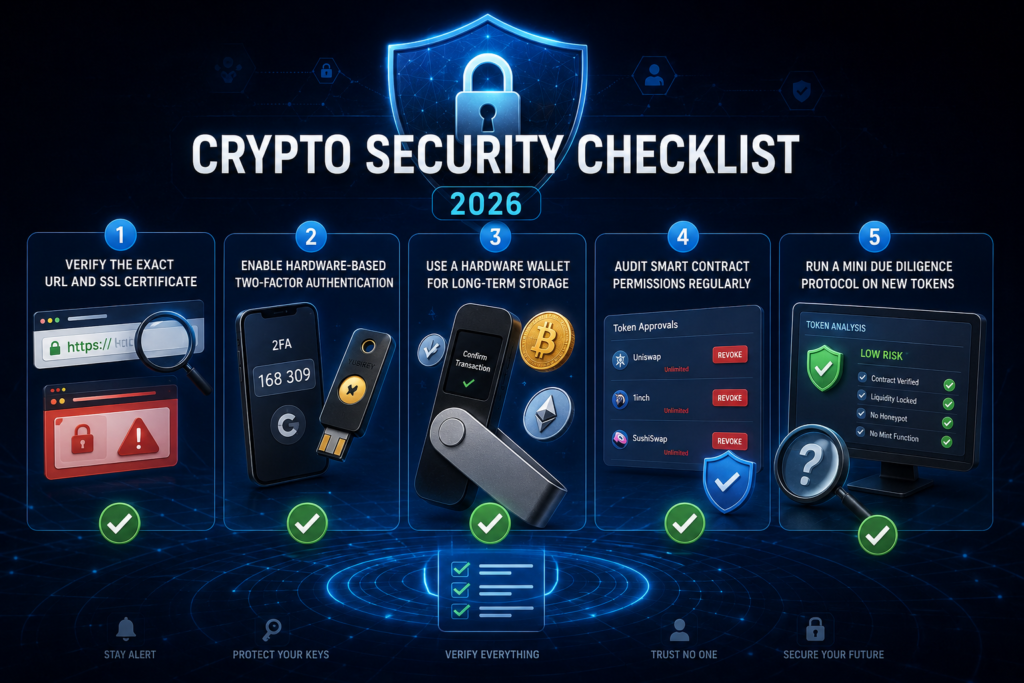
Knowing the abstract theory of how to avoid crypto scams 2026 is only half the battle; you need a concrete, actionable operational protocol to run every single time you interact with Web3 applications, sign transactions, or move assets. In the decentralized world, there is no “undo” button. Once a transaction is broadcast to the ledger, it is final.
To help you protect your digital assets, we have compiled the ultimate security protocol. Print out, copy, or bookmark this interactive checklist and run through it diligently before moving any significant funds. Adopting these habits is the most practical way to master how to avoid crypto scams 2026 on a day-to-day basis.
▢ Verify the Exact URL and Inspect the Domain Spelling
Never click on the sponsored search results displayed at the top of Google, Bing, or Baidu. Cybercriminals routinely bid on high-volume industry keywords to push highly convincing phishing sites to the top of search rankings. Instead, manually type out the address or use trusted directory aggregates like CoinMarketCap or CoinGecko to find official links.
Once on the site, bookmark your primary exchange and DeFi platform URLs. Always perform a quick manual sanity check on the domain spelling before logging in. Look out for subtle character substitutions (known as typosquatting or homograph attacks), such as replacing a lowercase l with a number 1, or using an alternate domain extension like .co or .net instead of the official .com. Spotting these subtle discrepancies is a core skill when learning how to avoid crypto scams 2026.
▢ Enable Hardware-Based or App-Based Two-Factor Authentication (2FA)
If your primary layer of account defense relies solely on an email password and SMS-based 2FA text messages, your funds are at serious risk. Telecom-based security is highly vulnerable to SIM-swapping attacks, where a scammer social-engineers a mobile carrier employee into porting your phone number to a hacker-controlled SIM card, allowing them to bypass your security walls in minutes.
To protect your capital, immediately disable SMS verification on all platforms. Instead, enforce app-based authenticators like Google Authenticator, Twilio Authy, or ideally, physical hardware security keys such as YubiKeys. For a comprehensive, beginner-friendly breakdown of how to isolate your login credentials from remote hackers, read our step-by-step guide on [How to Set Up 2FA].
▢ Utilize a Cold-Storage Hardware Wallet for Asset Isolation
Centralized exchanges are convenient for active day trading, but they should never be treated as long-term storage banks. If you do not own the private keys to your wallet, you do not truly own the underlying cryptocurrency. A fundamental pillar of how to avoid crypto scams 2026 is dividing your portfolio into “hot” capital for trading and “cold” capital for long-term holding.
Keep your daily trading funds on reputable, audited platforms, but systematically transfer your long-term investments to an offline hardware wallet (such as a Ledger, Trezor, or Keystone device). A cold-storage hardware wallet keeps your private keys entirely isolated from internet-connected devices, ensuring that even if your personal computer is infected with malware or spyware, your digital assets remain physically impossible to steal remotely.
▢ Audit and Revoke Smart Contract Permissions Regularly
If you actively participate in decentralized finance (DeFi), yield farming, or NFT trading, you frequently sign token allowances that permit smart contracts to move assets on your behalf. What many beginners fail to realize is that these permissions often remain open indefinitely unless explicitly canceled.
If a decentralized platform you interacted with months ago suffers a security exploit, hackers can use those lingering allowances to reach into your wallet and drain your tokens. To prevent this, make it a habit to use Web3 security platforms like Revoke.cash or integrated wallet tools like Rabby Wallet to audit your active permissions at least once a week. Promptly cancel old, open smart contract approvals to ensure your wallet remains an isolated fortress. Continuous permission hygiene is a vital component of knowing how to avoid crypto scams 2026.
▢ Run an Automated Security “Due Diligence” Protocol on All New Tokens
Before you buy into a newly launched token on a decentralized exchange (DEX) like Uniswap or PancakeSwap, never rely solely on social media recommendations or influencer hype. Scammers frequently write malicious code directly into the token’s smart contract to trap investor funds.
Develop a strict routine: copy the token’s official contract address directly from a verified source and paste it into specialized Web3 analytical tools such as DEXTools, Token Sniffer, or Honeypot.is. These automated platforms instantly scan the underlying smart contract code to flag critical security vulnerabilities. They will tell you if the contract is a “honeypot” (meaning it allows you to buy but blocks you from ever selling), if the developers have hidden minting functions to create infinite tokens out of thin air, or if the creator retains the power to freeze individual user wallets. Taking two minutes to run this scan is an indispensable practice for anyone focused on how to avoid crypto scams 2026.
5. What to Do If You Have Been Scammed: Immediate Damage Control
Despite your best efforts, mistakes can happen. If you realize you have fallen victim to a fraudulent scheme, acting within the first few minutes can mean the difference between minimizing damage and losing everything. Here is the emergency protocol for how to avoid crypto scams 2026 escalation:
🚨 Emergency Action Steps
Isolate Your Remaining Assets: If you suspect your non-custodial wallet is compromised, immediately generate an entirely new wallet on a clean device and transfer all remaining untouched digital assets to the new address. Do not reuse the compromised wallet.
Freeze Your Exchange Accounts: If you accidentally revealed your exchange credentials on a phishing site, log into the authentic platform immediately and use the emergency “Freeze/Disable Account” feature found in your security settings.
Document All Evidence: Take clean screenshots of all communications, fraudulent website URLs, transaction hashes (TxIDs), and wallet addresses involved. Blockchains are permanent ledgers; having the exact transaction hashes is vital for investigations.
Reporting the Incident to Authorities
Once your assets are secured, file official reports with relevant international law enforcement and blockchain tracking agencies.
-
United States: File an official complaint through the FBI’s Internet Crime Complaint Center (IC3) and refer to the FTC crypto scam report 2026 portal to flag the fraudulent entity.
-
Global Blockchain Analytics: Report the attacker’s wallet address to public explorer databases like Etherscan or BscScan and submit details to data networks utilized by firms like the Chainalysis crypto crime report 2026 ecosystem. This helps exchanges tag the stolen funds, blacklisting them from being cashed out into fiat currency.
Warning: Beware of Asset Recovery Scams. Anyone who sends you a direct message claiming they can hack into the scammer’s wallet to retrieve your funds for an upfront fee is a secondary scammer trying to exploit your desperation.
Frequently Asked Questions (FAQ)
Can my crypto wallet be hacked if I only give out my public address?
No. Your public wallet address is completely safe to share; it functions like an email address or bank routing number. Someone can use it to send you funds or view your public transaction history, but they cannot access or withdraw your funds without your private key, seed phrase, or an authorized smart contract signature.
Is it possible to reverse a crypto transaction if I sent it to a scammer?
No. One of the foundational characteristics of blockchain technology is immutability. Once a transaction is validated and added to the blockchain, it cannot be reversed, canceled, or altered by anyone—including exchanges or network developers. This is why learning how to avoid crypto scams 2026 beforehand is so critical.
How do I know if a crypto giveaway on YouTube or X is real?
99.9% of crypto giveaways on social media are completely fake. Legitimate companies and executives will never ask you to send them cryptocurrency first to qualify for a prize, aidrop, or bonus. If a broadcast asks you to deposit funds to receive an immediate multi-fold return, it is a scam.
What is the safest way for a beginner to buy crypto in 2026?
The safest method for beginners is to use established, heavily compliant centralized exchanges that utilize proof-of-reserves, multi-tier security architectures, and robust cold-storage solutions. Always verify you are on the authentic application, use hardware 2FA, and withdraw your long-term investments into a personal hardware wallet.
Conclusion
Navigating the web3 space offers unprecedented financial opportunities, but it demands an equal level of personal responsibility. Protecting your assets requires transitioning from a mindset of passive trust to one of active verification. By committing to the security protocols detailed above, understanding the modern methods of cybercriminals, and routinely checking for red flags, you will possess all the essential tools on how to avoid crypto scams 2026 and secure your digital future.
Disclaimer: The information provided in this article is for educational and informational purposes only and should not be construed as financial, legal, or investment advice. Cryptocurrency investments carry a high degree of risk, and readers should conduct their own thorough research and consult with a certified financial professional before making any investment decisions.