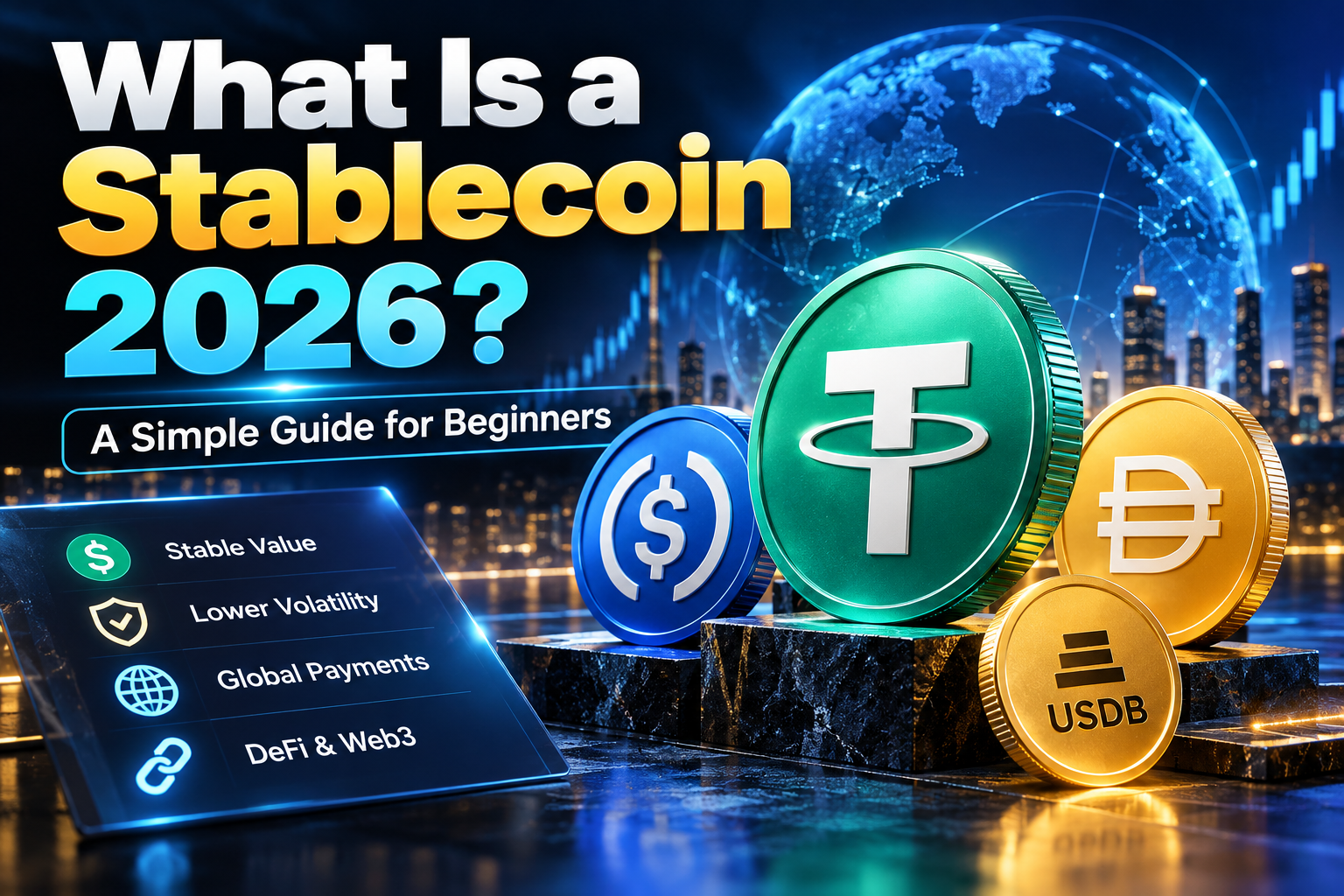
What Is a Stablecoin 2026? A Simple Guide for Beginners
What is a stablecoin 2026? If you have ever explored the world of cryptocurrency, you know how volatile digital assets can be. Bitcoin and Ethereum can jump or plunge by 10% or more in a single afternoon. While this volatility attracts traders looking for quick gains, it makes everyday transactions, savings, and value transfer stressful.
This is where understanding what is a stablecoin 2026 becomes essential.
Stablecoins serve as the financial bridge between traditional fiat currency and the decentralized crypto ecosystem. In 2026, the total market capitalization for stablecoins stands at an astonishing $304+ billion, cementing their role as the primary medium of exchange and settlement layer for modern global finance.
If you are looking to build a foundation in digital assets, you should also read our introductory guide on What Is Cryptocurrency 2026. In this guide, we will break down what is a stablecoin 2026 in simple terms, explore how they work, compare the market leaders, evaluate the risks, and show you how to use them effectively.
1. What Is a Stablecoin? (The Carnival Ticket Analogy)
At its core, a stablecoin is a specialized category of cryptocurrency engineered specifically to hold a stable, predictable financial value. Unlike traditional cryptocurrencies like Bitcoin (BTC) or Ethereum (ETH)—whose prices fluctuate wildly based on market supply, demand, and trader speculation—a stablecoin achieves price stability by pegging its market value to a real-world asset.
Most commonly, stablecoins are pegged to major global fiat currencies at a strict 1:1 exchange ratio, with the U.S. Dollar (USD) serving as the universal benchmark standard.
When asking what is a stablecoin 2026, the simplest answer is that it represents a tokenized, programmable digital dollar. It combines the fixed value and stability of traditional money with the lightning-fast speed, borderless reach, and transparency of blockchain networks. One unit of a USD-pegged stablecoin is designed to equal exactly $1.00 USD at all times.
The Carnival Ticket Analogy: How Stablecoins Work in Everyday Life
To help conceptualize how stablecoins bridge the gap between traditional banking and the blockchain world, imagine taking a trip to a large amusement park or local carnival:
The Carnival Ticket Analogy:
Imagine you walk up to the entrance of a massive, modern carnival. The vendors inside—operating game booths, food stands, ride tickets, and souvenir shops—do not want to take the time to inspect, count, or verify physical bills from hundreds of different foreign currencies or write down paper receipts for every small transaction.
Instead, you step up to the Front Gate Ticket Booth. You hand the clerk $100 in cash. In return, the clerk issues you 100 carnival tickets stamped with a guaranteed value of $1 per ticket. The carnival operator takes your $100 cash and locks it safely inside their central bank vault as collateral.
Throughout the day, you walk freely around the carnival grounds. You hand over 5 tickets for a funnel cake, 10 tickets for a roller coaster ride, or even trade tickets with other visitors for prizes. Everyone inside the park accepts these tickets instantly because everyone trusts that each ticket represents exactly $1 of real cash holding in the vault.
At the end of the day, when you are ready to head home, you return to the front gate ticket booth, hand back your remaining 40 tickets, and receive $40 in real cash directly back into your hands or bank account.
Deconstructing the Analogy: Mapping the Carnival to Web3
Understanding this everyday analogy makes navigating the complex mechanics of digital assets much simpler:
+-----------------------------------------------------------------------------------+
|                            THE CARNIVAL ANALOGY MAP                               |
+--------------------------+--------------------------------------------------------+
| CARNIVAL ELEMENT         | REAL-WORLD CRYPTO EQUIVALENT                           |
+--------------------------+--------------------------------------------------------+
| The Cash ($100 bill)     | Traditional Fiat Currency (USD, EUR, JPY)              |
| The Front Gate Booth     | Stablecoin Issuers (Tether, Circle) & Centralised Exch.|
| The Carnival Vault       | Audited Bank Reserves & U.S. Treasury Bill Holdings     |
| The Carnival Tickets     | Stablecoins on Blockchains (USDT, USDC, DAI)          |
| The Carnival Grounds     | Web3 Ecosystem, Crypto Exchanges, & DeFi Applications  |
+--------------------------+--------------------------------------------------------+
-
The Cash: Represents traditional government-issued fiat money sitting inside the legacy banking system.
-
The Front Gate: Represents centralized stablecoin issuers (like Circle for USDC or Tether for USDT) or major cryptocurrency exchanges. They act as the minting and redemption bridge.
-
The Vault: Represents the segregated, audited financial bank reserves holding cash equivalents and short-term government bonds to back every single token in circulation.
-
The Carnival Tickets: Represent stablecoins moving over blockchain networks like Ethereum, Solana, or Arbitrum.
-
The Carnival Grounds: Represents the vast decentralized finance (DeFi) ecosystem, Web3 dApps, and global trading platforms.
Why the “Carnival Ticket” Engine Matters in 2026
When you trade or invest in crypto, transferring funds back to a traditional bank account (cashing out to fiat) can be slow, expensive, and subject to banking hours and wire transfer delays.
Understanding what is a stablecoin 2026 helps you realize that stablecoins allow you to “exit” volatile crypto positions without ever leaving the blockchain network. By swapping your Bitcoin into stablecoins during a market drop, you effectively convert your funds back into “carnival tickets”—locking in your dollar value instantly, keeping your assets liquid 24/7/365, and remaining completely prepared to re-enter the market whenever the right opportunity arises.
2. Why Do We Need Stablecoins in 2026?
Why not just use regular U.S. Dollars or stick to Bitcoin? Understanding what is a stablecoin 2026 requires looking at three major pain points in traditional banking and standard crypto:
+-----------------------------------------------------------------------+
|                       WHY STABLECOINS ARE NEEDED                       |
+-----------------------------------+-----------------------------------+
| TRADITIONAL BANKING / STANDARD CRYPTO |        STABLECOIN ADVANTAGE      |
+-----------------------------------+-----------------------------------+
| Heavy price volatility (BTC/ETH)  | Price stability ($1.00 target)    |
| Slow wire transfers (1-5 days)    | Instant transfers (24/7/365)      |
| High international remittance fees| Near-zero transaction fees        |
| Bank operating hours / holidays   | Always-on blockchain rails        |
+-----------------------------------+-----------------------------------+
Eliminating Price Volatility
If you buy $1,000 worth of Bitcoin today to pay for rent next week, that Bitcoin might be worth $850 or $1,150 when rent is due. Holding funds in stablecoins removes this anxiety while keeping your assets on the blockchain.
Frictionless Global Transfers
Sending $1,000 internationally via traditional SWIFT wire transfers can take several business days and cost $30 to $50 in intermediary bank fees. Understanding what is a stablecoin 2026 allows you to move millions of dollars across borders in seconds for pennies.
The Universal Currency for Trading and DeFi
Stablecoins serve as the base quote asset across major exchanges and decentralized application (dApp) ecosystems. If you want to explore decentralized lending, liquidity pools, or passive yield generation, check out our guides on [What Is DeFi 2026: [link bài đã publish]] and the [Crypto Passive Income Guide: [link bài đã publish]].
3. The 3 Types of Stablecoins (And the 2022 Terra/UST Lesson)
Not all stablecoins are constructed the same way. When asking what is a stablecoin 2026, you must realize that stability is maintained through different mechanisms:
                        +----------------------+
                        | TYPES OF STABLECOINS |
                        +----------+-----------+
                                   |
        +--------------------------+--------------------------+
        |                          |                          |
+-------v-------+          +-------v-------+          +-------v-------+
|  Fiat-Backed  |          | Crypto-Backed |          |  Algorithmic  |
| (USDT, USDC)  |          |     (DAI)     |          | (USDe, USDS)  |
+---------------+          +---------------+          +---------------+
A. Fiat-Backed Stablecoins (e.g., USDT, USDC)
These are the simplest and most widely adopted stablecoins. A centralized issuer holds real cash, cash equivalents, and short-term U.S. Treasury bills in bank reserves for every token minted. If 1,000 tokens are in circulation, $1,000 in cash reserves exists.
B. Crypto-Backed Stablecoins (e.g., DAI / USDS)
These stablecoins are backed by other cryptocurrencies rather than fiat cash. To offset crypto volatility, they use over-collateralization. For instance, to mint $100 worth of DAI, a user might lock up $150 worth of Ethereum (ETH) inside a smart contract vault.
C. Algorithmic & Synthetic Stablecoins
These tokens rely on smart contract algorithms, arbitrage incentives, or delta-neutral derivatives strategies rather than 1:1 cash reserves.
⚠️ The Terra/UST Lesson (2022) & Risks
In May 2022, the algorithmic stablecoin TerraUSD (UST) suffered a catastrophic “death spiral,” losing tens of billions of dollars in market value almost overnight because its underlying stabilization code failed under market panic.
The crash of UST taught the global crypto industry an invaluable lesson: algorithmic mechanisms without strong collateral backing carry high structural risk. In 2026, regulated fiat-backed models dominate institutional finance, while modern synthetic stablecoins require far stricter collateral risk management.
4. USDT vs. USDC: How Do They Differ in 2026?
When analyzing what is a stablecoin 2026, the two giant market leaders you will encounter everywhere are Tether (USDT) and USD Coin (USDC). Together, they represent over 80% of the entire stablecoin market.
+---------------------+---------------------------------+---------------------------------+
| FEATURE             | TETHER (USDT)                   | USD COIN (USDC)                 |
+---------------------+---------------------------------+---------------------------------+
| Market Cap (2026)   | ~$184.0 Billion                 | ~$73.5 Billion                  |
| Market Share        | ~60.4%                          | ~24.1%                          |
| Issuer              | Tether Limited                  | Circle Internet Financial       |
| Primary Strengths   | High offshore liquidity, trading| Full regulatory compliance,     |
|                     | pairs, worldwide adoption       | transparent audits, EU MiCA ok  |
| Best Used For       | Active exchange trading         | Institutional settlement, DeFi  |
+---------------------+---------------------------------+---------------------------------+
Tether (USDT)
USDT remains the undisputed liquidity champion of the crypto world, commanding a market cap of $184.0 billion. It is the most heavily traded pair across international exchanges like Bybit and Binance.
USD Coin (USDC)
Issued by Circle, USDC holds a market cap of $73.5 billion. USDC is widely regarded as the gold standard for regulatory transparency, holding official compliance certification under strict frameworks like Europe’s MiCA legislation.
5. Key Risks of Stablecoins: Depeg, Issuer Risk, and Regulations
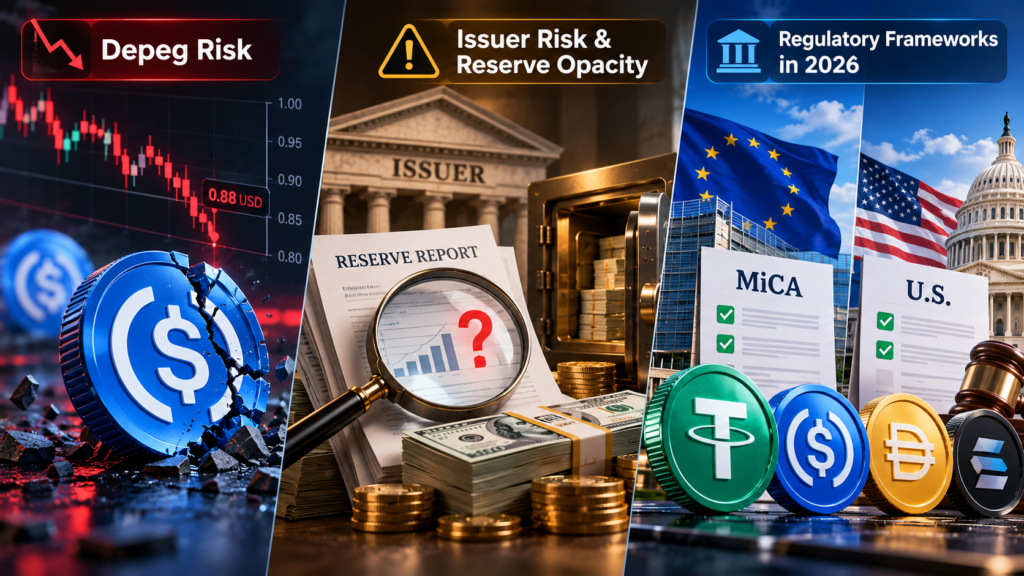
While learning what is a stablecoin 2026, beginners must understand a critical financial rule: “stable” does not mean entirely risk-free.
Although stablecoins remove the extreme price volatility typical of Bitcoin or Ethereum, they introduce a distinct set of operational, systemic, and regulatory risks. To protect your capital and make informed investment decisions, you must evaluate the primary risk factors associated with holding and using digital dollars:
a. Depeg Risk (Loss of the 1:1 Dollar Parity)
A depeg occurs when a stablecoin’s open-market trading price diverges from its fixed target asset (usually $1.00 USD), trading either below or above its intended value.
+-------------------------------------------------------------------------+
|                            DEPEG MECHANICS                              |
+-------------------------------------------------------------------------+
|  Normal State:    1 Stablecoin Token = $1.00 USD Liquid Reserve          |
|  Depeg Event:     Market Panic / Illiquidity -> Price drops to $0.88    |
|  Impact:          Loss of investor confidence, liquidation cascades    |
+-------------------------------------------------------------------------+
Depegging can occur due to several underlying triggers:
-
Liquidity Crunches & Bank Failures: Even institutional fiat-backed tokens are vulnerable to external systemic shocks. For example, during the U.S. regional banking crisis in March 2023, USDC temporarily dipped to $0.88 after $3.3 billion of its backing reserves were briefly stuck at Silicon Valley Bank. Once regulators guaranteed bank deposits, the peg was fully restored, but the event highlighted how traditional banking fragility can spill over into crypto markets.
-
Algorithmic Collapses: Uncollateralized or algorithmically maintained tokens can experience market panic that triggers a downward spiral, rendering the stabilization code mathematically incapable of restoring the $1.00 peg.
b. Issuer Risk, Insolvency & Reserve Opacity
When you hold a centralized fiat-backed stablecoin like USDT or USDC, you are fundamentally trusting a private corporate entity to maintain 100% backing in real cash or liquid equivalents. This introduces critical counterparty risks:
-
Reserve Composition & Asset Quality: Not all reserves are created equal. If an issuer backs its tokens with higher-yield, riskier financial assets (such as commercial paper, corporate bonds, or illiquid loans) rather than short-term U.S. Treasury bills and cash deposits, a financial crisis could prevent the issuer from liquidating assets fast enough to cover mass user redemptions.
-
Lack of Transparent Audits: Without frequent, independent, and rigorous third-party accounting attestations, investors cannot verify whether every circulating token is genuinely backed 1:1.
-
Centralized Freeze Orders & Legal Seizures: Centralized issuers retain smart contract privileges that allow them to blacklist wallet addresses, freeze funds, or seize balances in response to law enforcement requests, sanctions enforcement, or legal disputes.
c. Regulatory Frameworks & Compliance Mandates in 2026
Regulatory scrutiny surrounding what is a stablecoin 2026 has shifted from uncertain policy discussions to fully enforced global legal standards. Government agencies worldwide now treat stablecoins as systemic financial infrastructure:
+--------------------------------------------------------------------------+
|                     GLOBAL STABLECOIN REGULATIONS                        |
+-------------------+------------------------------------------------------+
| JURISDICTION      | CORE COMPLIANCE REQUIREMENTS                         |
+-------------------+------------------------------------------------------+
| European Union    | • Strict 1:1 liquid reserve ratio in licensed banks  |
| (MiCA Enforced)   | • Prohibitions on non-compliant foreign issuers      |
|                   | • Mandatory redemption rights for retail holders     |
+-------------------+------------------------------------------------------+
| United States     | • Mandatory federal or state bank oversight          |
| (Federal Framework)| • Permitted assets limited to cash & U.S. T-Bills    |
|                   | • Monthly audited public attestations required       |
+-------------------+------------------------------------------------------+
-
European Union (MiCA): The fully implemented Markets in Crypto-Assets (MiCA) framework mandates that stablecoin issuers obtain an Electronic Money Institution (EMI) license within the EU. Issuers must keep significant reserve portions in segregated bank accounts and adhere to strict daily transaction caps for non-euro denominated stablecoins. Non-compliant stablecoins face delisting across European exchanges.
-
United States: Federal standards require domestic stablecoin issuers to back tokens exclusively with liquid assets (U.S. dollars, short-dated Treasury bills, and central bank deposits). Issuers must publish regular third-party accounting audits and demonstrate robust anti-money laundering (AML) and know-your-customer (KYC) compliance programs.
6. Practical Applications: How Stablecoins Are Used on Exchanges

Understanding what is a stablecoin 2026 moves from theoretical knowledge to a vital practical tool the moment you set up an account on major cryptocurrency exchanges like Binance, Bybit, or Coinbase.
Rather than serving as passive store-of-value assets, stablecoins act as the operational engine, universal accounting unit, and central liquidity pool across both centralized exchanges (CEXs) and decentralized finance (DeFi) platforms.
Here is a detailed breakdown of how everyday traders and long-term investors actively utilize stablecoins in their daily operations:
a. Universal Base Quote Currency for Precision Trading
In traditional finance, stock market investors track profits and losses in their local national currency (such as USD or EUR). In crypto markets, trading directly between two highly volatile altcoins—for example, exchanging Solana (SOL) directly for Avalanche (AVAX)—makes tracking actual performance nearly impossible because both assets fluctuate in price simultaneously.
By using stablecoins as the fundamental base quote asset (such as the BTC/USDT or ETH/USDC trading pairs):
-
Clear Profit/Loss Accounting: You measure portfolio gains directly in digital dollar terms without calculating complex dual-asset exchange rates.
-
Superior Market Liquidity: Stablecoin trading pairs command the deepest order books globally. This deep liquidity ensures tighter bid-ask spreads, allowing traders to execute large market orders with minimal price slippage.
b. Immediate “Safe Haven” Hedging During Market Downtrends
Cryptocurrency markets operate 24 hours a day, 7 days a week, and sudden market corrections can cause digital assets to drop by 15% to 30% within hours.
When market downturns occur, converting crypto assets directly into fiat bank accounts is often slow, incurs high withdrawal fees, and triggers tax reporting events depending on your jurisdiction.
The Quick-Park Strategy:
Instead of cashing out to a traditional bank, traders execute instantaneous market orders to convert volatile assets (like BTC, ETH, or altcoins) into stablecoins within seconds directly on the exchange platform.
By parking capital in USDT or USDC, traders protect their principal purchasing power from market drops while keeping their capital liquid and ready on the exchange to “buy the dip” as soon as prices stabilize.
c. Passive Income Generation via Exchange “Earn” Programs & DeFi
Holding traditional physical U.S. Dollars in a standard bank checking account often generates minimal interest income. In contrast, stablecoins allow investors to put their capital to work natively on the blockchain:
-
Centralized Flexible & Fixed Earn Accounts: Platforms like Binance Earn or Bybit Savings allow users to deposit stablecoins into flexible-term savings accounts, earning competitive Annual Percentage Yields (APY) paid out daily in stablecoins.
-
Decentralized Lending & Borrowing Protocols: By transferring stablecoins to non-custodial Web3 wallets (e.g., MetaMask), users can supply liquidity to decentralized lending platforms (such as Aave or Compound) to earn yield from borrowers, or deposit into automated market maker (AMM) liquidity pools.
d. Seamless Capital Mobility Between Exchanges & Wallets
Before stablecoins, moving capital between different crypto exchanges required either transferring slow, volatile cryptocurrencies or waiting days for international bank wire transfers (SWIFT) to clear.
In 2026, traders move thousands or millions of dollars between platforms like Bybit, Binance, OKX, and self-custody cold wallets within seconds over high-speed layer-1 and layer-2 blockchains (such as Solana, Arbitrum, Optimism, or Polygon). Transaction costs often range from a fraction of a cent to a few pennies, making arbitrage trading and swift fund reallocation available to traders worldwide.
Frequently Asked Questions (FAQ)
1. Is a stablecoin considered real money?
A stablecoin is not official government-issued legal tender, but rather a digital representation of real money tokenized on a blockchain network.
While traditional money (fiat) is issued, regulated, and backed directly by central banks (such as the Federal Reserve for the U.S. Dollar), stablecoins are issued by private technology companies (like Tether or Circle) or managed autonomously by decentralized smart contracts.
However, in everyday practical terms, stablecoins function just like digital dollars within the global Web3 ecosystem. They allow users to price goods, send cross-border remittances, hold savings, and settle trades instantly without experiencing the severe price swings associated with standard cryptocurrencies like Bitcoin or Ethereum.
2. Can a stablecoin lose its value or drop to zero?
Yes, it is possible for a stablecoin to lose its value—an event known in crypto as a depeg—and in catastrophic cases, collapse to zero. How vulnerable a stablecoin is to this risk depends entirely on its underlying design architecture:
-
Algorithmic Stablecoins (High Risk): Stablecoins that rely on financial engineering, code-driven supply adjustments, or uncollateralized mint-and-burn mechanics can fail completely during severe market panics. The most famous example occurred in May 2022 with the collapse of TerraUSD (UST), which lost its $1.00 peg and wiped out tens of billions of dollars in market capitalization almost overnight.
-
Fiat-Backed Stablecoins (Lower Risk): Fully collateralized stablecoins like USDC or USDT maintain their $1.00 value by holding equivalent cash reserves, short-term bank deposits, and government securities in regulated bank vaults. While they are significantly safer and structurally backed 1:1, they still carry minor risks related to banking liquidity, issuer mismanagement, or regulatory freezing orders.
3. How do stablecoin issuers generate massive profits?
Stablecoin issuers operate a business model similar to traditional banks, earning substantial income primarily through interest yield on reserve assets:
-
Capital Collection: When users or institutions want to mint new stablecoins (e.g., $100 million worth of USDC), they deposit $100 million in real U.S. Dollar cash directly with the issuer.
-
Yield-Bearing Investments: Instead of letting hundreds of billions of dollars sit idle in low-interest checking accounts, the issuer allocates the majority of these reserves into ultra-safe, short-term financial instruments—most notably U.S. Treasury Bills (T-bills) and overnight repurchase agreements.
-
Interest Accumulation: With billions of dollars in circulation and competitive benchmark interest rates, these short-term government bonds yield hundreds of millions (or even billions) of dollars in annual interest income, which the issuer retains as net profit.
-
Secondary Revenue Streams: Issuers also charge small redemption/minting fees for high-volume institutional clients converting large sums between fiat and stablecoins.
4. How do I safely store and transfer my stablecoins?
Storing stablecoins safely requires choosing the right type of crypto wallet based on your financial needs:
-
Self-Custody Wallets (Best for Ownership & DeFi): Software wallets (like MetaMask or Trust Wallet) and hardware cold wallets (like Ledger or Trezor) give you full control over your private keys. This means no central authority can freeze your funds, making them ideal for long-term storage and interacting with decentralized finance protocols.
-
Exchange Wallets (Best for Trading): Keeping stablecoins on major, regulated centralized exchanges (like Binance or Bybit) offers convenience for active traders, but means you rely on the platform’s security and custody measures.
-
Transfer Networks: When sending stablecoins to another wallet or exchange, always ensure you select the correct blockchain network (e.g., Ethereum ERC-20, Solana, or Arbitrum). Sending tokens over an incompatible network can lead to permanent loss of funds.
Conclusion
Understanding what is a stablecoin 2026 is one of the most foundational and transformative steps for anyone stepping into the Web3, cryptocurrency, and modern fintech ecosystem. By effectively bridging the gap between traditional fiat currencies and decentralized networks, stablecoins eliminate the paralyzing volatility of traditional crypto assets while preserving the core benefits of blockchain technology: instant global settlement, 24/7 accessibility, complete transparency, and near-zero transaction fees.
As we navigate the financial landscape of 2026, stablecoins have evolved from simple trading tools on exchanges into robust, multi-billion-dollar global payment rails and settlement networks. Whether you are using USDT for active exchange trading, leveraging USDC for compliant institutional transactions, exploring decentralized yield strategies in DeFi, or transferring funds across borders to family and business partners, stablecoins provide the essential infrastructure that powers the modern digital economy.
However, navigating the stablecoin market requires a balanced approach. While fiat-backed stablecoins offer significant stability and convenience, users must remain mindful of potential risks, including counterparty issuer exposure, regulatory shifts across major jurisdictions, and smart contract security. By choosing well-audited, highly liquid, and regulatory-compliant stablecoins, you can confidently hedge against market downturns and unlock the full potential of digital finance.
Disclaimer: The information provided in this article is for educational and informational purposes only and should not be construed as financial, legal, or investment advice. Cryptocurrencies and stablecoins carry inherent market, regulatory, and technological risks. Always conduct your own research (DYOR) and consult with a licensed financial advisor before making any investment decisions.