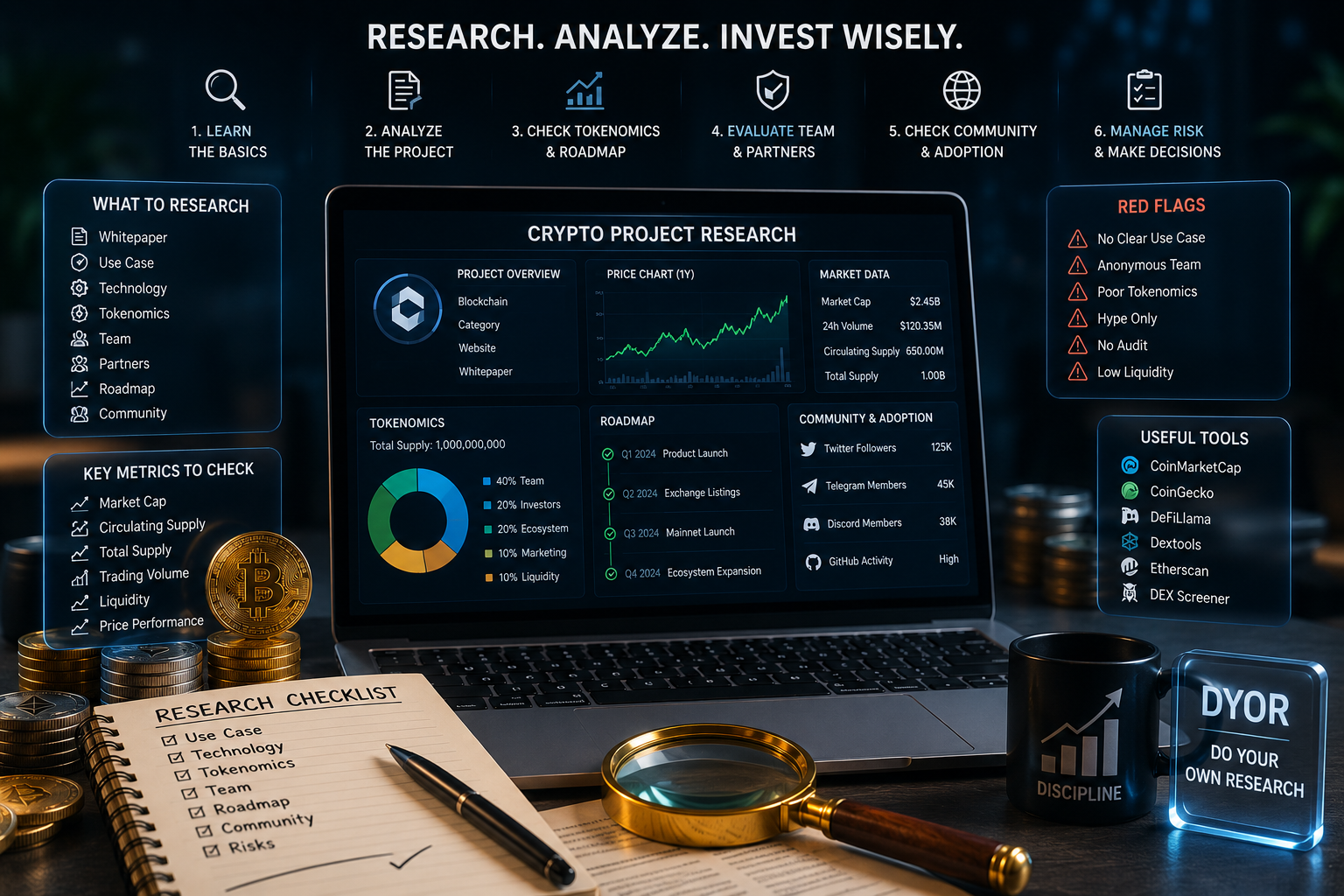
Wondering how to research crypto before investing 2026? Discover our step-by-step DYOR guide covering whitepapers, tokenomics, community metrics, and top research tools.
The cryptocurrency market is moving faster than ever. With thousands of active projects, new layer-1 blockchains, decentralized AI networks, and real-world asset (RWA) tokenization platforms launching daily, finding the next gem requires more than just following hype on social media.
If you want to protect your hard-earned capital and find legitimate opportunities, you must master the art of DYOR (Do Your Own Research).
In this comprehensive guide, we will break down exactly how to research crypto before investing 2026, offering you a practical, step-by-step framework to analyze any crypto project like a seasoned pro.
1. What is DYOR and Why Does It Matter in 2026?
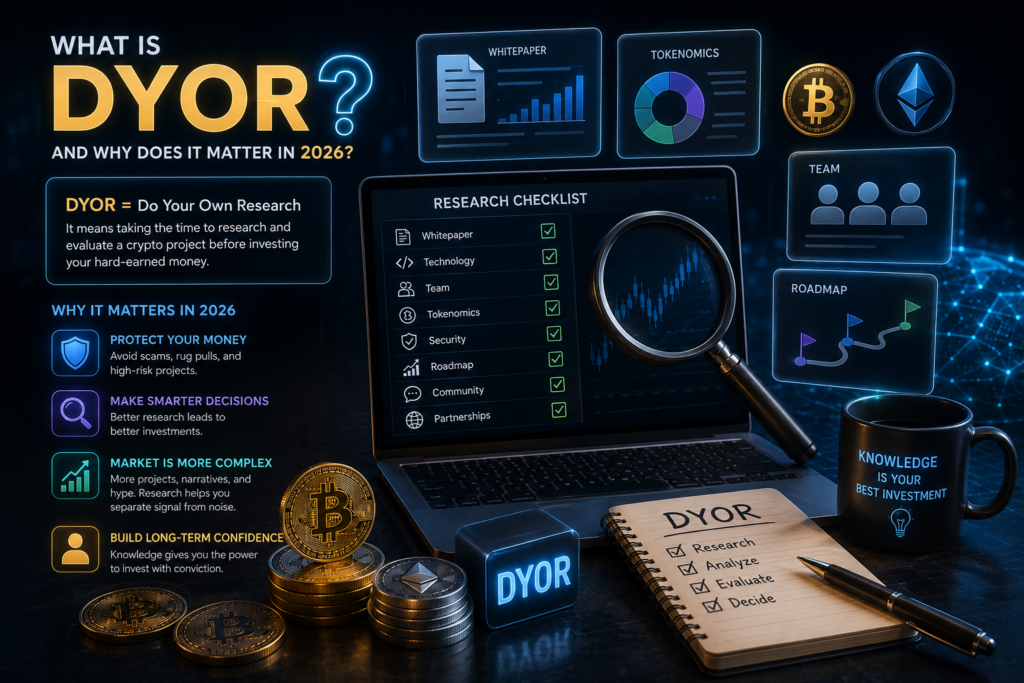
DYOR stands for Do Your Own Research. In the traditional financial world, you have central regulators, licensed brokers, and strict disclosure laws protecting retail investors. In Web3, you are your own bank—which means you are also your own financial analyst.
Learning how to research crypto before investing 2026 is the single best way to avoid expensive mistakes. Without a solid research framework, you are essentially gambling on random price charts.
Why Hype Alone is a Dangerous Strategy
During bull runs, social media platforms like TikTok, X (formerly Twitter), and YouTube flood with influencers promoting the “next 100x coin.” However, most of these promotions are paid sponsorships or “pump-and-dump” schemes. By the time a coin is trending on X, the early insiders are often already looking to exit their positions.
By understanding how to research crypto before investing 2026, you learn to look past the marketing noise and evaluate projects based on real-world utility, healthy token economics, and genuine user adoption. This knowledge acts as your ultimate shield against market manipulation.
2. The 7-Step Framework: How to Research Crypto Before Investing 2026
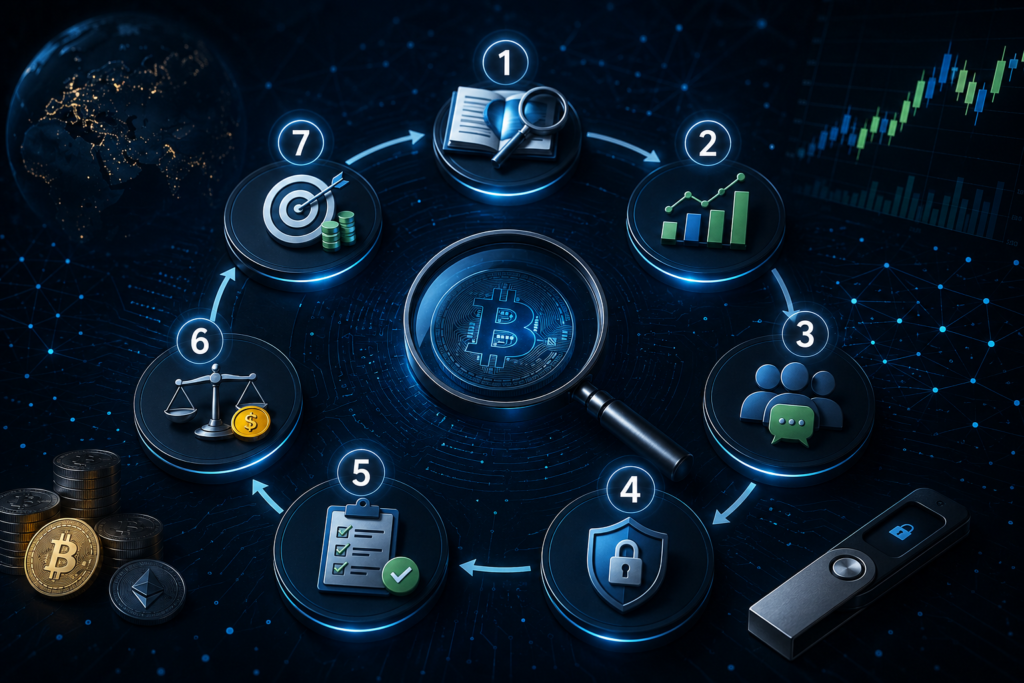
To make this actionable, let’s walk through a structured, 7-step process. To keep things practical, we will use Ethereum (ETH) as our baseline example to illustrate how these research steps work in practice.
Step 1: Read the Whitepaper (The Simple Way)
The whitepaper is a project’s foundational manifesto. It explains the technology, the problem the project aims to solve, and how its native token functions.
How to analyze it: You don’t need a degree in computer science to read a whitepaper. Skip the dense cryptographic formulas at first and focus on answering three simple questions:
What real-world problem does this project solve?
How does it solve it differently than existing projects?
Why does this solution require a blockchain and a native token?
-
Real-world Example (ETH): The original Ethereum whitepaper written by Vitalik Buterin proposed a simple yet revolutionary idea: instead of just being a digital currency like Bitcoin, Ethereum would be a global, decentralized computer that allows anyone to run smart contracts and decentralized applications (dApps).
Step 2: Check the Team and Founders
A brilliant idea is useless without an experienced team to execute it. When learning how to research crypto before investing 2026, checking the human element behind the code is crucial.
-
Doxxed vs. Anonymous Teams: A “doxxed” team means the founders have public identities. Check their LinkedIn profiles, GitHub repositories, and past work history. Have they delivered successful tech projects before? If the team is completely anonymous, proceed with extreme caution. While some legendary projects (like Bitcoin) have anonymous creators, most modern anonymous projects carry a much higher risk of exit scams.
-
Advisors and Backers: Look at who is advising or funding the project. Are there reputable venture capital (VC) firms involved, or is it backed by unknown entities?
Step 3: Analyze the Tokenomics (Supply, Distribution, and Vesting)
Tokenomics (token economics) dictates how a token’s price behaves over time based on supply and demand. Even if a project has incredible technology, poor tokenomics can cause the token price to crash due to massive inflation.
When figuring out how to research crypto before investing 2026, make sure to evaluate these three tokenomics pillars:
-
Circulating Supply vs. Max/Total Supply: Circulating supply is the number of tokens currently active in the market. Max supply is the absolute limit of tokens that will ever exist. If a project has only 5% of its total supply in circulation, the remaining 95% will eventually enter the market, causing heavy selling pressure on early investors.
-
Token Distribution: How are the tokens distributed? If the founders, team, and early VC backers own 60% of all tokens, they hold massive power to dump their tokens on retail investors. A healthier distribution allocates a significant portion to public sales, community rewards, and ecosystem development.
-
Vesting Schedules: Legitimate projects lock up team and VC tokens for months or years (called vesting). Always check when these tokens unlock. A massive unlock event often leads to a sharp drop in token price.
Step 4: Evaluate the Real-World Use Case and Utility
Ask yourself: Why does this token need to exist?
A utility token should have a clear purpose within its ecosystem. For example:
-
Gas Fees: Users need the token to pay for transaction fees on the network (e.g., ETH on Ethereum).
-
Governance: Holding the token allows users to vote on key project decisions.
-
Staking: Users can lock up their tokens to secure the network and earn passive yield.
If a project’s token has no clear utility other than speculation, its long-term value is highly questionable. This is a core concept to master when learning how to research crypto before investing 2026.
+------------------+-------------------------------------------------------------+
| Utility Type     | What It Means for the Token's Value                         |
+------------------+-------------------------------------------------------------+
| Gas Fees         | Constant buying demand as transaction volume increases.      |
| Staking/Security | Locks up circulating supply, reducing market sell pressure.  |
| Governance       | Gives institutional holders a voice, driving utility.       |
+------------------+-------------------------------------------------------------+
Step 5: Assess Community Size and Engagement
A project can have advanced technology, but without an active, passionate community, it will struggle to survive.
-
Where to look: Monitor the project’s official channels on Telegram, Discord, Reddit, and X.
-
Quality over Quantity: Do not just look at the raw follower count, as these can easily be faked with bots. Look at active discussions. Are community members asking smart questions about development, or are they just spamming “When moon?” and “When 100x?”
Step 6: Analyze Market Cap and Trading Volume
Before buying any token, you must understand its current financial metrics using tracking platforms like CoinGecko or CoinMarketCap.
-
Market Cap vs. Fully Diluted Valuation (FDV): Market cap is calculated by multiplying the circulating supply by the current price. FDV is the valuation if all tokens were in circulation. If the FDV is dramatically higher than the market cap, it indicates high future token inflation. For a deeper dive into these metrics, check out our guide on What Is Crypto Market Cap.
-
Trading Volume: Healthy daily trading volume indicates liquidity. If a token has very low trading volume, it will be incredibly difficult for you to sell your tokens without causing the price to crash.
Step 7: Examine On-Chain Data Basics
On-chain data is the ultimate truth in crypto because the blockchain ledger cannot be faked. Knowing how to research crypto before investing 2026 means looking at actual network activity:
-
Active Addresses: Are the number of unique, active wallets interacting with the protocol growing over time?
-
Transaction Volume: Is there real economic activity happening on the blockchain?
-
Total Value Locked (TVL): For DeFi platforms, TVL represents the total amount of capital deposited by users. A rising TVL indicates growing trust and adoption.
3. Red Flags to Avoid When Researching Crypto Projects
As you practice how to research crypto before investing 2026, you will inevitably encounter thousands of highly speculative, questionable, or outright fraudulent projects. The decentralized and permissionless nature of Web3 means that anyone, anywhere, can deploy a smart contract and market it to the world in minutes. Developing a sharp, cynical eye for warning signs is not just a useful skill—it is your absolute primary line of defense to protect your hard-earned capital from devastating losses.
When conducting your due diligence, look out for these major, non-negotiable red flags. If a project exhibits even one of these characteristics, it is highly recommended to walk away.
Major Red Flags to Watch Out For:
1. Promises of “Guaranteed” or High-Yield Returns
There is a golden rule in financial markets that becomes doubly true in Web3: High yield always equals high risk. Legitimate cryptocurrencies operate on open market dynamics of supply, demand, and utility. Therefore, no legitimate web3 project, decentralized protocol, or investment platform can ever guarantee fixed daily, weekly, or monthly returns.
Be exceptionally wary of platforms offering “low-risk, high-return” staking models or programs promising fixed payouts (such as “1% daily return guaranteed” or “300% APY risk-free”). These structures almost always rely on inflationary token printing or, worse, a classic Ponzi scheme mechanism where payouts to older investors are funded solely by the capital of incoming new users. When the influx of new buyers inevitably slows down, the entire system collapses overnight, leaving late depositors with worthless tokens.
2. Unclear, Hidden, or Overly Complex Tokenomics
A project’s token distribution model must be entirely transparent. If you cannot easily find a clear, detailed breakdown of how tokens are allocated, you should immediately halt your research.
When evaluating a project’s token design, watch out for these specific sub-red flags:
-
The “Black Box” Allocation: The project’s documentation lacks a visual pie chart or table showing the exact percentages allocated to the team, private investors, public sale, marketing, and treasury.
-
No Public Vesting Schedules: There are no smart-contract-locked vesting schedules (cliff and release periods) for the founders and early venture capital (VC) backers. If early insiders can dump 100% of their tokens on the very first day of public trading, retail buyers will become exit liquidity.
-
Insiders Control the Majority: If the team, advisors, and private VCs collectively own more than 40% to 50% of the total token supply, the network is highly centralized. These large holders wield the power to completely crash the token’s market price at any moment.
3. Vague Technical Claims and “Buzzword Soup”
Legitimate blockchain developers write whitepapers to explain complex technical structures as clearly as possible to engineers and prospective users. Scam projects, on the other hand, write whitepapers to confuse, dazzle, and overwhelm readers with highly technical jargon that ultimately means nothing.
Be highly skeptical of websites and pitch decks that are filled to the brim with trendy buzzwords—such as “Next-generation, AI-powered, hyper-scalable, quantum-resistant, decentralized layer-1 meta-networks”—yet fail to explain:
-
What exact cryptographic consensus mechanism the network uses.
-
How the network plans to achieve its claimed transactions per second (TPS).
-
Why their specific solution actually requires a blockchain rather than a traditional, centralized SQL database.
If a project’s technical architecture sounds like science fiction and cannot be backed up by public open-source code on a platform like GitHub, treat it as a marketing illusion.
+------------------------------------------+-------------------------------------------------+
| Vague Scam Pitch (Red Flag)              | Legitimate Technical Detail (Green Flag)        |
+------------------------------------------+-------------------------------------------------+
| "Revolutionary AI blockchain utilizing   | "A Layer-2 rollup leveraging zero-knowledge      |
| quantum-neural processing to generate    | proofs (ZK-proofs) to batch transactions off-  |
| infinite wealth for all stakers."        | chain, reducing Ethereum gas fees by 90%."      |
+------------------------------------------+-------------------------------------------------+
4. Aggressive, Hype-Driven Marketing and FOMO Tactics
Healthy crypto ecosystems grow through developer adoption, user utility, and organic community support. Fraudulent or weak projects, however, rely entirely on artificial hype cycles to pump their token prices before early insiders exit the market.
Pay close attention to how a project markets itself. It is a massive red flag if the project’s strategy includes:
-
Paying Non-Web3 Lifestyle Influencers: Hiring luxury-lifestyle influencers, models, or celebrities who have no background in technology or finance to aggressively promote the coin on Instagram, TikTok, or X.
-
Artificial Urgency: Using high-pressure sales tactics on their website, such as flashing countdown timers, “last chance to buy” pop-ups, or claiming that the token price will double in the next hour.
-
Lavish Promos Over Development: Spending millions of dollars on extravagant yacht parties, luxury car giveaways, or massive billboard campaigns while their developer GitHub repositories remain completely inactive with zero code commits.
Real Web3 protocols focus their resources on building secure, working products and attracting actual developers. If a project’s marketing department is ten times larger than its engineering department, walk away.
If you encounter any of these red flags, do not make exceptions just because a project is currently trending or displaying a green candle on a chart. To ensure you stay completely safe in this rapidly evolving market, make sure to read our comprehensive guide on How to Avoid Crypto Scams 2026.
4. Essential Tools for Crypto Research in 2026
To execute your research effectively, you need the right toolkit. Fortunately, many of the best industry-standard tools are completely free to use.
       +--------------------------------------------------------+
       |                  CRYPTO RESEARCH TOOLS                 |
       +----------------------------+---------------------------+
                                    |
         +--------------------------+--------------------------+
         |                                                     |
         v                                                     v
+------------------+                                  +------------------+
|  MARKET TRACKING |                                  |  DEFI & ON-CHAIN |
|  - CoinGecko     |                                  |  - DeFiLlama     |
|  - CoinMarketCap |                                  |  - Etherscan     |
+------------------+                                  +------------------+
         |                                                     |
         +--------------------------+--------------------------+
                                    |
                                    v
                          +------------------+
                          | DEEP RESEARCH    |
                          | - Messari        |
                          +------------------+
-
CoinGecko & CoinMarketCap: These are the go-to platforms for tracking token prices, circulating supply, trading volume, historical charts, and official social links. Always use these sites to find the correct smart contract address of a token to avoid buying fake copycat tokens on decentralized exchanges.
-
Messari: Perfect for deep-dive professional research. Messari provides institutional-grade analytical reports, governance updates, and clear tokenomics breakdowns for major assets.
-
DeFiLlama: The premier tool for decentralized finance (DeFi) analytics. Use it to track the TVL, protocol revenue, fee generation, and chain-specific dominance of various protocols.
-
Block Explorers (e.g., Etherscan, Solscan): These allow you to track transactions, wallet distributions, and smart contract code directly on-chain.
If you are ready to start investing after completing your research, make sure you choose a reputable platform by reading our review of the Best Crypto Exchanges 2026.
5. Your Ultimate DYOR Checklist for 2026
To help you put this guide into practice, copy this handy checklist before evaluating your next potential crypto investment:
-
[ ] Whitepaper: Have I read it, and can I explain the project’s core utility to a friend in simple terms?
-
[ ] Problem & Solution: Does this project solve a real-world pain point, or is it just a solution looking for a problem?
-
[ ] Team Background: Is the team fully doxxed with proven experience in Web3 or tech?
-
[ ] Tokenomics Check: What is the ratio between circulating supply and max supply? Is the vesting schedule fair?
-
[ ] Community Vibe: Is the community growing organically, or is it filled with promotional bots and hype?
-
[ ] Liquidity & Volume: Is there sufficient trading volume on reputable exchanges to buy and sell without massive price slippage?
-
[ ] Security Audits: Has the project’s smart contract code been audited by a recognized, third-party cybersecurity firm (e.g., CertiK, Hacken, OpenZeppelin)?
Frequently Asked Questions (FAQs)
How long should I spend researching a crypto project before buying?
There is no universal, one-size-fits-all time limit, but treating crypto research as a formal process rather than a quick chore will save you thousands of dollars in the long run. For a casual buy or small speculative trade, you might spend 3 to 5 hours cross-referencing basic metrics. However, for a major, long-term portfolio investment, a seasoned researcher will easily dedicate several days to a few weeks monitoring the project before committing serious capital.
Your research should not happen in a single, isolated session. Instead, you want to observe the project dynamically over time:
-
Day 1–2: Focus on the fundamentals. Read the whitepaper, dissect the tokenomics, and map out the distribution and vesting schedules.
-
Day 3–5: Engage in social monitoring. Spend time inside their Discord and Telegram channels, track their developer updates on GitHub, and evaluate how the core team communicates during market volatility.
-
Day 6+: Monitor transactional behavior. Use block explorers to look at holding patterns and search for any red flags or sudden large wallet movements.
Never make an investment decision under the influence of FOMO (Fear of Missing Out) based on a single YouTube video, a viral TikTok, an influencer’s tweet, or a sudden, unexplained price pump. If a project is truly a fundamentally strong long-term play, it will still be a great buy after you have taken the necessary time to run it through your comprehensive 7-step DYOR framework.
Is a project safe if it has been fully audited?
No. While a smart contract audit from a reputable firm (such as CertiK, Hacken, Trail of Bits, or OpenZeppelin) is an essential first layer of security, it is never a 100% guarantee of safety.
To understand why, you must understand what an audit actually does—and what it does not do:
-
What an audit does: A technical audit is a peer review of the smart contract’s code. Cybersecurity experts scan the code to ensure there are no obvious security loopholes, coding bugs, logical vulnerabilities, or backdoors that external hackers could exploit to drain the project’s funds.
-
What an audit does NOT do: An audit cannot measure human maliciousness, team ethics, or economic design flaws. Even if a project has a completely “clean” audit report, the founders can still execute a rug-pull (manually draining the liquidity pools or dumping their massive allocations of unlocked tokens).
Additionally, audits cannot predict “economic exploits” or oracle manipulation attacks. In these scenarios, hackers don’t exploit a bug in the code, but rather manipulate the market price of a token on one platform to unfairly drain assets from another. Always look for projects that have continuous bug-bounty programs, multi-signature (multisig) wallets for treasury management, and a long-standing track record of battle-tested security alongside their official audit certificates.
Where can I find a token’s contract address safely?
Locating the authentic smart contract address of a token is one of the most critical security steps in Web3. When you swap tokens on a decentralized exchange (DEX) like Uniswap or PancakeSwap, anyone can create a fake token with the exact same name and ticker symbol (e.g., creating a fake token and naming it “ETH” or “USDT”). If you import the wrong contract address, you will end up buying worthless imitation tokens, or worse, interacting with a malicious “honeypot” contract that drains your wallet.
To protect yourself, always follow these strict security protocols to find the real contract address:
-
Use Verified Aggregators: Always look up the token on trusted industry trackers like CoinGecko or CoinMarketCap. Search for the asset, look for the “Contract” or “Info” section, and copy the address directly from there. These platforms have dedicated verification teams that constantly audit and update these addresses.
-
Check Official Block Explorers: You can verify the token’s contract activity directly on network explorers like Etherscan (for Ethereum), Solscan (for Solana), or BscScan (for BNB Chain). Look for verified checkmarks, high transaction volumes, and thousands of unique holders to ensure you are looking at the genuine contract.
-
Never Trust Direct Messages or Search Ads: Scammers frequently pay for Google Search Ads that mimic legitimate project websites but display fake contract addresses. Similarly, never copy a contract address sent to you via a direct message on Telegram, Discord, or social media platforms. Legitimate team members or administrators will never proactively DM you a contract address and ask you to buy or swap tokens.
Conclusion: Become a Smart Web3 Investor
The crypto market brings massive opportunities driven by technological maturity, but it also features increasingly sophisticated risks. The ultimate differentiator between a successful investor and someone who consistently loses capital is the depth of their preparation.
Mastering the framework of how to research crypto before investing 2026 is not just about hunting for the next breakout token—it is your absolute best shield against market manipulation and capital loss. Make the 7-step DYOR checklist a disciplined habit. Whenever you are faced with social media FOMO or “guaranteed 100x” tips, always slow down, look past the hype, and verify the data yourself.
Stay objective, keep learning, and navigate your Web3 investment journey with clarity and confidence!
Disclaimer: The content provided in this article is for informational and educational purposes only and should not be construed as financial, investment, legal, or tax advice. Cryptocurrency markets are highly volatile, speculative, and carry a substantial risk of capital loss. You could lose some or all of your invested funds. Before making any financial decisions, you should independently verify all data, evaluate your personal risk tolerance, and consult with a licensed financial professional. The author and platform assume no responsibility or liability for any direct or indirect financial losses resulting from the use of or reliance on the information contained in this guide.