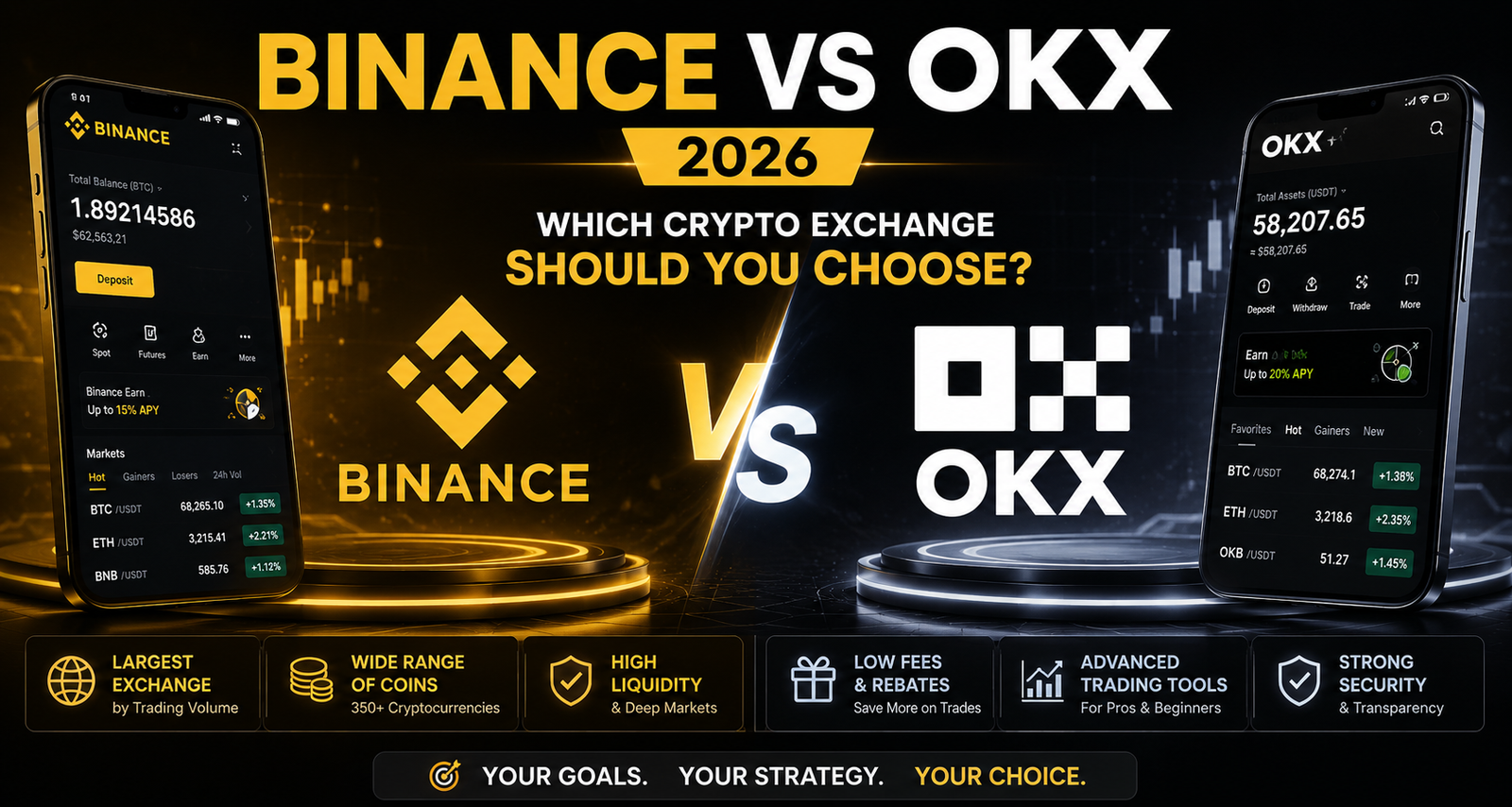
Binance vs OKX 2026 – Compare the world’s leading crypto platforms in our comprehensive binance vs okx 2026 guide. Discover fees, security features, coin listings, and Web3 wallets to make the right choice.
Selecting the right digital asset platform is crucial for navigating the evolving crypto landscape. Two giants dominate the conversational radar of global traders: Binance, the undisputed heavyweight leader by trading volume, and OKX, a powerful contender that has rapidly closed the gap through major technological advancements. When comparing these platforms, analyzing the binance vs okx 2026 dynamics reveals distinct differences in fee structures, security guarantees, user experience, and Web3 ecosystem integrations.
This granular comparison details the key performance metrics, structural contrasts, and strategic advantages of both exchanges to help determine which platform best suits your specific trading needs.
1. Liquidity, Market Share, and Regional Accessibility

When evaluating the binance vs okx 2026 landscape, raw market presence and order book depth are the first metrics professional traders analyze. Centralized exchanges rely heavily on network effects, and the battle for liquidity in the binance vs okx 2026 ecosystem has created two distinct environments for global digital asset investors.
Market Share and Liquidity Metrics
In terms of global market share, Binance continues to maintain its undisputed top position worldwide. Moving into 2026, Binance officially reports over 300 million registered users globally, controlling roughly 36% to 39% of the entire cryptocurrency spot and derivatives market share. The platform processes trillions of dollars in monthly volume, ensuring the deepest order books and minimal slippage for high-volume institutional traders.
On the other side of the binance vs okx 2026 matchup, OKX solidly occupies the position of the closest challenger to the market leader, frequently ranking as the third-largest crypto exchange globally by trading volume. With a registered user base exceeding 60 million, the exchange has captured a significant slice of global capital. While smaller than its main competitor in absolute user numbers, the binance vs okx 2026 data from CoinGlass highlights that OKX has built massive liquidity pools, particularly for its derivatives, perpetual futures, and options markets, where its open interest consistently places it in the top tier of crypto execution venues.
The Regulatory Landscape and Geographic Availability
Regulatory developments have drastically reshaped how both exchanges operate globally. A critical factor in any practical binance vs okx 2026 comparison is geographic availability, as local laws restrict access to certain services.
-
United States: When looking at the binance vs okx 2026 availability guidelines, neither global platform is accessible to US residents due to strict federal regulatory frameworks. Binance relies on its separately operated, US-compliant entity, Binance.US, which features a significantly limited asset availability and lower liquidity. Meanwhile, the binance vs okx 2026 standard does not apply to a native OKX US exchange; instead, OKX has focused its expansion strategies on integrating compliant decentralized tools and smart Web3 accounts for international users while strictly restricting its main centralized exchange (CEX) platform from onboarding US residents.
-
Europe and Global Hubs: Following the full implementation of the European Markets in Crypto-Assets (MiCA) regulations, both platforms had to structurally adjust their operational frameworks. In this specific arena of the binance vs okx 2026 compliance race, OKX successfully positioned itself early as a highly regulated platform across several European jurisdictions, capturing market share from traders who prioritize regulatory clarity. Binance, while navigating historical legal settlements, has overhauled its compliance division to maintain its position as the primary hub for international liquidity across Latin America, Asia, and Africa.
Understanding these foundational parameters of the binance vs okx 2026 balance of power is essential before diving deeper into their respective fee schedules and technical architectures.
2. Trading Fees: Spot, Futures, and Network Cost Analysis
Cost efficiency remains a primary decision point for retail day traders, systematic algorithmic funds, and long-term institutional investors alike. Evaluating the binance vs okx 2026 fee structures shows that both platforms offer highly competitive tier systems, though they use completely different incentive mechanisms and loyalty tokens to lower your overall trading costs.
Understanding how these platform-specific costs accumulate across different financial instruments is crucial for optimizing your net returns.
Spot Market Fees
When looking at immediate asset purchases on the spot market, the binance vs okx 2026 comparison reveals minor differences in baseline rates that can significantly impact high-frequency traders over time:
-
Binance: Employs a standard baseline fee of 0.10% for both makers and takers at the VIP 0 entry level. However, users can easily reduce this fee by 25% (down to 0.075%) simply by holding Binance Coin (BNB) in their exchange spot wallet and opting to pay trading fees with it. As your 30-day trading volume scales past $1 million (or equivalent), you enter higher VIP tiers where baseline maker fees can drop to 0.00%.
-
OKX: Features a slightly lower baseline spot fee for regular, non-VIP users, starting at 0.08% for makers and 0.10% for takers. Instead of applying a flat deduction percentage like BNB, OKX calculates your fee discounts based on a dual system: your total holdings of the platform’s native OKB token and your rolling 30-day trading volume. If you hold more than 100 OKB, your maker fee immediately drops to 0.06%, giving it a slight edge for low-volume market makers who do not want to hold massive amounts of exchange tokens.
Futures and Derivatives Fees
For high-leverage perpetual swaps and dated futures contracts, transaction costs drop significantly on both platforms to accommodate rapid position turnover and high-volume leverage trading.
-
Binance: Standard USDT-margined and Coin-margined perpetual contracts start at a VIP 0 rate of 0.02% maker and 0.05% taker fees. Traders can claim an additional 10% discount on these rates by using BNB as their primary collateral or fee-paying asset, lowering net costs to 0.018% maker and 0.045% taker.
-
OKX: Matches the standard derivatives baseline exactly, opening at 0.02% maker and 0.05% taker fees for regular tier-1 users. For institutional traders clearing heavy volume (above $10 million monthly), the OKX fee schedule scales aggressively down, occasionally offering negative maker fees (rebates) faster than the traditional tier advancements found on competing exchanges.
Withdrawal and Deposit Friction
Depositing cryptocurrencies via on-chain transfers is entirely free on both platforms. However, when it comes to extracting capital from the exchange, network fees and internal processing costs vary:
-
Dynamic On-Chain Withdrawals: Withdrawal fees are completely dynamic and depend entirely on the chosen blockchain network’s congestion at the time of the transaction. For example, withdrawing stablecoins via Tron (TRC-20) or Arbitrum remains highly cost-effective on both applications. However, looking at the binance vs okx 2026 user feedback, OKX generally maintains a reputation for lower internal processing premiums, rarely adding arbitrary service surcharges on top of the base gas fees required by native blockchains.
-
Peer-to-Peer (P2P) Desks: For fiat-to-crypto on-ramps and off-ramps, the P2P desks on both platforms charge 0% platform fees to regular retail buyers and sellers. Instead, transaction costs are built directly into the localized fiat payment methods and the exchange spreads set by independent marketplace merchants.
For a deeper analysis of individual platform mechanics, asset-specific fee charts, and localized deposit channels, you can review our extensive Binance Review 2026 or explore alternative match-ups like Bybit vs Binance 2026.
3. How Safe Is Your Crypto? Binance SAFU vs. OKX Proof of Reserves

Security remains a foundational requirement for anyone holding digital assets on centralized platforms. When examining how your funds are protected, the binance vs okx 2026 security paradigms showcase two fundamentally different, yet highly robust, methodologies for managing risk, preventing insolvency, and protecting user capital against market anomalies or external exploits.
Binance: The SAFU Emergency Insurance Fund Model
Binance’s primary security safety net is built around a reactionary risk mitigation model known as the Secure Asset Fund for Users (SAFU). Established in 2018, this emergency insurance pool was designed to protect user balances in the rare event of a catastrophic security breach or platform exploit.
SAFU Structural Update: In early 2026, Binance finalized a major strategic transition for this fund. To protect the insurance pool from fiat inflation and banking vulnerabilities, Binance fully converted the $1 billion SAFU fund into 15,000 Bitcoins (BTC). This ensures the emergency reserve is held entirely in a high-value, non-fiat asset class. Under its 2026 operating guidelines, Binance officially commits to topping up this pool using exchange revenue if extreme market volatility drops the total valuation of these 15,000 Bitcoins below the $800 million threshold.
While the SAFU fund gives retail traders immense peace of mind, critics of this model point out that it is a reactive measure—it exists to fix a problem after an exploit has occurred, rather than proving solvency on a daily basis.
OKX: Continuous Cryptographic Proof of Reserves (PoR)
Rather than relying primarily on a post-event insurance fund, OKX approaches platform security through real-time, proactive financial transparency. In the binance vs okx 2026 security debate, OKX stands out for its industry-leading Proof of Reserves (PoR) program.
Instead of asking users to trust their internal ledgers blindly, OKX publishes monthly, interactive Proof of Reserves reports utilizing advanced Merkle tree cryptographic verifications. This specialized technology allows any individual user to log into their dashboard, pull their unique hashed balance, and verify independently that their specific assets are fully backed by physical tokens held in the exchange’s on-chain multi-signature wallets.
-
Asset Coverage Scale: OKX holds over $30 billion in total verifiable user assets, maintaining a completely clean balance sheet devoid of high-risk corporate debt or speculative self-issued collateral.
-
Over-Collateralization Ratios: The exchange’s reserve ratios consistently exceed 100% across all core digital assets. Bitcoin (BTC) balances sit comfortably at ~105% backing, Ethereum (ETH) maintains a ~105% ratio, and primary stablecoins like USDT and USDC range between 100% and 112% backing.
By prioritizing mathematical proof over corporate promises, OKX minimizes counterparty risk. This makes it an incredibly compelling choice for risk-averse traders who prioritize transparent solvency over standard insurance policies.
4. User Experience, Coin Selection, and Web3 Wallets
The day-to-day usability of a digital asset platform depends heavily on its user interface design, listing philosophies, and decentralized application (dApp) bridges. Examining the binance vs okx 2026 user product ecosystems highlights a competitive landscape where both platforms aim to capture retail, pro-level, and Web3 native traffic through distinct layout designs and cross-chain integrations.
Interface Complexity and Onboarding Experience
Managing your positions efficiently requires an intuitive trading terminal. Both applications provide clear choices depending on individual expertise:
-
Binance: Employs a comprehensive, data-rich layout that can feel intimidating for newcomers. To combat this, the mobile application offers a “Binance Lite” toggle, which simplifies asset purchasing down to basic fiat on-ramps and straightforward token swaps. However, the standard “Binance Pro” interface is built primarily for advanced traders who need immediate access to deep liquidity, multi-pane charting systems, and highly detailed conditional order types.
-
OKX: Features a unified, modern account architecture designed for high capital efficiency. Unlike traditional platforms that require users to manually shift capital between spot, margin, and derivatives wallets, the OKX Unified Account lets traders use their entire cross-chain portfolio as a single collateral pool. This highly streamlined setup provides a smoother experience for active multi-asset traders.
Coin Selection and Listing Philosophies
When building a diversified portfolio, the binance vs okx 2026 asset variety comparison highlights completely different strategic listing methodologies:
-
Binance: Focuses on maximizing market variety, boasting an extensive collection of over 600 unique cryptocurrencies and more than 1,500 trading pairs. It remains the primary CEX target for early-stage micro-caps, community-driven meme projects, and trending tokens looking for deep, high-volume retail liquidity.
-
OKX: Chooses a highly structured, risk-mitigated listing path, hosting around 300 to 350 thoroughly vetted digital assets. While this selective approach means OKX users miss out on some speculative low-cap altcoins, it drastically reduces retail exposure to illiquid tokens and potential project abandonments.
Centralized Web3 Wallet Integration
The intersection of centralized order books and non-custodial decentralized finance (DeFi) represents one of the most innovative areas in the binance vs okx 2026 product rivalry.
-
OKX Web3 Wallet: Widely considered an industry benchmark for exchange-native decentralized apps. It functions as a robust, self-custody wallet that supports over 130 native blockchain networks. It includes an advanced “Smart Account” feature built on Account Abstraction, allowing users to pay for network gas fees using stablecoins like USDC instead of holding the blockchain’s native token. It also features a built-in DEX router, an integrated NFT marketplace, and real-chain analytics dashboards.
-
Binance Web3 Wallet: Deeply integrated directly into the core Binance mobile application, this option utilizes Multi-Party Computation (MPC) technology. Instead of forcing users to store a traditional 12-word seed phrase, the private key is split into three secure “shares” across your device, cloud backup, and Binance’s verification server. Additionally, its automated “Security Center” actively scans for risky token approvals and known malicious smart contracts, providing an excellent gateway for users moving from centralized trading to on-chain ecosystems.
5. Summary Comparison Matrix
To properly weigh your options in the binance vs okx 2026 matchup, looking at individual features is helpful, but a comprehensive, head-to-head performance baseline provides a clearer picture. This comparative matrix condenses their operational structures, fee schedules, safety protocols, and decentralized service layers into a scannable format, highlighting exactly where each platform focuses its technological resources.
The 2026 Core Platform Metrics Matrix
| Feature / Selection Criteria | Binance Exchange Infrastructure | OKX Digital Asset Architecture |
| Global Trading Volume Tier | Ranked Number 1 — Handles roughly 39% to 41% of global spot and derivatives market liquidity. | Ranked Number 3 — Functions as a primary structural alternative for high-volume derivatives. |
| Total Registered User Base | Over 300 million registered profiles globally. | Exceeds 60 million active user accounts worldwide. |
| Baseline Spot Market Trading Fees | 0.10% maker and taker rates (reduced to 0.075% when paying with BNB). | 0.08% maker and 0.10% taker rates (scaled lower based on OKB token holdings). |
| Baseline Derivatives Trading Fees | 0.02% maker and 0.05% taker rates (an additional 10% discount applies via BNB). | 0.02% maker and 0.05% taker rates (scales down via rolling 30-day volume metrics). |
| Asset Variety and Listing Depth | Broadest market access with 600+ coins and 1,500+ dynamic trading pairs. | Vetted ecosystem featuring 300+ highly liquid, verified digital assets. |
| Primary Safety and Protection Model | SAFU Emergency Fund: A capital backstop fully converted into 15,000 physical Bitcoins. | Proof of Reserves (PoR): Monthly cryptographically verified, over-collateralized assets (>100%). |
| Internal Margin Account Architecture | Separate margin accounts require manual wallet balancing between asset pools. | Unified Account Setup: Cross-margin engine allows multi-currency collateral under one wallet. |
| On-Chain Web3 Connectivity Options | Binance Web3 Wallet: Multi-Party Computation (MPC) key-slice model integrated into the main app. | OKX Web3 Smart Wallet: Fully standalone, non-custodial portal spanning 130+ blockchains. |
Operational Insight: The data within this binance vs okx 2026 metrics ledger shows that while Binance focuses on sheer asset variety and deep volume capabilities, OKX concentrates heavily on infrastructure efficiency and transparent on-chain wallet technology. For high-volume derivatives traders, the base fees are essentially identical, shifts in total cost efficiency depend heavily on your holding preference between BNB and OKB.
When making a final choice in the binance vs okx 2026 comparison, neither exchange is universally superior; the right option depends entirely on your trading style, asset preference, and workflow requirements.
Choose Binance if:
-
You require maximum liquidity and deep order books to execute large, multi-million dollar spot or futures orders with minimal slippage.
-
You want to trade speculative, small-cap altcoins or access new project launches immediately.
-
You already hold a portfolio of BNB and want to utilize it to minimize your operational trading fees.
Choose OKX if:
-
You want a unified account structure where spot, margin, and derivatives positions can be managed out of a single collateral dashboard.
-
You prefer clear financial transparency verified through monthly, over-collateralized Proof of Reserves reports.
-
You want a seamless connection to decentralized ecosystems via an advanced, non-custodial Web3 multi-chain wallet interface.
Disclaimer: Cryptocurrency trading involves significant financial risk due to extreme price volatility. Centralized platforms carry structural counterparty risks. The data presented in this binance vs okx 2026 comparison is for informational and educational purposes only and does not constitute formal financial, investment, or legal advice. Always conduct independent research and assess your personal risk tolerance before committing capital to any digital asset platform.