The crypto landscape of 2026 has transitioned from the “Speculative Era” into the “Institutional Era.” Smart money is no longer chasing “moonshots” based on hype; instead, it is rotating into structural plays that integrate with global financial systems.
As of March 2026, here is the detailed breakdown of where the largest capital allocators—hedge funds, family offices, and corporate treasuries—are moving their liquidity.
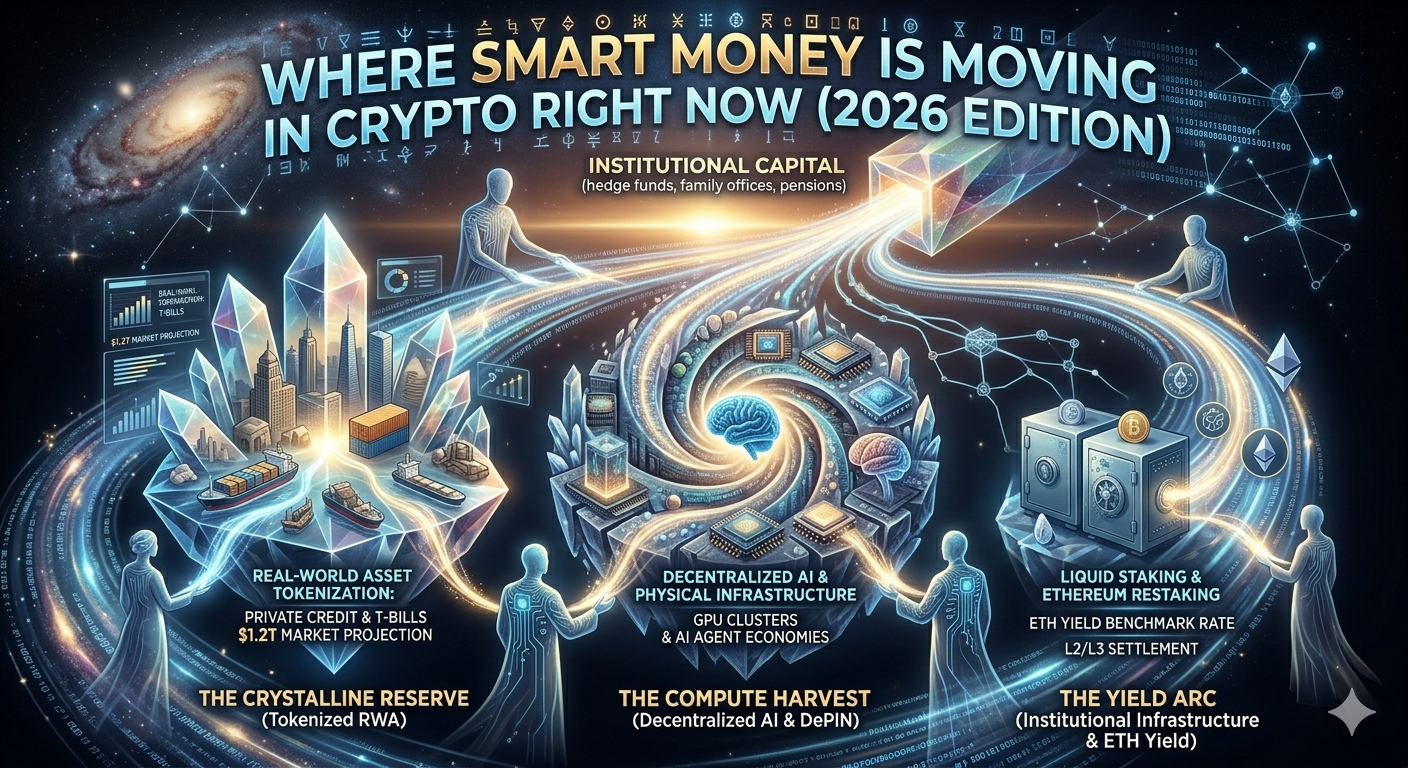
Where Smart Money Is Moving in Crypto Right Now (2026 Edition)?
1. The Great Rotation: From “Beta” to “Yield”
In early 2026, a significant shift occurred. Investors moved away from holding “naked” assets and toward yield-generating architectural plays.
-
Ethereum’s Execution Test: Following the Hegota upgrade in late 2025, smart money is treating ETH as the “Lindy-stable” settlement layer. Capital is moving into Liquid Staking and Restaking (EigenLayer/Symbiotic) to capture 4–7% base yields, which now compete with traditional fixed-income products.
-
Bitcoin as a Treasury Reserve (DAT 2.0): Institutional Bitcoin ETFs (like BlackRock’s IBIT) have reached over $130 billion in AUM. Smart money is now using BTC not just as a trade, but as a “Digital Asset Treasury” (DAT), collateralizing it to borrow liquidity for low-risk arbitrage.
2. Real-World Asset (RWA) Tokenization
This is the “killer app” of 2026. The total market for tokenized assets has surged to over $27 billion, driven by the migration of private credit and public equities on-chain.
-
On-Chain Treasuries: Capital is flowing into protocols like Ondo Finance and BlackRock’s BUIDL, which offer tokenized U.S. Treasury bills. In a high-inflation environment, this allows global capital to earn “risk-free” USD yield without leaving the blockchain.
-
Institutional Private Credit: Smart money is moving into Aave V3 and Centrifuge to fund real-world businesses. The attraction here is capital efficiency—DeFi loan-to-value (LTV) ratios are now outperforming traditional banking frameworks.
3. High-Conviction “Work” Narratives (AI & DePIN)
If 2024 was about “AI hype,” 2026 is about “AI work.” Capital is moving into tokens that represent physical or computational utility.
-
Decentralized Compute (DePIN): Massive inflows are being seen in Render (RNDR) and io.net. As centralized GPU costs (Nvidia) remain high, smart money is betting on decentralized clusters to power AI model training.
-
Agentic Economies: The rise of Autonomous AI Agents (using protocols like Bittensor (TAO) and Fetch.ai) has created a new class of “Smart Money.” These are automated systems that trade, govern, and optimize liquidity 24/7 without human intervention.
4. Layer 2 Consolidation & Interoperability
The “L2 Wars” are maturing. Instead of spreading capital across 50 different chains, smart money is concentrating on “Winner-Take-Most” infrastructure:
-
The Big Three: Base, Arbitrum, and Optimism are capturing the lion’s share of institutional liquidity due to their regulatory compliance tools and deep integration with Coinbase and other major on-ramps.
-
Modular Liquidity: Capital is flowing into Celestia (TIA) and EigenDA as the industry realizes that “Data Availability” is the most profitable part of the blockchain stack in 2026.
The “Smart Money” signature right now is accumulation during corrections. On-chain data shows massive exchange outflows into cold storage whenever Bitcoin dips below $70k. These investors aren’t looking for the next 100x memecoin; they are building a “Digital Toll Road” portfolio consisting of Staked ETH, Tokenized Treasuries (RWA), and AI-Compute Infrastructure.
Market Sentiment & Macro Indicators (March 2026)
| Metric | Current Status (March 2026) | Trend |
| Bitcoin Dominance | ~58.8% | Increasing (Flight to Quality) |
| Fear & Greed Index | 25/100 (Fear) | Accumulation Zone |
| Stablecoin Supply | $1.2T Target (Aggressive Growth) | Dry Powder Ready |
| Institutional Ownership | ~58% of Total Market Cap | Structural Shift |
The “Institutional Era” of 2026 is defined by a paradox: record-breaking capital inflows occurring alongside compressed volatility and extreme caution. Unlike the retail-driven “moon missions” of the past, today’s market is steered by data-driven algorithms and macroeconomic policy.
As of late March 2026, here is the expanded analysis of the indicators and sentiment shaping the current cycle.
1. The Macro Backdrop: Fed Policy and AI Correlation
The primary driver of price action in Q1 2026 has been the tension between sticky inflation and central bank signaling.
-
The Post-FOMC Cycle: Historically, Bitcoin has found its local trough roughly 48 hours after a Fed announcement. In the March 17–18 FOMC meeting, the Fed held rates at 3.50–3.75%. While “Smart Money” expected a more dovish pivot, the persistent energy-driven inflation has kept the market in a state of “cautious consolidation.”
-
The Software-AI Drag: A unique phenomenon of 2026 is the high correlation between Bitcoin and the broader AI/Software sector. Large institutions currently treat Bitcoin as a “tech risk factor.” When AI software margins face pressure, institutional desks liquidate both software equities and BTC simultaneously. This has created a temporary price ceiling, even as BTC’s individual fundamentals remain strong.
-
Decoupling from the Dollar: Interestingly, the correlation between Bitcoin and the DXY (Dollar Index) has neared 0 over the last 50 sessions. This suggests that Bitcoin is increasingly viewed as an independent asset class rather than just a hedge against a weak dollar.
On-Chain Sentiment: Fear as an Accumulation Signal
Despite Bitcoin trading in a healthy range (holding above the $68,987 support), the Fear & Greed Index has dipped into the “Fear” (25–28/100) territory this March.
-
Institutional Absorption: While retail sentiment is fearful, the Spot BTC ETFs (led by BlackRock’s IBIT and Fidelity’s FBTC) continue to see net positive inflows, totaling over $1.3 billion in March alone. These ETFs are currently absorbing more than twice the annual mining supply.
-
The 20 Millionth Milestone: A massive sentiment driver is the approaching mining of the 20 millionth Bitcoin in late March 2026. This verifiable digital scarcity is being used by wealth managers to contrast crypto against the “uncertain” fiat monetary policies of global central banks.
-
Stablecoin Velocity: Total stablecoin supply has surged toward $400 billion. However, unlike 2021 where stablecoins sat on exchanges to buy dips, 2026 sees these assets moving through regulated payment processors for settlement, indicating that “dry powder” is now actively working in the real economy.
Deep Analysis: The “Regulatory Greenlight” of March 2026
The most consequential event of this month occurred on March 17, when the SEC and CFTC jointly issued a 68-page interpretive release. This document officially classified BTC, ETH, XRP, and SOL as Digital Commodities.
This classification has effectively ended the “Security vs. Commodity” debate for the majors, allowing pension funds and sovereign wealth funds—who were previously sidelined by legal ambiguity—to begin structural allocations. This “Regulatory Greenlight” provides a long-term valuation floor that simply did not exist in previous cycles.
The market sentiment of March 2026 is “Constructive Fear.” Retail investors are hesitant due to macro uncertainty and AI-sector volatility, but institutions are using this “quiet” period to build massive positions. With Bitcoin Dominance at ~58.8%, the market is in a “Flight to Quality” phase. Smart money is waiting for the AI-related panic to subside, at which point the monetary scarcity narrative—buttressed by the 20-millionth-coin milestone—is expected to trigger the next leg of the “Institutional Era” expansion.
Conclusion
The crypto landscape of 2026 marks the definitive end of the “Wild West” and the beginning of a sophisticated, utility-driven financial frontier. As smart money rotates away from pure speculation and toward Real-World Assets (RWA), AI-integrated infrastructure, and sustainable yield, the market is prioritizing structural value over short-term volatility.
Despite the current “Constructive Fear” driven by macroeconomic uncertainty and the evolving relationship between crypto and the AI sector, the underlying metrics remain historically strong. With the 20-millionth Bitcoin milestone approaching and a clearer regulatory framework finally in place, the “Institutional Floor” is firmer than ever. For those navigating this cycle, the strategy is clear: follow the liquidity into infrastructure and focus on the digital assets that act as the essential “toll roads” for the future global economy.