The crypto landscape of 2026 has undergone a fundamental tectonic shift. The “Lindy Effect” has finally caught up with the market: while Meme Coins provided the dopamine-driven speculative mania of the early 2020s, the maturation of global regulations and the entry of institutional “Real Money” have forced a massive migration of capital.
Investors are no longer chasing 10,000x “dog coins” hosted on centralized servers; they are positioning themselves in the “digital steel and concrete” of the internet’s next financial layer.
The Institutional Imperative: From “Slot Machines” to “Settlement Layers”
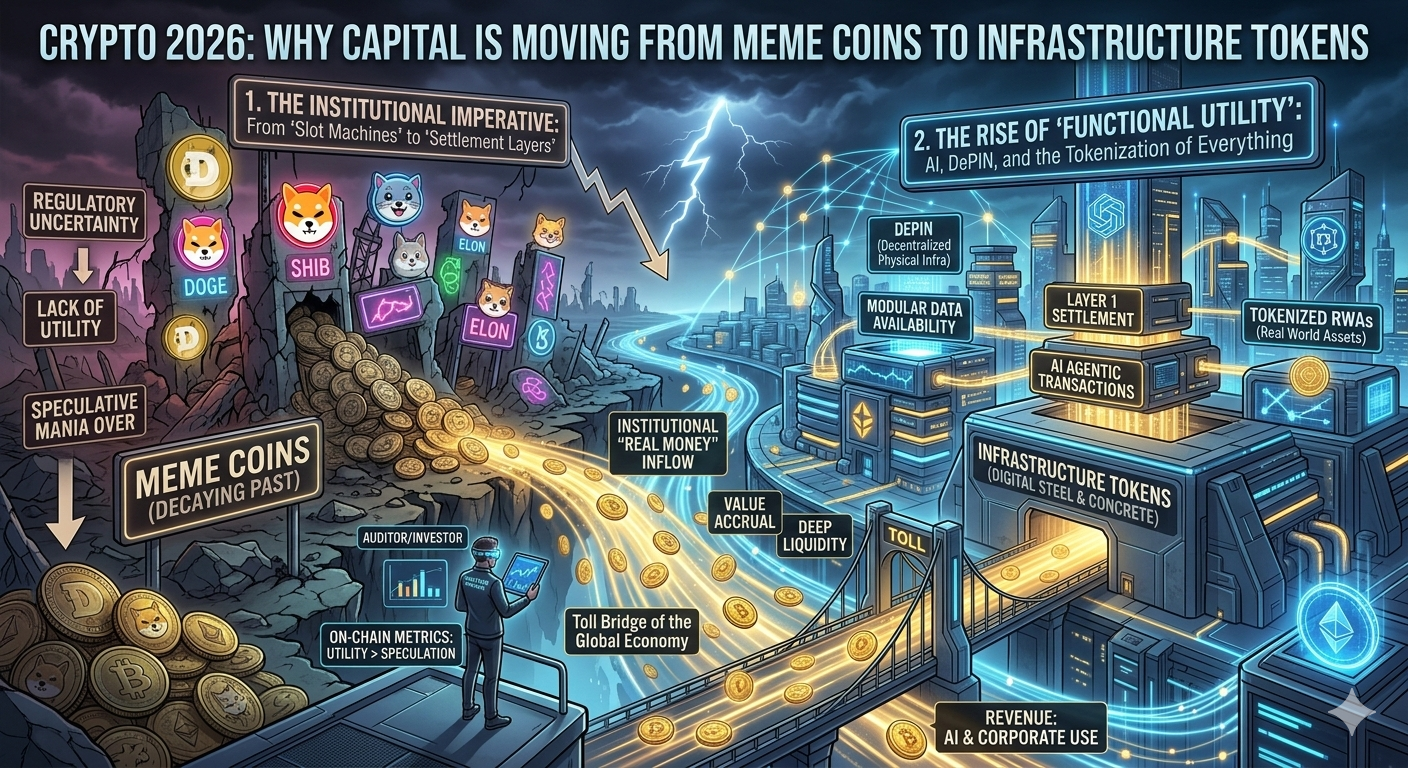
By 2026, the primary reason capital is fleeing Meme Coins for Infrastructure is the shift in Who is buying. The market is no longer dominated by retail traders on Telegram; it is led by pension funds, sovereign wealth funds, and corporate treasuries operating under strict mandates.
The Death of “Vibes” as a Value Proposition
In previous cycles, Meme Coins thrived on “community” and “vibes.” However, in 2026, the novelty has worn off. High-frequency AI agents and institutional bots have made the Meme Coin market mathematically impossible for retail to win. When a new meme launches, AI bots snip the liquidity in milliseconds, leaving humans as “exit liquidity.” Capital is moving to Infrastructure because it offers predictable yield based on network usage rather than social media sentiment.
Infrastructure as the “Toll Bridge” of the Global Economy
Infrastructure tokens—specifically those powering Layer 1s, Modular Data Availability layers, and Decentralized Physical Infrastructure Networks (DePIN)—function as toll bridges.
-
The Revenue Model: Every time a bank tokenizes a real-world asset (RWA) or an AI agent executes a smart contract, they must pay a fee in the native infrastructure token.
-
Capital Efficiency: In 2026, holding a token like Ethereum, Celestia, or Solana is seen as owning a share of the “Global Settlement Layer.” Institutional investors prefer the “Value Accrual” of gas fees over the “Greater Fool Theory” of Meme Coins.
Regulatory “Safe Havens”
2026 is the year of enforcement. Most Meme Coins are now classified as “unregistered securities” due to their lack of utility and centralized marketing efforts. Infrastructure tokens, which provide essential services to the internet, have largely navigated the regulatory hurdles (such as the US Clarity Act). Capital is moving to where it won’t be frozen by a court order.
The Rise of “Functional Utility”: AI, DePIN, and the Tokenization of Everything
The second major driver is the emergence of technologies that require blockchain infrastructure to function. In 2026, crypto is no longer a “siloed” industry; it is the backend for AI and Physical Infrastructure.
AI-to-AI Transactions
The biggest buyers of crypto in 2026 aren’t humans—they are AI agents. An AI agent doesn’t care about a “cute dog” meme; it cares about bandwidth, storage, and compute power. To buy these resources, AI agents use Infrastructure tokens (like Filecoin for storage or Render for compute). This “Agentic Economy” creates a massive, constant buy-pressure on infrastructure that Meme Coins simply cannot replicate.
DePIN: The Physical Backbone
Decentralized Physical Infrastructure Networks (DePIN) have become the breakout sector of 2026. Capital is flowing into tokens that represent real-world utility:
-
Decentralized Energy: Trading excess solar power on the blockchain.
-
Mapping and Connectivity: Decentralized 5G networks and mapping services. Investors are rotating profits from the “virtual memes” of 2024 into “physical infra” of 2026 because these assets have intrinsic value—they are backed by hardware, towers, and real-world services.
Modular Sovereignty
The “Monolithic” vs. “Modular” debate has been settled. Capital is moving into the “Modular Stack.” Investors are buying tokens that provide specific services: Execution, Settlement, Data Availability, and Sequencing. By owning the “Lego bricks” of the blockchain world, investors are betting on the growth of the entire ecosystem rather than the success of a single, volatile community.
Conclusion: The Great Professionalization of Digital Assets
The transition of capital from Meme Coins to Infrastructure in 2026 represents the “Coming of Age” for the crypto industry. We have moved from the Speculative Era (where price was driven by attention) to the Industrial Era (where price is driven by utility).
While Meme Coins will always exist as a form of “cultural lottery,” they are no longer the engine of the market. The smart money has realized that in a gold rush, you don’t buy the “hope” of finding gold; you buy the shovels, the maps, and the land. Infrastructure tokens are the shovels of the 2026 digital economy, and they are where the next trillion dollars of value will be settled. The “Mirage of Stability” in memes has been replaced by the “Concrete Certainty” of infrastructure.
Ready to start your cryptocurrency journey?
If you’re interested in exploring the world of crypto trading, here are some trusted platforms where you can create an account:
🔹 Binance – A global leader in cryptocurrency trading.
🔹 Bybit – A user-friendly platform for both beginners and advanced traders.
These platforms offer innovative features and a secure environment for trading and learning about cryptocurrencies. Join today and start exploring the opportunities in this exciting space!
🚀 Want to stay updated with the latest insights and discussions on cryptocurrency?
Join our crypto community for news, discussions, and market updates: OCBCryptoHub on Telegram.
📩 For collaborations and inquiries: datnk710@gmail.com
Disclaimer: Always do your own research (DYOR) and ensure you understand the risks before making any financial decisions.