The cryptocurrency market has long been a theater of extreme emotion, where fortunes are made by the patient and lost by the impulsive. As we move through 2026, the traditional “four-year cycle” is being dismantled by institutional forces and regulatory clarity. However, the fundamental reason most retail investors lose remains the same: they arrive at the party just as the lights are being turned off.
To understand why the “late entry” phenomenon persists and how 2026 is fundamentally changing the rules of engagement, we must look at the intersection of human psychology and the evolving financial infrastructure.
Why Most Retail Investors Enter Too Late in Crypto Cycles?

1. The Psychology of the “Late Entry”: Why Retail Investors Wait for the Top
The most significant barrier to retail success isn’t a lack of technical knowledge; it is the biological wiring of the human brain. Most investors are hardwired to seek safety in numbers, which is the exact opposite of what is required in a volatile asset class like crypto.
Retail investors typically ignore crypto during “boring” accumulation phases (like the lows of late 2022 or the mid-cycle lulls of 2024). They only pay attention when the mainstream media begins reporting on new All-Time Highs (ATHs). This creates a dangerous cycle:
-
Stage 1: Disbelief. The price starts rising, but retail assumes it’s a “dead cat bounce.”
-
Stage 2: Validation. Major news outlets cover the rally. The investor’s social circle begins talking about gains.
-
Stage 3: Euphoria & Entry. Driven by the Fear Of Missing Out (FOMO), the retail investor buys in at the peak, providing “exit liquidity” for the smart money that bought months or years earlier.
In 2026, the concept of “exit liquidity” has become more sophisticated. In previous cycles, retail investors were the primary fuel for market tops. Today, even with institutional presence, retail often buys into high-valuation “Low Float, High FDV” (Fully Diluted Valuation) projects promoted by influencers, only to see early venture capital (VC) investors sell their unlocked tokens into that retail demand.
2. The 2026 Structural Shift: How the “Four-Year Cycle” Broke
For a decade, the “halving cycle” dictated crypto’s rhythm. Every four years, the Bitcoin supply issuance was cut in half, leading to a predictable boom and bust. However, 2026 marks the year this pattern officially decoupled from its historical roots.
With the maturity of Spot Bitcoin and Ethereum ETFs in 2024 and 2025, the market in 2026 is no longer driven solely by retail sentiment. Institutional capital is “sticky.” Unlike retail investors who panic-sell during a 20% dip, pension funds and corporate treasuries treat crypto as a strategic reserve asset. This has led to compressed volatility: the peaks are less “bubbly,” but the crashes are shallower.
In 2026, the market is influenced more by Global Macro Liquidity and central bank interest rates than by the Bitcoin halving alone. Retail investors waiting for a “predictable” 80% crash to enter—similar to 2018 or 2022—found themselves sidelined in 2025 and early 2026 as the market moved sideways or up, supported by massive institutional inflows and the integration of Real-World Assets (RWA) onto blockchains.
3. The New Rules of 2026: From Speculation to Infrastructure
The “Game” in 2026 is being reset by three major pillars that retail investors must understand to survive.
The Wild West is over. By 2026, the European Union’s MiCA (Markets in Crypto-Assets) and new U.S. market structure laws have created a “walled garden.” Retail investors can no longer hide behind anonymous exchanges to avoid taxes or regulation. This “cleans up” the market but also means that the 100x gains from obscure, unregulated “shitcoins” are rarer. Success now requires analyzing revenue-generating protocols rather than just memes.
A major shift in 2026 is the use of AI Agents for trading. Professional firms now use autonomous agents that can execute trades, bridge assets, and farm yields 24/7 with zero emotional bias. Retail investors who “manual trade” based on tweets are now competing against machines that process on-chain data in milliseconds. To survive, retail is shifting toward AI-managed vaults and decentralized index products.
Bitcoin is no longer just “digital gold” for enthusiasts; in 2026, it is increasingly discussed as a sovereign treasury asset. As nations and corporations hold BTC on their balance sheets, the “entry price” for retail becomes less about catching a bottom and more about “Time in the Market” versus “Timing the Market.”
How 2026 Is Resetting the Game
In 2026, the “retail trap” is no longer just a matter of bad timing; it is a collision between old human habits and a new, hyper-professionalized financial machine. While the 2000s were about the internet of information, 2026 is the year of the Internet of Value, where the rules of the “game” have been rewritten by institutions, AI, and regulation.
Here is a detailed analysis of how 2026 is resetting the crypto game and why the traditional retail entry strategy is now more dangerous than ever.
1. The Institutional “Moat”: The Death of the 80% Crash
For years, retail investors relied on a predictable cycle: a massive bull run followed by an 80-90% “crypto winter” crash where they could eventually buy back in. In 2026, that floor has been reinforced by concrete.
With the full integration of Spot Bitcoin and Ethereum ETFs, along with the 2025-2026 surge in Digital Asset Treasury (DAT) companies, the market’s liquidity profile has changed. Institutional allocators are “long-term rebalancers.” When prices dip, they don’t panic-sell; they add to their positions to maintain their target allocations.
-
Compressed Volatility: In 2026, Bitcoin often sees “sideways” consolidations or shallow 20-30% corrections rather than the catastrophic wipes of the past.
-
The Retail Sidelining: Retail investors waiting for “lower prices” based on 2018 or 2022 patterns are finding themselves permanently sidelined. By the time they realize the 80% crash isn’t coming, the price has already doubled, forcing them to enter at the new, higher “institutional floor.“
Bitcoin in 2026 is behaving less like a tech start-up and more like Sovereign Reserve Gold. Its correlation with traditional assets is shifting, and it is increasingly influenced by global M2 money supply and central bank interest rates. Retail investors who only watch “crypto news” miss the broader macro signals that now drive the price.
2. The Rise of the Machine: AI Agents and “Agentic” Finance
The biggest “reset” of 2026 is that retail is no longer just competing against Wall Street whales; they are competing against AI Agents.
In 2026, a significant portion of on-chain liquidity is managed by autonomous agents. These agents:
-
Scan mempools for arbitrage in milliseconds.
-
Auto-compound yields thousands of times a day across Layer 2s like Base or Solana.
-
Execute “Intents”: A user simply says, “Maximize my yield with low risk,” and the agent handles the bridging, swapping, and security checks.
Retail investors who trade manually based on “gut feeling” or influencer tweets are now at a severe mathematical disadvantage. AI agents operate without fatigue or FOMO. By the time a human reads a news alert, an AI agent has already priced it into the market. This creates a “bifurcated” market where the “Smart Money” is increasingly “Silicon Money.”
3. Regulatory Fortress: The End of the “Wild West”
In 2026, the global regulatory landscape—led by MiCA in Europe and the GENIUS Act in the U.S.—has effectively built a wall around the crypto ecosystem.
The “Travel Rule” is now fully embedded. Anonymous transactions are severely constrained, and every major Crypto-Asset Service Provider (CASP) must adhere to strict governance and capital requirements.
-
Exit of the “Small Fish”: High compliance costs have led to market consolidation. The thousands of “micro-cap” coins that retail used to gamble on are being replaced by regulated, revenue-generating protocols.
-
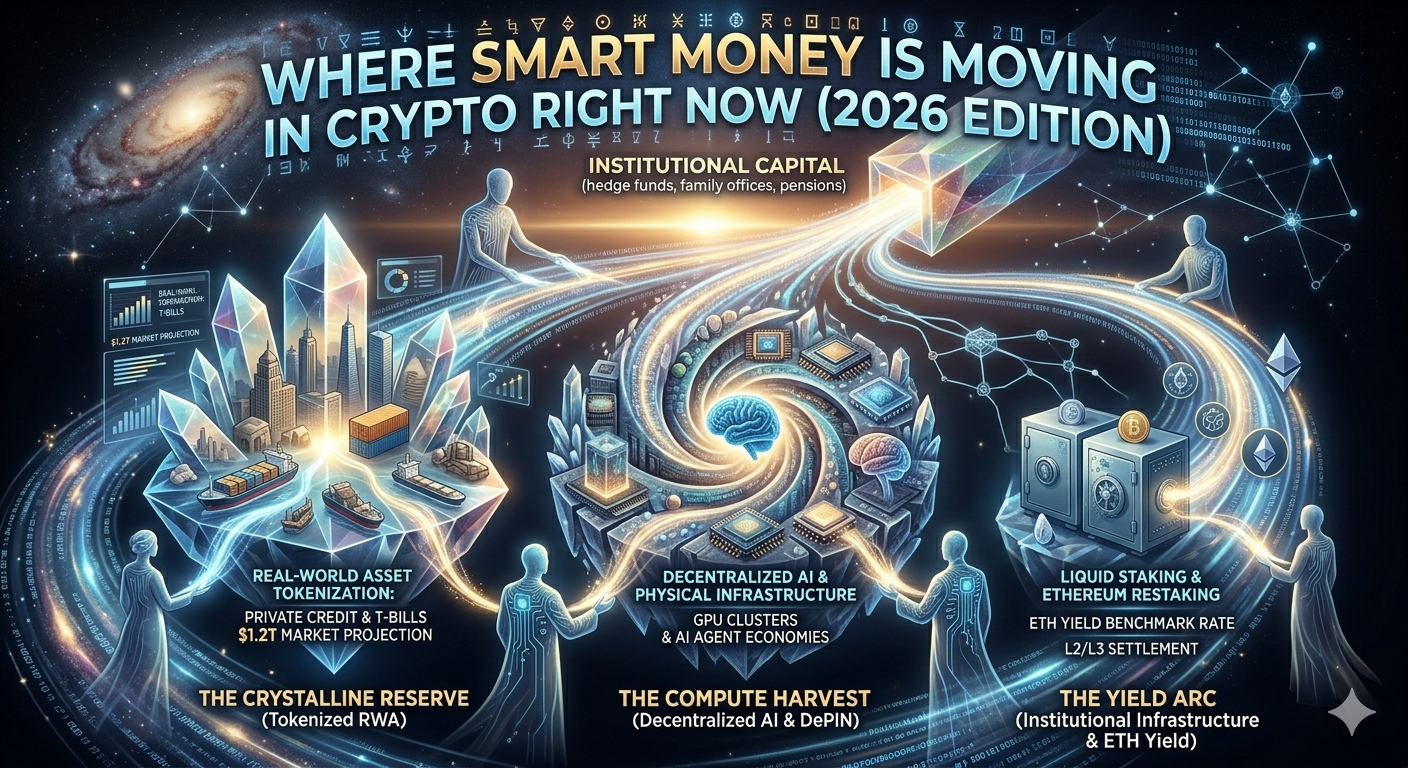
Tokenization of Everything (RWA): 2026 is the year Real-World Assets go mainstream. From tokenized U.S. Treasuries to fractionalized commercial real estate, the “value” in crypto is shifting from speculative memes to productive, yield-bearing assets.
In the past, “Alpha” (market-beating information) was found on Discord or Telegram. In 2026, Alpha is found in audited financial disclosures and on-chain revenue metrics. Retail investors who don’t know how to read a protocol’s balance sheet are essentially flying blind in a market that now demands professional-grade analysis.
The “Game” hasn’t ended; it has simply matured. The 2026 reset means that the old retail habit of “buying the hype” is a guaranteed path to becoming exit liquidity. To survive the new era, investors must shift from Speculation to Infrastructure.
The winners of 2026 are those who:
-
Embrace “Time in the Market”: Using automated DCA (Dollar Cost Averaging) to compete with institutional consistency.
-
Utilize AI Tools: Moving away from manual trading and toward AI-managed vaults or index products.
-
Focus on Utility: Investing in protocols that provide actual financial services or bridge real-world value on-chain.
Conclusion: Adapting to the “Permanent Bull” Era
The reason retail enters too late is rooted in human nature, but the 2026 reset offers a new path. The era of the “four-year cycle” is being replaced by a more stable, institutionally-backed financial layer.
To avoid being the “exit liquidity” of the future, investors must move away from chasing green candles on social media and toward a structural accumulation strategy. In 2026, the winners are not those who find the next “1000x gem,” but those who treat digital assets as a core component of a diversified portfolio, entering during periods of quiet consolidation rather than loud euphoria. The game hasn’t ended; the rules have simply become more professional.
Ready to start your cryptocurrency journey?
If you’re interested in exploring the world of crypto trading, here are some trusted platforms where you can create an account:
🔹 Binance – A global leader in cryptocurrency trading.
🔹 Bybit – A user-friendly platform for both beginners and advanced traders.
These platforms offer innovative features and a secure environment for trading and learning about cryptocurrencies. Join today and start exploring the opportunities in this exciting space!
🚀 Want to stay updated with the latest insights and discussions on cryptocurrency?
Join our crypto community for news, discussions, and market updates: OCBCryptoHub on Telegram.
📩 For collaborations and inquiries: datnk710@gmail.com
Disclaimer: Always do your own research (DYOR) and ensure you understand the risks before making any financial decisions.