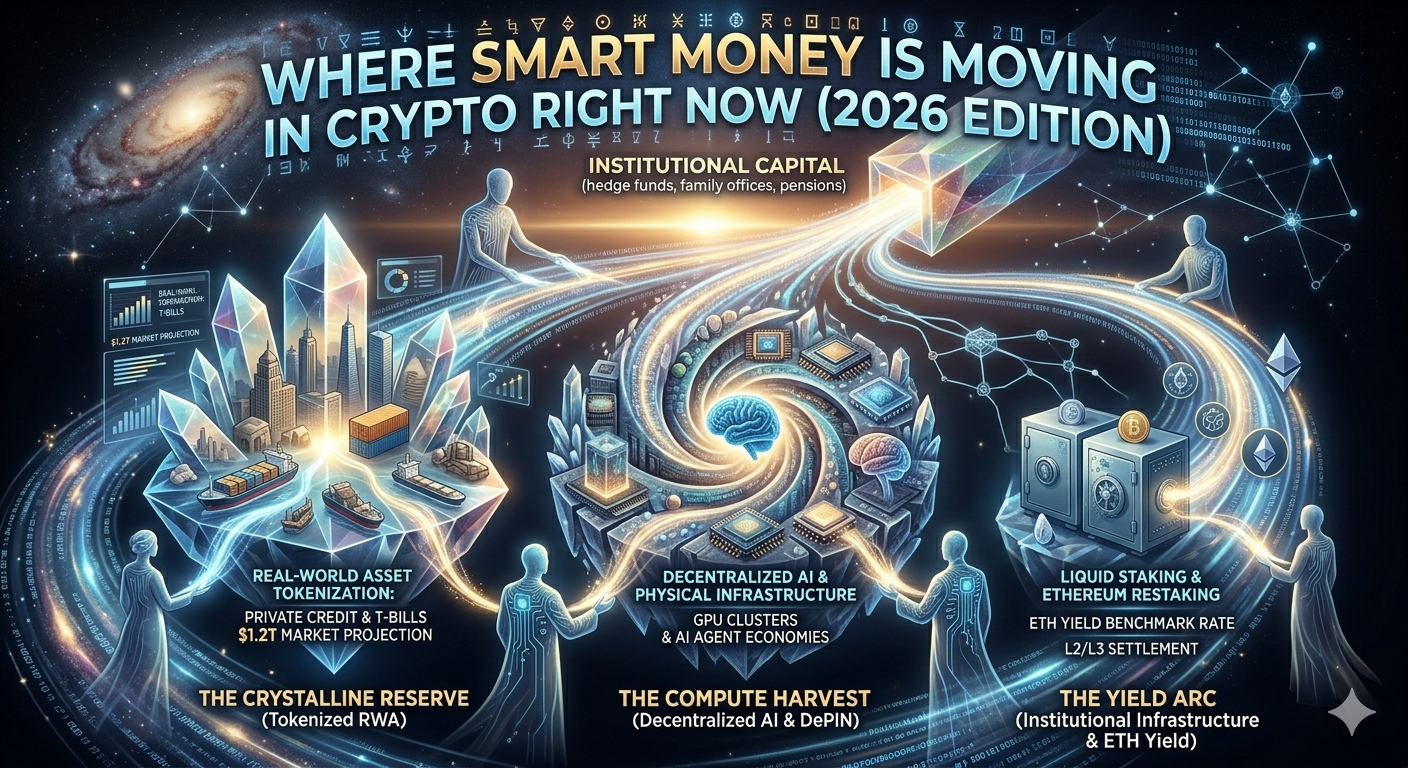
In 2026, the narrative has fundamentally shifted. Crypto is no longer defined by the volatility of “memecoins” or speculative tokens; it is defined by utility. The integration of Real-World Assets (RWAs) into the blockchain has transformed crypto into the primary operating system for global finance.
Here is a detailed breakdown of why 2026 is the year the Crypto Takeover of physical and financial assets became inevitable.
Why Real-World Assets are 2026’s Ultimate Growth Engine?

1. The Death of the “Off-Chain” Silo
For decades, traditional finance (TradFi) operated in silos with fragmented ledgers that took days to reconcile. In 2026, the “Crypto Takeover” means these assets now live on-chain as the Golden Record.
-
Unified Ledgers: Major investment banks have moved from private, isolated blockchains to Permissioned Public Layers (like Ethereum L2s or Avalanche Subnets). This allows a tokenized building in New York to be traded against a tokenized gold bar in London instantly.
-
Programmable Value: Because these assets are now “Crypto-native,” they are programmable. A bond can now automatically trigger interest payments or “slash” collateral without a room full of lawyers, reducing operational overhead by up to 40%.
2. The Yield Gap: Why Crypto Rails are Winning
In 2026, the “Crypto Takeover” is driven by a simple mathematical truth: On-chain yields are more efficient.
-
Lowering the Barrier: Historically, investing in private equity or high-yield debt required $1M+ in capital. Through crypto-tokenization, these are fractionalized. A retail investor in 2026 can buy $100 worth of a SpaceX pre-IPO share or a piece of a Singaporean shipping lane.
-
The Liquidity Premium: Assets that were once “illiquid” (like real estate) now trade on secondary crypto markets. This “liquidity premium” has added an estimated $1.5 trillion in value to previously stagnant asset classes.
3. Institutional “Crypto-First” Strategies
2026 marks the year where the world’s largest asset managers stopped asking “Why Crypto?” and started asking “How much on-chain?“
-
The ETF Evolution: The spot Bitcoin and Ether ETFs of 2024 were just the “on-ramp.” By 2026, we have “Tokenized Basket ETFs”—a single crypto token that represents a diversified portfolio of real-world T-bills, corporate bonds, and carbon credits, all rebalanced in real-time by smart contracts.
-
Sovereign Participation: Small to mid-sized nations are now issuing Sovereign Debt on Crypto Rails to bypass the expensive intermediary fees of global investment banks, accessing a global pool of crypto-liquid capital directly.
The 2026 Tech Stack: The “Invisible” Crypto
The reason 2026 is the ultimate growth engine is that the user experience has finally caught up.
-
Chain Abstraction: Investors no longer care if an asset is on Polygon, Base, or Solana. “Chain abstraction” layers make the underlying crypto tech invisible. Users see a “Buy” button for a 7% yield bond, and the crypto plumbing handles the rest.
-
Stablecoin Maturity: With the $PYUSD, $USDC, and various Euro-pegged stables being fully regulated, they have become the standard settlement currency for RWA trades, replacing the slow SWIFT system for high-velocity trading.
Comparative Analysis: The RWA Growth Engine
| Asset Class | Old World (2023) | Crypto Takeover (2026) | Impact |
| Real Estate | 30-day closing, high fees | Instant fractional ownership | Global access to local markets |
| US Treasuries | T+2 settlement, 9-5 hours | 24/7 Liquidity, T+0 | Capital efficiency for treasurers |
| Private Credit | Opaque, institutional only | Transparent, On-chain auditing | Trustless lending for SMEs |
| Art/Collectibles | High storage/provenance risk | NFT-backed physical vaults | Provenance solved via blockchain |
In 2026, we are witnessing the financialization of everything. By migrating Real-World Assets onto crypto infrastructure, the global economy has gained a level of transparency and velocity that was previously impossible. Crypto isn’t just an “asset class” anymore—it is the infrastructure upon which all assets now move.
Conclusion: The New Economic Standard
The “Crypto Takeover” of 2026 is not merely a technological trend; it is a fundamental restructuring of how value is created, stored, and moved across the globe. By stripping away the inefficiencies of legacy finance and replacing them with the transparency and speed of blockchain, Real-World Assets have become the definitive bridge between the digital and physical economies.
As we move through 2026, the distinction between “Crypto” and “Finance” is rapidly disappearing. We have moved past the era of digital gold and into the era of digital everything. For investors, this means unprecedented access to global markets; for institutions, it means a level of capital efficiency that was once a mathematical impossibility.
The breakout is no longer a forecast—it is our current reality. The infrastructure is built, the regulations are set, and the liquidity is flowing. In the history of global markets, 2026 will be remembered as the year that Crypto Rails became the backbone of the world’s $400 trillion asset pool.
Ready to start your cryptocurrency journey?
If you’re interested in exploring the world of crypto trading, here are some trusted platforms where you can create an account:
🔹 Binance – A global leader in cryptocurrency trading.
🔹 Bybit – A user-friendly platform for both beginners and advanced traders.
These platforms offer innovative features and a secure environment for trading and learning about cryptocurrencies. Join today and start exploring the opportunities in this exciting space!
🚀 Want to stay updated with the latest insights and discussions on cryptocurrency?
Join our crypto community for news, discussions, and market updates: OCBCryptoHub on Telegram.
📩 For collaborations and inquiries: datnk710@gmail.com
Disclaimer: Always do your own research (DYOR) and ensure you understand the risks before making any financial decisions.