In early 2026, the cryptocurrency market has matured beyond the “wild west” era of pure speculation. Reading market signals now requires a sophisticated blend of traditional macroeconomics, on-chain data, and an understanding of the newly solidified regulatory landscape.
If you are looking to navigate the markets today, here is a detailed breakdown of how to interpret signals in this “Institutional Era.”
How to Read Crypto Market Signals in Early 2026
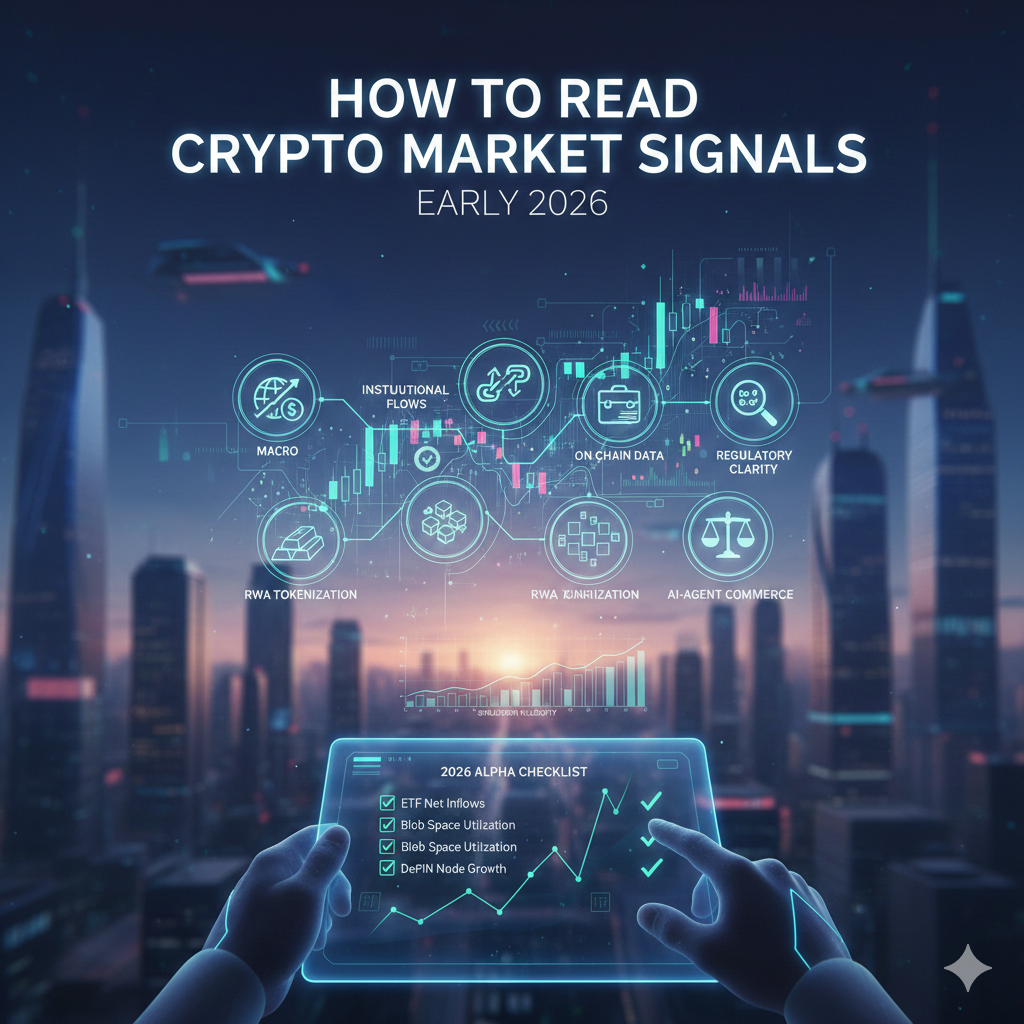
1. The Macro-Crypto Convergence
For the first time, crypto is trading as a primary component of the global financial system. To read the market, you must start with the “Big Macro” signals.
-
Federal Reserve Policy & Interest Rate Paths: In early 2026, the market is highly sensitive to the Fed’s “dot plot.” Lower interest rates generally signal a “risk-on” environment for Bitcoin and Ethereum. Conversely, if inflation remains “sticky” (above 3%), expect crypto to face headwinds as liquidity is pulled from the system.
-
The “Fiat Debasement” Signal: Watch the U.S. Dollar Index (DXY). There is a strong inverse correlation: when the dollar weakens due to rising national debt or fiscal stimulus, Bitcoin typically rallies as an alternative store of value.
-
Geopolitical Hedging: Pay attention to global conflicts. In early 2026, Bitcoin has increasingly acted as a “digital gold,” with price spikes often coinciding with geopolitical instability in regions like South America or the Middle East.
2. Technical Signals: The New “Normal”
With the influx of institutional capital, traditional technical analysis (TA) has become more reliable, though volatility remains higher than in equities.
Key Indicators to Monitor:
-
The 50-Day and 200-Day Moving Averages (MA): These are the “battle lines” for institutions. In early January 2026, Bitcoin’s breach of the 50-day MA ($92,200) was a major signal of renewed bullish momentum.
-
The $100,000 Psychological Barrier: For Bitcoin, $100,000 is the ultimate “signal.” Breaking and holding this level transforms the market sentiment from “cautiously optimistic” to “aggressively bullish.”
-
Relative Strength Index (RSI): Look for RSI “resets” near the 50 level. A bounce from neutral RSI during an uptrend is a classic entry signal for the current 2026 cycle.
3. On-Chain Data & Institutional “Footprints”
You no longer just track “whales”; you track “funds.” On-chain data is your window into what the “smart money” is doing.
-
ETF Inflow/Outflow Data: This is perhaps the most important signal of 2026. Consistent net inflows into U.S.-listed spot ETFs (like BlackRock’s IBIT) indicate structural demand. If ETFs see $1B+ in inflows over a 48-hour period, it often signals the end of a corrective phase.
-
The “Dormant Supply” Metric: Watch the percentage of Bitcoin that hasn’t moved in 1+ years. In early 2026, a growing share of supply is being locked in corporate treasuries and pension funds. When “liquid supply” drops, even small buy orders can trigger massive price spikes.
-
Stablecoin Velocity: Monitor the market cap and transaction volume of USDC and USDT. High stablecoin minting usually precedes a market-wide rally, as it represents “dry powder” ready to be deployed into risk assets.
4. Regulatory & Fundamental Triggers
Regulatory news is no longer just “FUD” (Fear, Uncertainty, Doubt); it is a fundamental catalyst.
-
The “GENIUS Act” & Clarity Act: With the U.S. passing major crypto market structure legislation, “Regulatory Clarity” is a green light. Signals of further bipartisan support for crypto-native banking are strong “Buy” indicators.
-
Tokenization (RWA) Milestones: Watch for announcements of major banks (JPMorgan, Goldman Sachs) launching tokenized Treasury funds. Growth in Real World Assets (RWA) signals that the underlying blockchain networks (Ethereum, Solana) are gaining “utility-based” value.
-
AI x Crypto Integration: Signals in 2026 are heavily driven by the “Agentic Economy.” Projects that provide infrastructure for AI agents to transact autonomously are the new high-beta plays.
5. Sentiment Analysis: Avoiding the FOMO Trap
Market sentiment in early 2026 is “cautiously positive.” The goal is to trade against extreme emotions.
-
Fear & Greed Index: If the index hits “Extreme Greed” (above 80) while Bitcoin is testing All-Time Highs (ATH), it is a signal to take profits.
-
Retail vs. Institutional Sentiment: Use tools like Santiment to track social media buzz. A “healthy” rally in 2026 is one where retail investors are still slightly skeptical or “impatient,” while institutional flows remain steady.
Crypto as Infrastructure in 2026
the noise of speculative “memecoin” cycles and overnight 100x gains has faded into the background, replaced by a much more profound signal: Crypto as Infrastructure. For the first time since Bitcoin’s inception, the market is no longer valued based on what it might do, but on the volume of real-world activity moving across its “rails.” If you are reading the market in 2026, understanding this shift is the difference between chasing ghosts and investing in the backbone of the new global economy.
1. The Death of the “Pure Speculation” Era
Historically, crypto signals were driven by retail hype and technical “pumps.” In 2026, the signal has shifted toward Structural Integration. As leading financial institutions like J.P. Morgan and BlackRock have fully embedded blockchain into their settlement systems, the price of “Blue Chip” assets (BTC, ETH, SOL) is now increasingly a reflection of Network Throughput rather than social media sentiment.
When we talk about “Infrastructure,” we mean that blockchain has become the “invisible layer” of finance—much like TCP/IP is the invisible layer of the internet. You don’t “use” TCP/IP; you use the web. Similarly, in 2026, millions of people use blockchain-based apps without ever knowing they are interacting with a token.
2. Stablecoins: The Internet’s Global Dollar
The most dominant “Infrastructure” signal in early 2026 is the explosion of Regulated Stablecoins. With the total stablecoin market cap surpassing $500 billion, these assets have evolved into the primary payment rails for global commerce.
-
Institutional Settlement: In 2026, corporate treasurers use stablecoins like USDC and regulated bank-issued tokens to settle cross-border invoices instantly, bypassing the 3-to-5-day delays of the legacy SWIFT system.
-
The “Cryptodollar” Signal: Watch the Stablecoin Velocity (transaction volume divided by market cap). A rising velocity in 2026 indicates that capital isn’t just sitting in wallets; it is moving through the economy. This is a massive bullish signal for the underlying “L1” networks (like Ethereum or Solana) that collect the transaction fees.
3. Tokenization of Real-World Assets (RWA)
By early 2026, “Tokenization” is no longer a buzzword—it is a production-scale industry. Trillions of dollars in U.S. Treasuries, private credit, and even real estate now exist as “On-Chain Entitlements”.
-
The T-Bill Signal: On-chain money markets now offer higher transparency and 24/7 liquidity compared to traditional brokerage accounts.
-
Yield as a Signal: In the 2026 market, the “risk-free rate” of the crypto economy is the yield on tokenized U.S. Treasuries (like BlackRock’s BUIDL fund). When on-chain yields for these assets rise, it creates a “floor” for the entire DeFi ecosystem, attracting trillions in institutional “dry powder.”
4. DePIN: The Physical Infrastructure Revolution
Perhaps the most exciting signal in early 2026 is the rise of Decentralized Physical Infrastructure Networks (DePIN). This sector bridges the gap between digital tokens and physical hardware.
-
Distributed Compute & AI: Projects like Render and Akash provide the GPU power necessary for the 2026 AI boom. When the demand for AI training spikes, the “Compute Utility” signal on these networks acts as a leading indicator for price action.
-
Telecom and Energy: Networks like Helium (wireless) and decentralized energy grids are now competing with traditional utilities. The signal here is Node Growth: the more physical hardware plugged into these networks, the more “moat” the protocol has against competitors.
5. The “Business-in-the-Front, Protocol-in-the-Back” Model
In 2026, the successful “Crypto Infrastructure” plays follow a specific architecture. Banks and fintechs run private, permissioned interfaces for their customers (the “Front”), but they use public blockchains and Zero-Knowledge (ZK) Proofs to settle transactions and prove solvency (the “Back”).
-
The ZK-Signal: Watch for the adoption of ZK-Rollups. These allow institutions to use the security of a public chain (like Ethereum) while keeping sensitive customer data private. In early 2026, the volume of “ZK-Verified” transactions is a key metric for determining which scaling solutions have actually won the “L2 Wars.”
Conclusion
The shift from “Crypto as a Casino” to “Crypto as Infrastructure” marks the most significant evolution in the history of digital assets.
The New Market Paradigm
As we have explored, the signals that matter now are those that prove the utility of the “rails.” Whether it is the surge in stablecoin velocity for cross-border settlement, the growth of tokenized RWAs on institutional balance sheets, or the rise of AI agents transacting autonomously, the underlying message is clear: blockchain is becoming invisible.
The successful investor in 2026 is one who recognizes that:
-
Volatility is maturing: While price swings still exist, they are increasingly driven by macro liquidity and institutional flows rather than retail panic.
-
Regulation is an unlock, not an obstacle: Compliance has become a competitive advantage, bringing in the “patient capital” that provides the market with its new, higher floor.
-
Utility is the ultimate indicator: The value of a network is now directly correlated to the volume of real-world activity it settles.
Looking Ahead
In this “Institutional Era,” the biggest risk is no longer the market “going to zero,” but rather missing the transition from a speculative asset to a foundational technology. The bull market of 2026 is being built not on hype, but on the quiet, steady deployment of code that makes the global economy faster, cheaper, and more transparent.
As you navigate the rest of this year, keep your eyes on the infrastructure signals. When the technology fades into the background and the results take center stage, you know the market has finally reached its destination.
Ready to start your cryptocurrency journey?
If you’re interested in exploring the world of crypto trading, here are some trusted platforms where you can create an account:
🔹 Binance – A global leader in cryptocurrency trading.
🔹 Bybit – A user-friendly platform for both beginners and advanced traders.
These platforms offer innovative features and a secure environment for trading and learning about cryptocurrencies. Join today and start exploring the opportunities in this exciting space!
🚀 Want to stay updated with the latest insights and discussions on cryptocurrency?
Join our crypto community for news, discussions, and market updates: OCBCryptoHub on Telegram.
📩 For collaborations and inquiries: datnk710@gmail.com
Disclaimer: Always do your own research (DYOR) and ensure you understand the risks before making any financial decisions.