In 2026, the global cryptocurrency landscape has shifted from the “Wild West” of 2021 to a highly regulated, institutionally dominated “Global Financial Layer.” However, with the arrival of Spot ETFs, sovereign wealth fund participation, and the widespread use of automated AI market makers, the nature of volatility has evolved. The most dangerous phenomenon in this new era is False Stability—a period where price action appears calm and resilient, masking a structural decay in market health that eventually leads to a catastrophic “flash-deleveraging.”
Understanding false stability requires looking past the surface-level price ticker and peering into the plumbing of the blockchain. Here is a comprehensive analysis of how to navigate this deceptive environment.
The Institutional Facade: Identifying “Dark Pool” Divergence and Synthetic Support
By 2026, the majority of Bitcoin and Ethereum liquidity has moved off-chain into regulated custodial environments and “Dark Pools.” These are private exchanges where institutional players execute massive orders without revealing their intentions to the public order book. This creates a veneer of stability on retail exchanges while the “real” price discovery is happening in the shadows.
The Mechanics of Synthetic Support
In a falsely stable market, institutional players often use Total Return Swaps and other synthetic derivatives to maintain a price floor. They do this to protect their collateralized positions or to ensure that their quarterly reports show low volatility to satisfy risk-management committees. This creates a “price peg” that isn’t supported by organic demand, but by financial engineering.
To spot this, an investor must look at the Net Flow of Custodial Wallets. If the price of an asset remains flat for weeks, but on-chain data shows a massive, consistent drain of assets from “Hot Wallets” to “Cold Storage” (or vice versa) without a corresponding price reaction, the market is decoupled from reality. In 2026, we call this The Dam Effect: the price is a wall holding back a massive reservoir of pressure; once the synthetic support reaches its capital limit, the “wall” breaks, and the price adjustment is instantaneous and violent.
The Delta Neutral Trap
Another driver of false stability is the rise of automated Delta-Neutral strategies. AI bots now sell futures contracts at the exact same rate they buy spot assets to “farm” funding rates. This suppresses price movement, creating a flat line on the chart. However, if the underlying funding rate turns negative, these bots all exit their positions simultaneously. To a retail trader, the market looked “safe” because it wasn’t moving, but in reality, it was a crowded trade waiting for a single trigger to unwind.
The AI-Liquidity Mirage: Deciphering Algorithmic “Wash-Walls” and Latency Arbitrage
The second major pillar of false stability in 2026 is the dominance of Large Language Model (LLM) Trading Agents. Unlike the simple bots of 2021, these agents can read sentiment, monitor regulatory filings in real-time, and coordinate “Flash Liquidity” to prevent price slippage. This creates a market that looks liquid and stable, but is actually “hollow.”
Spotting “Ghost” Liquidity
In 2026, order books are often “padded” by AI agents. They place millions of dollars in buy and sell orders that are designed to be canceled the millisecond a real trade approaches them. This is known as Spoofing 2.0.
To identify this, you must analyze the Order Book Decay Rate. If you see $500 million in “support” at a certain price level, but that support vanishes as soon as a sell order of only $5 million enters the system, you are dealing with false stability. The market “looks” deep, but it has no “structural integrity.” The stability exists only as long as no one actually tries to trade against it.
The Signal-to-Noise Disconnect
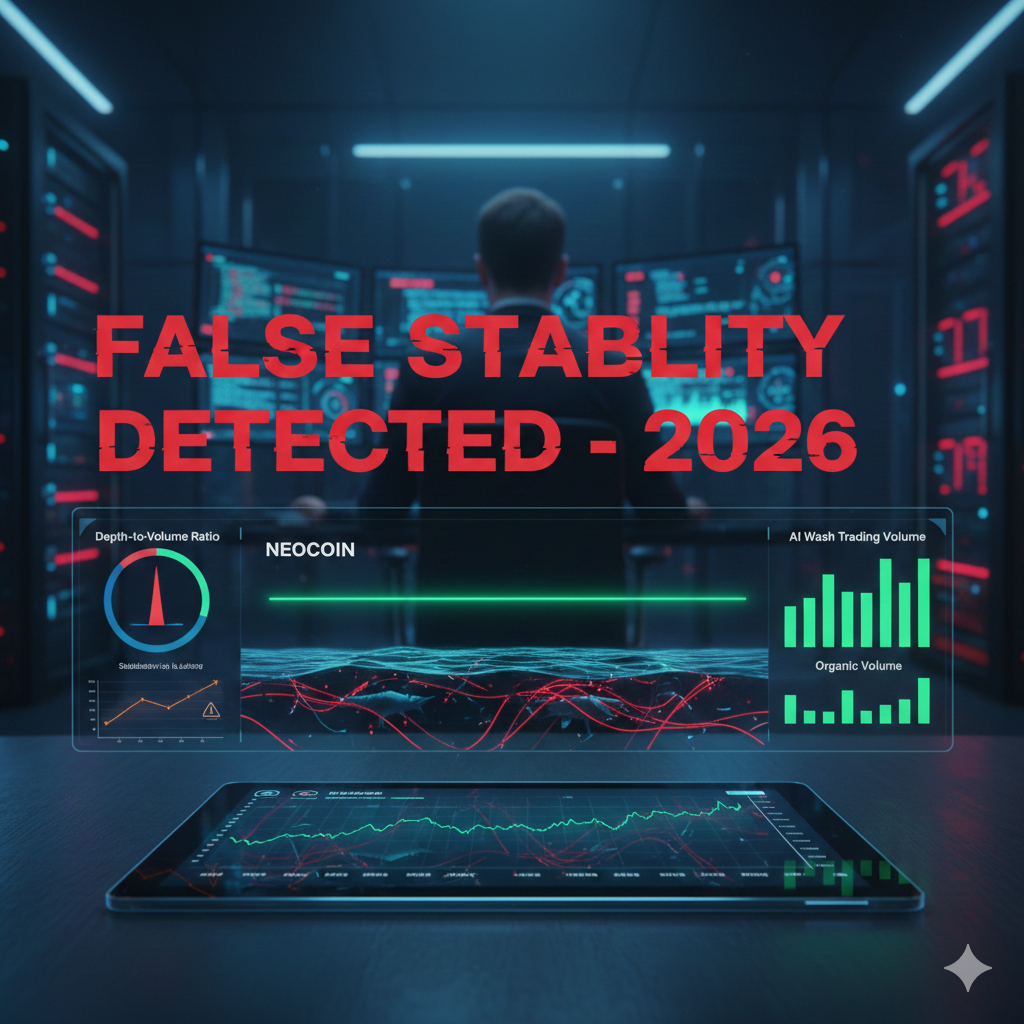
Another key metric in 2026 is the Volatility-to-Volume Ratio. In a healthy, stable market, low volatility is accompanied by steady, moderate volume. In a falsely stable market, you will often see High Volume with Zero Volatility. This is a classic sign of “Wash Trading” or “Painting the Tape.” AI entities are trading with each other to create the appearance of a vibrant, liquid market to attract retail investors or to satisfy exchange listing requirements.
If the volume is “screaming” but the price is “whispering,” the stability is a lie. This usually precedes a Liquidity Vacuum, where the bots suddenly turn off their algorithms due to a “Black Swan” event, leaving the market with no buyers and no sellers, leading to a 30-40% drop in a matter of seconds.
Critical Analysis: Navigating the 2026 Landscape
To survive in 2026, a trader must adopt a “skeptical-first” mindset. True stability is a product of widely distributed ownership and diverse utility. False stability is a product of concentrated manipulation and algorithmic consensus.
Key Checklist for 2026 Investors:
-
The Funding Rate Test: If the price is stable but the funding rates for perpetual futures are extremely high (positive or negative), the stability is being “paid for” by speculators and is unsustainable.
-
The “Oracle” Check: Compare the price on decentralized exchanges (DEXs) with centralized ones. If there is a persistent gap (arbitrage) that isn’t being closed, it means “True Liquidity” has fled, and the centralized price is being artificially manipulated.
-
The Narrative-Lag Factor: In 2026, news travels at the speed of AI. If major negative news breaks (e.g., a protocol hack or a regulatory crackdown) and the price doesn’t move for several hours, do not assume the market is “resilient.” Assume the “Exit Liquidity” is being managed by bots to allow insiders to leave first.
Conclusion: The Cost of Deceptive Calm
In the hyper-sophisticated crypto ecosystem of 2026, stability is no longer the absence of risk; often, it is the camouflage for it. As we move further away from the era of retail-driven “pump and dumps” and deeper into an age of institutional dominance and AI-driven liquidity, the signals we once relied on have become increasingly obscured. False stability is the ultimate psychological trap, designed to lul investors into a state of complacency just as the structural integrity of the market reaches its breaking point.
To navigate this landscape, the modern investor must look beyond the “flat line” of the price chart. Survival in 2026 requires a rigorous interrogation of the data:
-
Trust On-Chain Reality over Exchange Optics: Prices can be manipulated by bots, but the movement of collateral and the health of stablecoin reserves are much harder to hide.
-
Respect the “Coiled Spring”: High open interest combined with low volatility is rarely a sign of peace; it is usually the silence before a “volatility expansion” event.
-
Maintain Algorithmic Skepticism: If the market feels too perfect—if the spreads are too tight and the volume too consistent—it is likely a manufactured environment that can vanish in a millisecond.
Ultimately, the most expensive lesson a trader can learn in 2026 is that a market that refuses to move despite significant external pressure is not “strong”—it is distorted. By staying vigilant for the cracks in the institutional facade and the mirages of AI liquidity, you can avoid becoming the “exit liquidity” for the players who built the illusion in the first place.
Ready to start your cryptocurrency journey?
If you’re interested in exploring the world of crypto trading, here are some trusted platforms where you can create an account:
🔹 Binance – A global leader in cryptocurrency trading.
🔹 Bybit – A user-friendly platform for both beginners and advanced traders.
These platforms offer innovative features and a secure environment for trading and learning about cryptocurrencies. Join today and start exploring the opportunities in this exciting space!
🚀 Want to stay updated with the latest insights and discussions on cryptocurrency?
Join our crypto community for news, discussions, and market updates: OCBCryptoHub on Telegram.
📩 For collaborations and inquiries: datnk710@gmail.com
Disclaimer: Always do your own research (DYOR) and ensure you understand the risks before making any financial decisions.