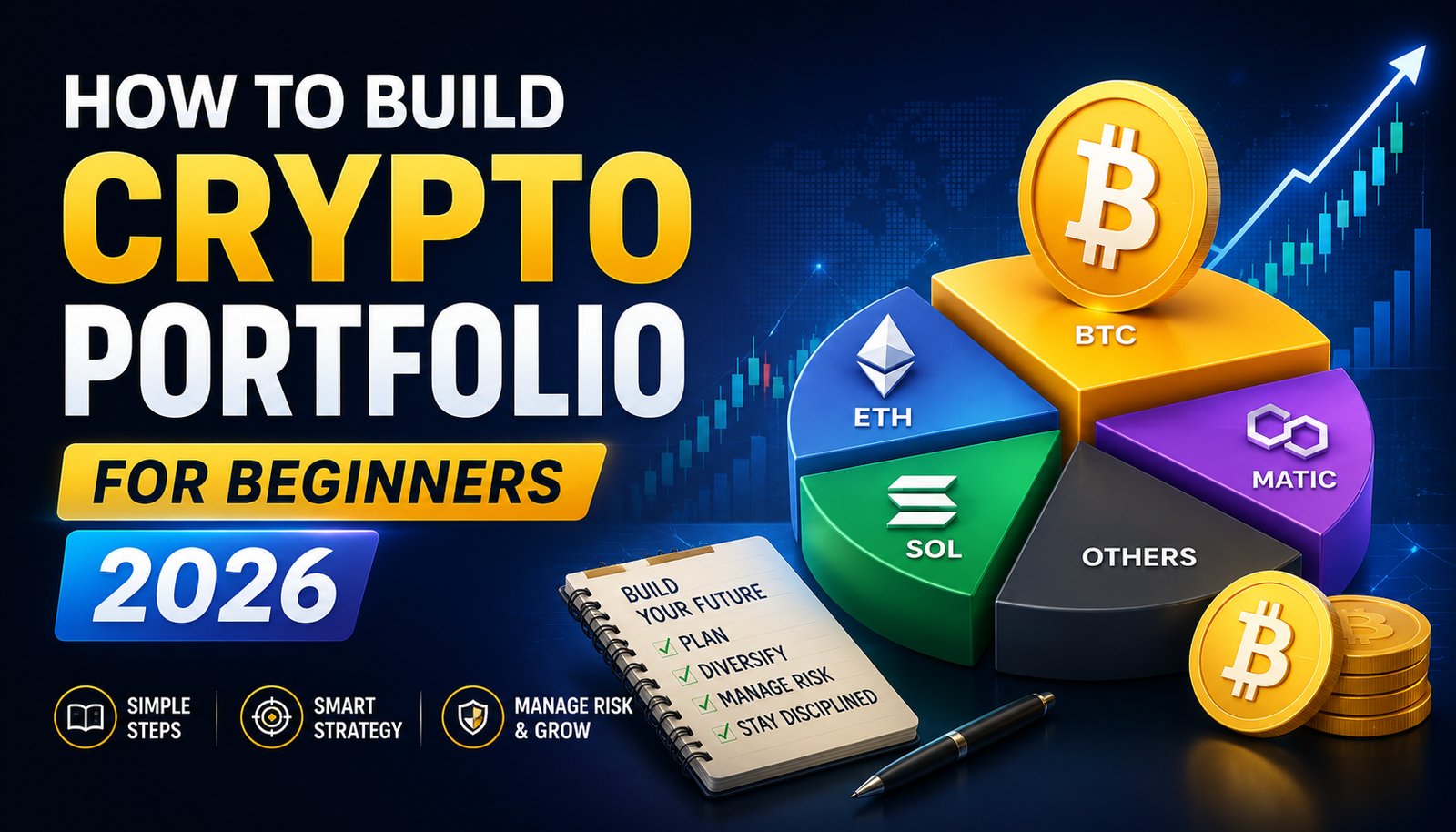
Building a crypto portfolio for 2026 requires moving beyond the “buy and hold” mentality of previous cycles. As of late 2025, the market is shifting from a retail-driven “meme” economy to an Institutional Era characterized by regulatory clarity (like the U.S. CLARITY and GENIUS Acts) and the integration of crypto into traditional finance (TradFi).1
How to Build a Crypto Portfolio for 2026 Based on Market Regimes
To build a resilient portfolio, you must align your allocations with four primary Market Regimes likely to dominate 2026.
1. The “Monetary Hedge” Regime
Market Condition: High public debt, fiat currency debasement risks, and global macro uncertainty.
In this regime, Bitcoin (BTC) and Ethereum (ETH) act as “digital gold” and “digital oil,” respectively. Grayscale and Fidelity note that 2026 will see increased demand for scarce digital commodities as a ballast against inflation.2
-
Portfolio Allocation: 40%–50% (Core)
-
Key Assets: * BTC: The primary store of value for nation-states and corporate treasuries.3
-
ETH: The foundational collateral for the “on-chain” economy.
-
-
Strategy: “Accumulation & Yield.” Use regulated ETFs for tax efficiency or stake ETH to earn native network rewards.
2. The “Tokenization & RWA” Regime
Market Condition: Regulatory frameworks like MiCA (EU) and new U.S. laws enable the migration of traditional assets (stocks, bonds, real estate) onto blockchains.
This regime shifts the focus from “speculative tokens” to “utility tokens” that capture real protocol revenue.
-
Portfolio Allocation: 15%–20%
-
Key Sectors: * RWA Protocols: Projects bringing Treasury bills and private credit on-chain (e.g., Ondo, BlackRock’s BUIDL-related ecosystem).4
-
Solana (SOL): Increasingly favored for “Internet Capital Markets” due to its high-speed settlement for tokenized assets.5
-
-
Strategy: Look for “Tokenomics 2.0” models that feature fee-sharing or “buy-and-burn” mechanisms tied to platform usage rather than just hype.6
3. The “AI-Crypto Convergence” Regime
Market Condition: The rise of autonomous AI agents that require “machine-to-machine” payments and decentralized compute power.7
By 2026, AI agents are expected to be the primary “users” of certain blockchains, conducting high-frequency microtransactions that humans cannot.
-
Portfolio Allocation: 10%–15%
-
Key Sectors: * Decentralized AI (DeAI): Networks providing GPU power or verifiable AI training (e.g., Bittensor, Render).
-
Agentic Rails: Protocols enabling AI agents to hold wallets and launch services (e.g., x402, specialized L1s).8
-
-
Strategy: High-growth/high-risk. Focus on infrastructure that AI companies actually use for “inference” (processing) rather than just “narrative” tokens.
4. The “Stablecoin & Payments” Regime
Market Condition: Stablecoins become the dominant global rail for remittances and cross-border settlements, moving beyond the $1T market cap range.9
This is a “defensive” regime used to preserve capital during the “Summer Lulls” or volatility predicted for mid-2026.
-
Portfolio Allocation: 15%–20% (Dry Powder/Yield)
-
Key Assets: * Regulated Stablecoins: USDC, EURC, or tokens compliant with the GENIUS Act.10
-
Yield Aggregators: Protocols that offer 5%–10% APY on stables via over-collateralized lending.
-
-
Strategy: Maintain “dry powder” in on-chain vaults to rotate into growth sectors during market drawdowns.
2026 Portfolio Construction Summary
| Component | Weight | Focus Area | Goal |
| Foundation | 45% | BTC, ETH | Capital preservation & Macro hedge |
| Utility | 20% | SOL, L2s, RWA | Capturing the “Tokenization” of TradFi |
| Innovation | 15% | AI, DePIN, Privacy | Capturing asymmetric “Tech” growth |
| Liquidity | 20% | Stablecoins | Yield & opportunistic buying power |
Pro-Tip: The “Four-Year Cycle” Warning
While many institutional analysts (Grayscale, Bitwise) believe the traditional 4-year halving cycle is breaking in favor of a “sustained bull market,” retail sentiment remains cautious.11 Most models predict a strong Q1 2026, a potential correction in the summer, and a recovery in the fall.
1. The “Supercycle” vs. The “Four-Year Cycle”
The most significant debate for 2026 is whether the traditional 4-year halving cycle has finally broken.
-
The Old Rule: Crypto enters a multi-year “winter” after the post-halving peak.
-
The 2026 Reality: Analysts from Grayscale and Bitwise suggest we are in a “Sustained Bull Market.” High institutional “sticky” capital (via ETFs) and corporate fair-value accounting rules (FASB) are smoothing out the violent 80% drawdowns of the past.
-
Portfolio Adjustment: Instead of selling everything in early 2026, focus on Dynamic Rebalancing. If your “Innovation” bucket (AI/DePIN) moonshots to 30% of your portfolio, trim it back to your 15% target and move the profits into “Liquidity” (Stablecoins) to prepare for the expected “Summer Lull.”
2. Deep Dive: High-Conviction Sub-Sectors
To maximize the 15% Innovation and 20% Utility allocations, monitor these high-velocity trends:
A. The “Fat App” Thesis & Revenue Sharing
In previous years, Layer 1 (L1) blockchains captured all the value. In 2026, value is migrating to the Applications.
-
Strategy: Look for “Enshrined Apps”—blockchains that build their own revenue-generating exchanges or stablecoins directly into the protocol (e.g., Hyperliquid’s model).
-
Target: Tokens with “Tokenomics 2.0” (fee-switches that pay holders in SOL, ETH, or USDC).
B. DePIN (Decentralized Physical Infrastructure)
This is the “Internet of Things” meet Crypto. By 2026, projects providing decentralized wireless (Helium), mapping (Hivemapper), or GPU compute (Render) are expected to show real-world revenue.
-
Why 2026? This sector has a longer “build” phase. By 2026, the hardware networks will be mature enough to compete with centralized providers on price.
C. Bitcoin Layer 2s (The “Orange” DeFi Summer)
Bitcoin is evolving from a “Pet Rock” to a programmable layer.
-
Target: Stacks (STX) and emerging BTC-L2s.
-
Goal: Earning yield on your BTC foundation without leaving the security of the Bitcoin ecosystem.
3. The 2026 “Seasonality” Playbook
Historical data and 2026 macro-projections suggest a specific rhythm for the year:
| Period | Market Sentiment | Portfolio Action |
| Q1 2026 | The “Final Blow-Off” | Euphoria often peaks here. Start scaling out of high-beta AI and Meme tokens. |
| Q2-Q3 2026 | The “Summer Shakeout” | Sharp corrections of 20-30%. Use your 20% “Liquidity” bucket to buy the dip in ETH and SOL. |
| Q4 2026 | The “Institutional Rebound” | Year-end tax planning and new 2027 allocations drive a recovery. Focus on RWA and Blue Chips. |
4. Risk Management: The “Reg-First” Filter
In 2026, “unregulated” is a liability. The GENIUS Act (U.S.) and MiCA (EU) will create a “two-tier” market.
-
Tier 1 (Compliant): Assets like BTC, ETH, and regulated stablecoins (USDC) will have the highest liquidity and lowest volatility.
-
Tier 2 (Offshore/Grey): High-yield but high-risk. Ensure no more than 5% of your total portfolio is in protocols that lack clear legal standing in major jurisdictions.
Conclusion
Building a successful crypto portfolio for 2026 is no longer about finding the “next 100x gem” through sheer luck. It is about strategic alignment with a maturing financial system. As the “Institutional Era” takes hold, the market is moving away from purely speculative cycles toward a model driven by utility, regulatory compliance, and technological integration.
Key Summary of the 2026 Strategy
To navigate the year effectively, your final portfolio posture should reflect these core principles:
-
The Death of the “Four-Year Cycle”: Prepare for a “Sustained Bull Market” rather than a vertical spike followed by an 80% crash. Institutional demand via ETFs and corporate treasuries (DAT 2.0) acts as a price floor, making 2026 a year of structural growth rather than just a bubble.
-
The Rise of Productive Assets: 2026 marks the shift to Tokenomics 2.0. Favor protocols that offer “Real Yield” (fee-sharing) and those enabling the tokenization of real-world assets (RWA) like Treasuries and private credit.
-
Autonomous Economy: Recognize AI Agents as the new primary users of blockchain rails. Your allocation in the “Innovation” sector should focus on the infrastructure (DePIN and DeAI) that allows machines to transact, compute, and settle autonomously.
-
Regulatory as a Feature: With the GENIUS Act (U.S.) and MiCA (EU) fully operational by 2026, “compliant” is the new “safe.” Portfolios heavily weighted toward regulated assets and stablecoins will enjoy higher liquidity and institutional trust.
The Final Outlook
The market regime of 2026 rewards the disciplined allocator. By maintaining a core foundation in BTC and ETH, capturing the utility of Solana and RWA, and keeping a liquid reserve for seasonal “Summer Shakes,” you position yourself to benefit from crypto’s transition into a permanent, multi-trillion-dollar asset class.
Final Thought: In 2026, the winners won’t be those who trade the most, but those who own the most “sovereign block space” and “digital commodity” infrastructure.
Ready to start your cryptocurrency journey?
If you’re interested in exploring the world of crypto trading, here are some trusted platforms where you can create an account:
🔹 Binance – A global leader in cryptocurrency trading.
🔹 Bybit – A user-friendly platform for both beginners and advanced traders.
These platforms offer innovative features and a secure environment for trading and learning about cryptocurrencies. Join today and start exploring the opportunities in this exciting space!
🚀 Want to stay updated with the latest insights and discussions on cryptocurrency?
Join our crypto community for news, discussions, and market updates: OCBCryptoHub on Telegram.
📩 For collaborations and inquiries: datnk710@gmail.com
Disclaimer: Always do your own research (DYOR) and ensure you understand the risks before making any financial decisions.