As we stand at the threshold of 2026, the crypto industry is reflecting on 2025 as a “Filtering Year.” While 2024 was defined by the euphoric approval of Spot ETFs and the initial return of the bull market, 2025 served a more sober purpose: it separated speculative noise from structural value, and experimental protocols from institutional-grade infrastructure.
This “filter” was not a market crash, but a rigorous stress test of regulations, corporate treasuries, and technological utility.1 Here is a detailed analysis of why 2025 was a filtering year and how it has re-engineered the landscape for 2026.
Why 2025 Crypto Was a Filtering Year?
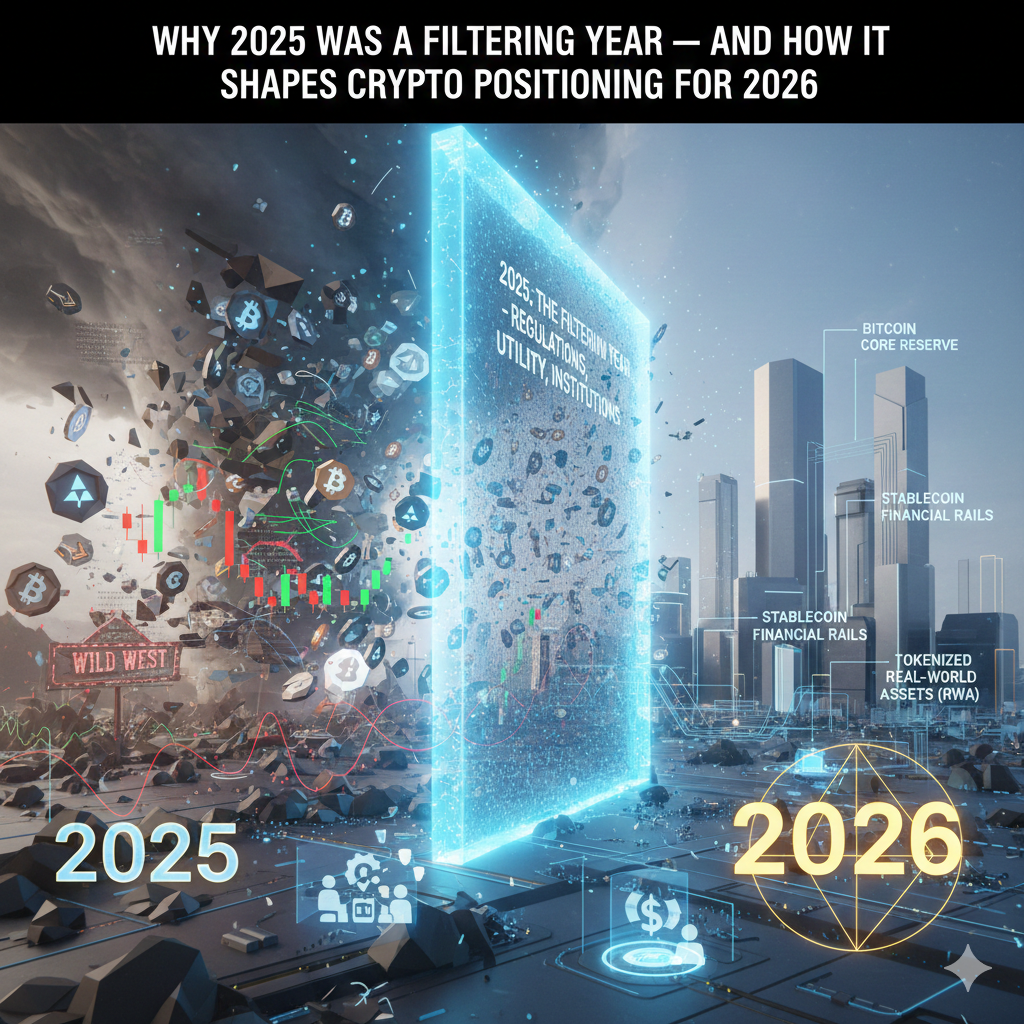
1. The Regulatory Filter: From “Wild West” to “The Rulebook”
For years, “regulatory clarity” was a vague promise. In 2025, it became a reality that forcibly filtered the market.
-
The GENIUS Act and the CLARITY Act: In the U.S., the passage of the GENIUS (Guiding and Establishing National Innovation for U.S. Stablecoins) Act in mid-2025 provided the first federal playbook for stablecoins.2 This effectively “filtered out” offshore, under-collateralized stablecoins in favor of regulated, bank-integrated assets.
-
The MiCA Deadline: In Europe, the full implementation of the Markets in Crypto-Assets (MiCA) regulation forced exchanges and custodians to meet rigorous standards or exit the market.3
-
The Result: By 2026, the “regulatory overhang” has largely lifted. Positioning for 2026 now favors compliant, onshore platforms over “decentralized” entities that are actually centralized and non-compliant.
2. The Institutional Filter: The “Digital Asset Treasury” (DAT) Reset
2025 saw a massive surge in corporations putting Bitcoin on their balance sheets (following the MicroStrategy model).4 However, the Q4 2025 market volatility acted as a filter.
-
Survival of the Disciplined: Companies that over-leveraged to buy Bitcoin saw their stock prices “filter” downward as premiums evaporated.5
-
DAT 2.0: Moving into 2026, the narrative has shifted from simple “HODLing” to Active Treasury Management. Institutions are no longer just buying BTC; they are positioning for 2026 by utilizing “Onchain Vaults” (ETFs 2.0) that allow for staking yield, lending, and hedging directly within regulated wrappers.
3. The Utility Filter: “Fat Apps” over “Ghost Chains”
The “L1 Wars” reached a stalemate in 2025. Investors grew tired of high-valuation Layer 1 blockchains with no users (Ghost Chains).
-
The Shift to Revenue: 2025 filtered projects based on Real-World Activity (RWA) and fee generation. Solana and Ethereum emerged stronger because they moved from “meme-driven” cycles to “revenue-generating” ecosystems.
-
Agentic AI: A key filter in 2025 was the integration of AI.6 Protocols that couldn’t support autonomous AI agents (which need low-latency, high-throughput rails for micro-transactions) began to lose relevance.
Positioning for 2026: Investors are now rotating out of “infrastructure for infrastructure’s sake” and into Application-Specific Chains (AppChains) and protocols that enshrine revenue-generating apps directly into their core code.7
How 2025 Shapes Your 2026 Positioning
The market has been “cleansed” of its most fragile elements. Here is how the 2025 filter dictates the 2026 strategy:
A. The “Flight to Quality” remains the dominant theme
With Bitcoin having touched six-figure territory in 2025, it is no longer a “fringe” asset.8 In 2026, positioning should focus on Bitcoin as a Core Reserve Asset, but with a twist: the focus is now on Bitcoin L2s and Yield.
Strategy: Look for protocols that bring DeFi utility to Bitcoin without compromising its security.
B. Stablecoins as the New “Financial Rails”
2025 proved that stablecoins are the “killer app.” By 2026, the total stablecoin market cap is projected to exceed $1.2 Trillion.
Strategy: Position in the infrastructure that powers global payments (Stellar, Hedera, and bank-led stablecoin issuers) rather than purely speculative altcoins.
C. The Tokenization of Everything (RWA)
2025 saw the pilot phase of tokenized T-Bills and real estate.9 2026 will be the year of Massive Liquidity.
Strategy: Focus on “Institutional DeFi”—platforms that bridge the gap between BlackRock-level capital and on-chain transparency.
Summary Table: The 2025-2026 Transition
| Feature | 2025 (The Filter) | 2026 (The Positioning) |
| Regulation | Uncertainty and Lawsuits | Compliance and Licensing |
| Market Driver | Retail Hype & ETFs | Institutional “DAT 2.0” & AI Agents |
| Tech Focus | Layer 2 Scalability | Interoperability & RWA Tokenization |
| Investment Style | “Spray and Pray” | Actively Managed & Hedged Funds |
Building on the structural changes of the early year, the final months of 2025 have solidified the “Filtering” narrative. We are no longer in a market where a rising tide lifts all boats; instead, we are in a market of ruthless selection. Here is a deeper look into the specific filters of late 2025 and how they are actively re-engineering portfolios for the 2026 “Dawn of the Institutional Era.”
The Liquidity Filter: The “Massacre” of Low-Utility Alts
While Bitcoin and major assets like Solana reached new highs in 2025, the mid-to-late year saw a “structural liquidation” of tokens that lacked genuine product-market fit.
-
The Ghost Token Purge: Recent data indicates that over 50% of all tokens launched since 2021 have effectively “died” in 2025, reaching near-zero liquidity.
-
Infrastructure Stress: Even “elite” protocols with high-tier VC backing—such as Aptos, Polkadot, and certain Layer 2s—experienced drawdowns of 70% to 80% from their 2025 peaks. This “filter” proved that engineering excellence is no substitute for a vibrant, fee-paying user base.
-
The Survivor Bias: The capital that exited failing altcoins didn’t leave the space; it “filtered” up into High-Conviction Assets (BTC, ETH, SOL) and Real-World Asset (RWA) protocols that show clear revenue.
The Technological Filter: The Rise of “Agentic AI”
If 2024 was about “AI hype,” 2025 was the year of AI Implementation. Protocols that could not integrate with autonomous AI agents were filtered out of the “innovation premium” category.
-
On-Chain AI Agents: We are seeing the birth of “Agentic DeFi,” where AI bots manage portfolios, execute cross-chain swaps, and provide liquidity without human intervention.
-
The DePIN Integration: 2025 was a massive year for Decentralized Physical Infrastructure Networks (DePIN). Projects that provide the “hardware” for AI—like decentralized GPU rendering and data storage—became the top performers of the year.
-
Positioning for 2026: Investors are moving away from “general purpose” blockchains and toward AI-aligned infrastructure. In 2026, the winner won’t just be the fastest chain, but the one with the most “verifiable” data for AI training.
The 2026 Outlook: Breaking the “Four-Year Cycle”
For a decade, crypto has followed a predictable four-year boom-and-bust cycle. However, the filtering events of 2025 suggest we are entering a “Grand Supercycle” or a “Longer Grind.”
Why the Cycle is Changing:
-
Supply Dynamics: Post-2024 halving, miners are earning 50% less, and exchange reserves are at their lowest levels since 2018. The supply is “thinning” while institutional demand via ETFs remains constant.
-
ETF Dominance: In 2026, it is projected that ETFs could purchase more than 100% of the new supply of BTC, ETH, and potentially SOL.
-
The “Flight to Quality”: Unlike 2021, where retail “aped” into everything, the 2026 investor is more disciplined. They treat Bitcoin like “Digital Gold” and Ethereum/Solana like “Digital Tech Equities.”
Conclusion: The “Clean” Slate of 2026
The “Filtering Year” of 2025 was painful but necessary. It removed the leverage, exposed the “ghost” projects, and forced a marriage between crypto and global regulation.
As we enter 2026, the market is no longer a speculative casino; it is a maturing asset class. * Bitcoin is positioning to become a standard part of corporate and even sovereign reserves.
-
Stablecoins are becoming the backend of global fintech.
-
Tokenization (RWA) is moving from a $35 billion niche to a multi-trillion dollar bridge to traditional finance.
The “filter” has done its work. For those who survived 2025, 2026 represents the most fundamentally sound environment in crypto history—one defined by tangible utility, institutional depth, and regulatory peace.
Ready to start your cryptocurrency journey?
If you’re interested in exploring the world of crypto trading, here are some trusted platforms where you can create an account:
🔹 Binance – A global leader in cryptocurrency trading.
🔹 Bybit – A user-friendly platform for both beginners and advanced traders.
These platforms offer innovative features and a secure environment for trading and learning about cryptocurrencies. Join today and start exploring the opportunities in this exciting space!
🚀 Want to stay updated with the latest insights and discussions on cryptocurrency?
Join our crypto community for news, discussions, and market updates: OCBCryptoHub on Telegram.
📩 For collaborations and inquiries: datnk710@gmail.com
Disclaimer: Always do your own research (DYOR) and ensure you understand the risks before making any financial decisions.