The crypto market, known for its extreme volatility and parabolic booms, is rapidly maturing. As we transition into 2026, the environment is fundamentally changing, demanding a significant shift from retail speculation to sophisticated, data-driven investment. The simple days of riding narratives are fading; success will hinge on analytical rigor and understanding on-chain fundamentals.
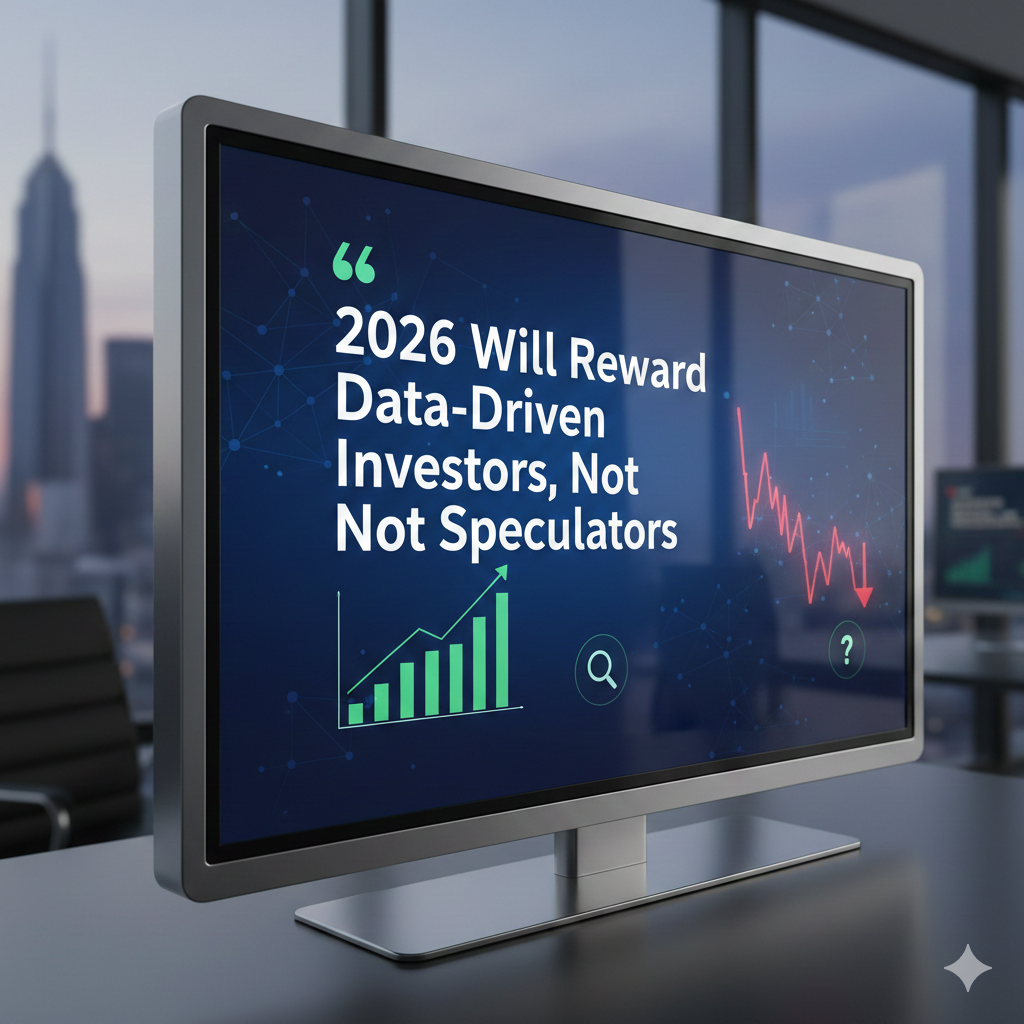
2026 Will Reward Data-Driven Crypto Investors
The primary driver for this shift is the formalization and institutionalization of the asset class.
1. Institutionalization and Regulatory Clarity
-
The ETF Effect: Following the approval of major spot ETFs (for Bitcoin, and potentially others), institutional capital is flowing into the market. These institutions—hedge funds, wealth managers, and pension funds—operate on rigorous risk models, valuation metrics, and compliance standards. Their involvement sets a new, higher bar for market discipline.
-
Data as Compliance: Increased global regulation means exchanges and projects must offer more transparent, verifiable data. This formalization reduces opportunities for market manipulation and rewards investors who can analyze the publicly available, auditable data.
-
The most significant factor driving the need for data is the arrival of traditional finance (TradFi) giants.
A. The Regulatory and Compliance Shift
-
Data as the New Barrier to Entry: Global regulators (like the EU’s MiCA, and anticipated US clarity) are establishing clear rules for stablecoins, custody, and token issuance. Crucially, these frameworks demand unprecedented data transparency and reporting from crypto service providers (CSPs). Starting in 2026, many jurisdictions will implement strict data collection requirements for tax reporting and anti-money laundering (AML) compliance.
-
Institutions Demand Rigor: Institutions (managing hundreds of billions in capital) do not invest based on Twitter sentiment. They require assets to fit within sophisticated risk models and capital allocation strategies. The approval and growth of Bitcoin and Ethereum ETFs have created regulated on-ramps, but these funds only attract capital because their underlying assets can be analyzed using institutional-grade data feeds and predictable compliance standards. This influx of ‘smart money’ intrinsically lowers the reward for pure speculation.
B. The Transformation of Trading Infrastructure
-
Quant Funds Dominate Liquidity: By 2026, the market depth and liquidity are increasingly controlled by high-frequency trading (HFT) firms and quantitative crypto hedge funds. These entities utilize AI and ML to execute complex arbitrage strategies across dozens of exchanges, reacting to data faster than human comprehension. This leaves speculators—who are often slow to react and use high, undiversified leverage—vulnerable to fast, systematic liquidations.
-
Risk Management Over YOLO: Institutional investors prioritize preserving capital through rigorous risk-adjusted returns (Sharpe Ratio, Sortino Ratio). Their models are fed by real-time data on slippage, market microstructure, and liquidity pool depth, creating a disciplined, data-first approach that directly contrasts with the “You Only Live Once (YOLO)” mentality of retail speculation.
-
2. The Abundance of On-Chain Data
The single greatest advantage of crypto over traditional finance (TradFi) is the transparency of its ledger.
-
Unlocking On-Chain Metrics: Investors in 2026 will heavily rely on deep on-chain analysis. Metrics like the SOPR (Spent Output Profit Ratio), MVRV (Market Value to Realized Value), and Net Unrealized Profit/Loss (NUPL) move beyond simple price charts to reveal actual investor behavior, market psychology, and cycles of capitulation or euphoria.
-
Ecosystem Activity: Data-driven investors track real utility, not just token price. This involves analyzing Total Value Locked (TVL) in DeFi, transaction counts and average transaction fees on Layer-1 and Layer-2 networks, active user addresses in dApps (decentralized applications), and adoption rates of specific smart contracts. A rising token price without corresponding on-chain activity is now a major red flag for sophisticated investors.
-
The core of data-driven crypto investing is leveraging the public, auditable nature of the blockchain itself—the ultimate data source.
A. Analyzing Real Utility vs. Hype
-
Beyond Price Action: Data-driven investors look past the token price to assess the underlying network health. Key on-chain metrics for 2026 include:
-
Active User Addresses & Developer Activity (GitHub Commits): This measures genuine adoption and continuous innovation—the true fundamental value.
-
Fee Revenue Generation: For Layer-1s and Layer-2s, the sustained, growing revenue generated from transaction fees is the crypto equivalent of a P/E ratio, showing which networks are actually monetizing their block space and attracting sticky users.
-
Total Value Locked (TVL) Quality: The maturity of DeFi requires investors to analyze not just the nominal TVL, but its composition—is it locked in risky, unaudited protocols, or stable, battle-tested platforms?
-
-
Sentiment Metrics as Contrarian Signals: Sophisticated investors use metrics like MVRV-Z Score or SOPR as contrarian indicators. When these metrics signal extreme investor euphoria (high MVRV), a data-driven investor begins scaling out, while a speculator is often jumping in late based on fear of missing out (FOMO).
-
B. Tokenomics and Supply Dynamics
-
The Inflation/Deflation Data: Data-driven investors model the supply schedule of a token over time, projecting its real inflation or deflation rate. They analyze vesting schedules to preemptively manage selling pressure from large venture capital or team allocations. Speculators, conversely, often buy a token at its launch, unaware that 90% of the supply is about to unlock, leading to inevitable price crashes.
-
Whale Tracking and Order Book Analysis: Using tools to track large wallet movements (crypto whales) and analyzing the density of order books provides data on market structure. This foresight allows data-driven players to anticipate potential resistance or support levels based on actual capital movements, not just arbitrary lines on a chart.
-
-
3. Systematic Trading vs. Emotional Trading
-
Quant Crypto Funds: Quantitative funds and market makers continue to dominate trading volume. They utilize sophisticated algorithms that analyze arbitrage opportunities, liquidity pools, and order book dynamics faster than any human can. This computational advantage systematically extracts profit, reducing the margin available for retail speculators.
-
The De-Flippening of Narratives: Speculators chase narratives (e.g., “The next meme coin,” “Eth-Killer,” or fleeting macro news). Data-driven investors use ML models to filter social media sentiment, identify pump-and-dump signals, and separate genuine community growth from coordinated hype, allowing them to fade noisy speculation.
The Failure of Pure Speculation in 2026
The strategies that led to quick riches in previous bull cycles are increasingly ineffective and dangerous.
-
Vulnerability to Liquidation: Markets are growing deeper, but leverage remains a double-edged sword. Speculators often use high leverage based on conviction or rumor. Data-driven systems, however, pinpoint key liquidation zones with precision, often triggering cascade events that wipe out speculators relying on weak stop-losses or emotional holding.
-
The Difficulty of Identifying True Value: In the pre-2025 era, simply investing in a promising whitepaper or an early-stage project could yield returns. By 2026, thousands of tokens exist. Success requires data-intensive analysis of tokenomics (vesting schedules, inflation rates), developer commitment (GitHub activity), and actual product market fit—analysis that pure speculators routinely ignore.
-
The Rise of Quality Over Quantity: Many altcoins will not survive the increasing regulatory scrutiny and the demand for real utility. Speculators who blindly diversify across low-cap tokens based on potential narrative alone will likely find themselves holding assets with zero liquidity and utility. Data-driven investors focus on tokens with demonstrable adoption metrics and sustainable fee generation.
The Convergence: Tokenization and AI Integration
The ultimate reward in 2026 will come from mastering the merging trends of blockchain with other technologies.
-
The Tokenization Data Layer: The tokenization of Real-World Assets (RWAs)—like private equity, real estate, and government bonds—is projected for significant growth. Data-driven investors will be rewarded because RWA tokens are inherently linked to TradFi performance. Analyzing the RWA token requires a dual data strategy: the on-chain data (custody, settlement speed) combined with the off-chain data (the real-world asset’s yield, valuation, and legal standing). Speculators who chase RWA tokens without understanding the off-chain fundamentals will risk catastrophic loss.
-
AI-Enhanced Analysis: AI and Machine Learning models are being deployed to predict short-term price movements and optimize DeFi yield generation. These tools are the very definition of data-driven, using pattern recognition on historical and real-time data to find minute market inefficiencies—the last remaining sources of low-risk alpha.
Conclusion
The year 2026 solidifies a new epoch in digital assets. The market’s increasing maturity, regulatory scaffolding, and institutional gravity are systematically penalizing the lack of analysis. The days of making fortunes by simply following Twitter and praying are over.
In 2026, the winners in the crypto market will be those who treat the blockchain as a quantifiable, auditable data source. They will use advanced on-chain metrics, institutional risk models, and a blend of TradFi fundamentals with crypto data to make unemotional, high-conviction investment decisions. Success will belong to the Data-Driven Crypto Investor, leaving the Hype-Fueled Speculator to become a footnote in the history of capital destroyed by volatile enthusiasm. The future of crypto is analytical, and the market is finally growing up.
The crypto ecosystem is rapidly graduating from a casino to a quantifiable asset class. In 2026, profit will be generated not by believing the next viral tweet, but by understanding the auditable truths embedded in the blockchain.
For Crypto Investors: The shift is mandatory. Success requires adopting tools for on-chain analysis, viewing tokens as quantifiable technology rather than speculative assets, and applying disciplined risk management derived from data, not emotion. The future of crypto returns belongs to the disciplined analyst who can transform complex on-chain signals into profitable investment decisions.
Ready to start your cryptocurrency journey?
If you’re interested in exploring the world of crypto trading, here are some trusted platforms where you can create an account:
🔹 Binance – A global leader in cryptocurrency trading.
🔹 Bybit – A user-friendly platform for both beginners and advanced traders.
These platforms offer innovative features and a secure environment for trading and learning about cryptocurrencies. Join today and start exploring the opportunities in this exciting space!
🚀 Want to stay updated with the latest insights and discussions on cryptocurrency?
Join our crypto community for news, discussions, and market updates: OCBCryptoHub on Telegram.
📩 For collaborations and inquiries: datnk710@gmail.com
Disclaimer: Always do your own research (DYOR) and ensure you understand the risks before making any financial decisions.