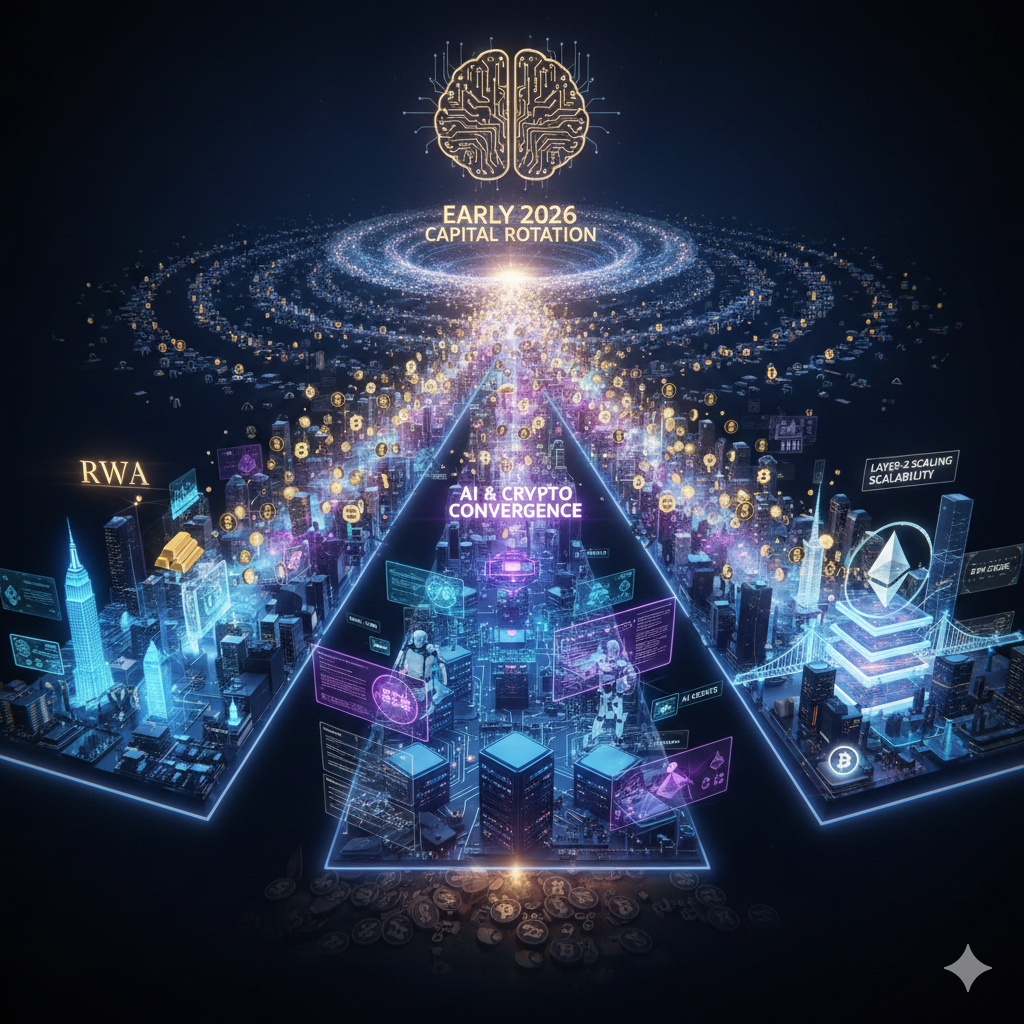
As the crypto market evolves past its mid-cycle euphoria, smart money is poised for a significant capital rotation in early 2026, shifting liquidity from older, often saturated assets toward sectors poised for institutional and technological breakout. This movement is less about simple speculation and more about optimizing for sustainable yield, regulatory clarity, and verified utility.
The dominant narratives expected to drive this shift are the institutionalization of Real World Assets (RWAs), the maturation of high-throughput Ethereum Layer-2 scaling solutions, and the synergistic growth of the AI and Crypto convergence, signaling a profound pivot toward infrastructure and finance that bridges the gap between traditional and decentralized systems.
Crypto Capital Rotation: Where Smart Money Will Flow in Early 2026
The crypto market operates in cycles, and “smart money”—institutional investors, VCs, market makers, and high-performing traders—is constantly anticipating the next major rotation to maximize returns.1 As the market enters early 2026, several key narratives and technological shifts are expected to drive this capital rotation, moving liquidity from older, saturated assets into newer, high-potential sectors with clearer utility and institutional appeal.2
1. The Institutionalization Play: Real World Assets (RWAs) and Decentralized Finance (DeFi)
The convergence of traditional finance (TradFi) and Decentralized Finance (DeFi) is arguably the most significant driver for smart money in 2026. This rotation is about transferring massive, previously untapped liquidity into the on-chain ecosystem.3
-
Real World Assets (RWAs): Projects focused on tokenizing assets like US Treasuries, corporate bonds, and real estate are attracting substantial institutional capital.4
-
The Thesis: RWAs provide stable, regulatory-compliant, and predictable yields (e.g., 4-6% on tokenized treasuries), which are highly attractive to institutions looking for resilience and reliable returns amidst market volatility.
-
Smart Money Flow: Capital is flowing into protocols like Ondo (ONDO) and similar projects that are “institutionalizing tokenized products, bridging real-world assets and Web3 liquidity.”5 This narrative is seen as a resilient investment, attracting TradFi involvement even during volatile periods.
-
-
Institutional DeFi Rails: Money is flowing into established, battle-tested DeFi protocols that are building dedicated, compliant products for institutions.6
-
The Thesis: With the growing adoption of crypto ETFs (like those for Bitcoin, Dogecoin, and XRP), institutions will need on-chain mechanisms to lend out or yield-farm these assets, as ETFs typically do not offer yield.7
-
Smart Money Flow: Lending platforms like Aave (AAVE) are positioned as the “bank” for the crypto ETF era. Smart money is migrating to these utility-focused, “yield” protocols, which are reopening double-digit APYs via sophisticated strategies (like fixed/floating income combinations).8
-
2. The Infrastructure Evolution: EVM and Layer-2 Scaling
Capital is continuously seeking the most scalable and efficient infrastructure, with a noticeable rotation occurring within the Layer 1/Layer 2 (L1/L2) ecosystem.
-
Ethereum Virtual Machine (EVM) Ecosystem Dominance: Smart money flows, according to recent analysis, are shifting heavily toward the EVM Stack (Ethereum and its Layer-2s like Arbitrum), while momentum in competing chains like Solana and Binance Smart Chain (BSC) has recently shown signs of waning.9
-
The Thesis: Ethereum’s planned upgrades (e.g., Fusako) and the maturity of its Layer-2 rollup technology (Zero-Knowledge and Optimistic rollups) are set to dramatically increase transaction throughput and lower costs.10 This ensures the Ethereum ecosystem remains the most robust and secure settlement layer, making it the preferred choice for enterprise and institutional applications.
-
Smart Money Flow: Expect a continued focus on high-performance Ethereum Layer-2 solutions and emerging Bitcoin Layer-2s (like Bitcoin Hyper) as the ultimate scalability solutions for the next wave of mass adoption.11
-
-
Alternative High-Performance L1s: While the EVM stack shows strength, highly scalable alternatives that emphasize speed and user experience, such as Solana (SOL) and SUI (SUI), are still viewed as strong competitors and reliable long-term infrastructure plays due to their technical advantages and growing developer activity.12
3. The New Technology Frontier: AI and Crypto Convergence
The intersection of Artificial Intelligence (AI) and blockchain is moving beyond simple speculative memes to real-world product-market fit (PMF).13
-
Crypto AI for Automation and Verification: Smart money is looking for projects where AI and crypto genuinely enhance each other.
-
The Thesis: This includes using blockchain-based payments and stablecoins to support automated transactions between AI agents, and leveraging technologies like Zero-Knowledge (ZK) proofs to make AI systems more verifiable and controllable.14
-
Smart Money Flow: Expect rotation into projects building support layers that enable seamless, verifiable collaboration between humans and AI, and protocols that allow AI agents to create tokenized financial strategies (tokenized strategy vaults).15 This sector is viewed as having significant long-term productivity and profit-boosting potential.
-
-
Decentralized Physical Infrastructure Networks (DePIN): This sub-sector, which connects token incentives with real-world infrastructure (like decentralized storage, wireless networks, or computing power for AI), is set to converge with the AI and RWA narratives, attracting capital due to its tangible utility.16
4. The Utility Rotation: New Altcoins Over Older Bets
A common theme in market cycles is the rotation of capital out of older, established altcoins that have lost momentum or are consolidating, into newer, faster projects with verified, immediate utility.17
-
Shift from Speculation to Utility: Analysts predict that in early 2026, some popular, older altcoins like Dogecoin (DOGE) and Cardano (ADA) may struggle as capital rotates into utility-driven projects.18
-
The Thesis: Institutional capital is flowing toward projects with a clear revenue path, credible incentives, and verified, immediate utility.19 This includes “PayFi” ecosystems that merge crypto and traditional finance, offering instant, low-friction crypto-to-fiat settlement for the global payments market.20
-
Smart Money Flow: The focus is on tokens where network activity or protocol revenue directly accrues value to the token holders (better “value capture mechanisms”), such as through fee-burns or staking incentives.21 This signals a move from purely speculative bets to value-oriented investments.
-
Summary of Expected Early 2026 Capital Flow
| Rotation Direction | Source (Outflow) | Destination (Inflow) | Key Narratives |
| Institutional Flow | Speculative/Older Altcoins | Real World Assets (RWAs) & Utility Tokens | Regulatory Clarity, Stable Yields, TradFi Integration |
| Infrastructure Flow | Less-Optimized L1s (Momentarily) | EVM L1/L2s (Ethereum, Arbitrum, etc.) | Scalability, Security, Developer Network Effect |
| New Tech Flow | General Market Liquidity | Crypto AI & DePIN | Product-Market Fit, Automation, Enterprise Adoption |
| DeFi Flow | General Market Liquidity | Institutional DeFi Protocols (Lending) | Yield Generation for ETF Liquidity, Risk Management |
The overarching theme for smart money in early 2026 is a move toward verifiable utility, institutional integration, and superior technical infrastructure. Projects that can clearly demonstrate revenue generation, compliance pathways, and real-world applicability are best positioned to capture the next surge of capital.
The Primary Drivers of Capital Rotation in Early 2026
1. The Dominance of Real World Assets (RWAs)
By early 2026, the RWA narrative is expected to transition from a niche market trend into a major pillar of DeFi. This strategic capital rotation is driven by the stability and regulatory compliance that smart money is actively seeking.
A. Tokenized Treasuries & Bonds
-
The Thesis: While many crypto assets are highly speculative, the tokenization of US Treasuries offers real, low-risk yield (currently around 4-5%) directly on-chain. This makes RWAs an attractive safe haven, especially during market volatility. It offers institutions a way to generate resilient yield on their stablecoin holdings.
-
Smart Money Flow: Capital will continue to flow into specialized protocols like Ondo (ONDO) and platforms facilitating these transactions. Institutions will utilize RWA offerings to gain stable returns on their excess Stablecoin liquidity, creating a steady and predictable source of demand.
B. Private Credit & Equity Assets
-
The Thesis: The next phase of RWA will focus on tokenizing higher-yielding but less liquid assets, such as private credit, real estate, and private equity. Tokenization provides liquidity to these assets, opening up markets previously exclusive to ultra-high-net-worth individuals to smaller institutional investors.
-
Smart Money Flow: There will be a rotation into infrastructure platforms that offer robust Know Your Customer/Anti-Money Laundering (KYC/AML) solutions to ensure regulatory compliance. This compliance backbone is the key requirement for attracting significant institutional funds.
2. The AI-Crypto Convergence
AI and Crypto are no longer separate sectors; they are merging to create entirely new business models and applications. Smart money is rotating capital into projects that address the following symbiotic needs:
A. Decentralized Compute Infrastructure (DePIN)
-
The Thesis: Developing advanced AI models requires enormous computing resources. DePIN enables the aggregation of surplus computing power from personal devices globally, providing a cheaper and decentralized alternative to centralized cloud providers (like AWS or Google Cloud).
-
Smart Money Flow: Capital will cycle into tokens that power and incentivize decentralized compute networks, such as Render (RNDR) (for GPU rendering) and projects offering computing power for AI’s Large Language Models (LLMs). This represents a crucial capital gateway into the physical infrastructure of the future.
B. Autonomous AI Agents
-
The Thesis: Autonomous AI agents require permissionless, decentralized payment systems to transact and execute financial contracts. Stablecoins and smart contracts form the backbone of this new automated economy.
-
Smart Money Flow: The rotation favors projects building protocols that enable AI agents to communicate, verify data (using Zero-Knowledge Proofs), and execute financial transactions autonomously. This includes service networks that specifically connect AI and DeFi applications, allowing for tokenized strategy vaults managed entirely by AI.
3. Infrastructure Optimization
The market will continue to reward solutions that deliver the best performance, security, and cost efficiency.
-
EVM and Rollup Dominance: The maturity of Ethereum Layer-2s (L2s) like Arbitrum and Optimism will solidify Ethereum’s position as the premier settlement layer. Smart money is betting heavily on L2s because they promise massive scalability for enterprise and consumer applications while retaining Ethereum’s core security properties.
-
Alternative High-Speed L1s: Although the EVM stack shows dominance, high-performance, purpose-built Layer-1 (L1) chains like Solana (SOL) and newer L1s based on the Move programming language (e.g., SUI) remain critical components of the capital rotation. They capture funds focused on applications requiring ultra-low latency, such as high-frequency Decentralized Exchanges (DEXs) and certain gaming platforms.
The capital rotation in early 2026 is not merely about finding the “next coin,” but about positioning funds in sectors that have the potential to onboard trillions of dollars from TradFi and enable the next wave of disruptive AI applications.
Conclusion: The Crypto Maturation and Focus on Tangible Utility in Early 2026
The capital rotation anticipated in early 2026 marks a significant step in the crypto market’s maturation, moving decisively beyond purely speculative cycles. Smart money is clearly positioning itself for a future defined by verifiable utility, institutional compliance, and integration with the real world.
The overwhelming theme driving this flow is the shift from “what could be built” to “what is working and compliant.”
-
The Institutional Bridge (RWAs): The rotation into Real World Assets (RWAs), particularly tokenized treasuries and private credit, is the most powerful signal of this shift. Smart money is prioritizing assets that offer stable, predictable, and regulated on-chain yield, effectively creating the first true bridge for massive institutional liquidity into the blockchain ecosystem. This narrative offers a resilient investment that performs regardless of broader market euphoria.
-
The Infrastructure Mandate (L2s): Funds are concentrating on optimizing the infrastructure layer, favoring high-throughput Layer-2 scaling solutions (L2s) on established chains like Ethereum, which promise the security and efficiency needed for enterprise-grade applications. Scalability is no longer a luxury, but a necessity for adoption.
-
The Technological Frontier (AI Convergence): Capital is flowing into the synergistic intersection of AI and Crypto, backing projects in Decentralized Physical Infrastructure Networks (DePIN) and autonomous AI agents. This rotation seeks out areas where tokenomics can incentivize the real-world data collection and compute power necessary to fuel the next generation of AI innovation.
In essence, the crypto market in early 2026 is expected to reward fundamentals over hype. Investors are favoring projects with clear revenue models, defined product-market fit, and a credible path to onboarding TradFi capital. This pivot suggests reduced volatility over the long term and the establishment of crypto as a powerful, integrated financial and technological layer for the global economy.
Ready to start your cryptocurrency journey?
If you’re interested in exploring the world of crypto trading, here are some trusted platforms where you can create an account:
🔹 Binance – A global leader in cryptocurrency trading.
🔹 Bybit – A user-friendly platform for both beginners and advanced traders.
These platforms offer innovative features and a secure environment for trading and learning about cryptocurrencies. Join today and start exploring the opportunities in this exciting space!
🚀 Want to stay updated with the latest insights and discussions on cryptocurrency?
Join our crypto community for news, discussions, and market updates: OCBCryptoHub on Telegram.
📩 For collaborations and inquiries: datnk710@gmail.com
Disclaimer: Always do your own research (DYOR) and ensure you understand the risks before making any financial decisions.